





Every year, when a mall starts getting ready for Christmas, the first thing everyone talks about is the tree.
That part is easy to understand. A big tree always feels like the heart of the whole atrium. It is the first thing people notice in a rendering, the first thing shoppers see from a distance, and usually the first thing a client asks about. Height, lights, branch density, topper, daytime look, nighttime effect — most conversations start there.
And honestly, they should.
A tree matters.
But after working on enough real projects, one thing becomes very clear: a beautiful tree is not the same as a complete scene.
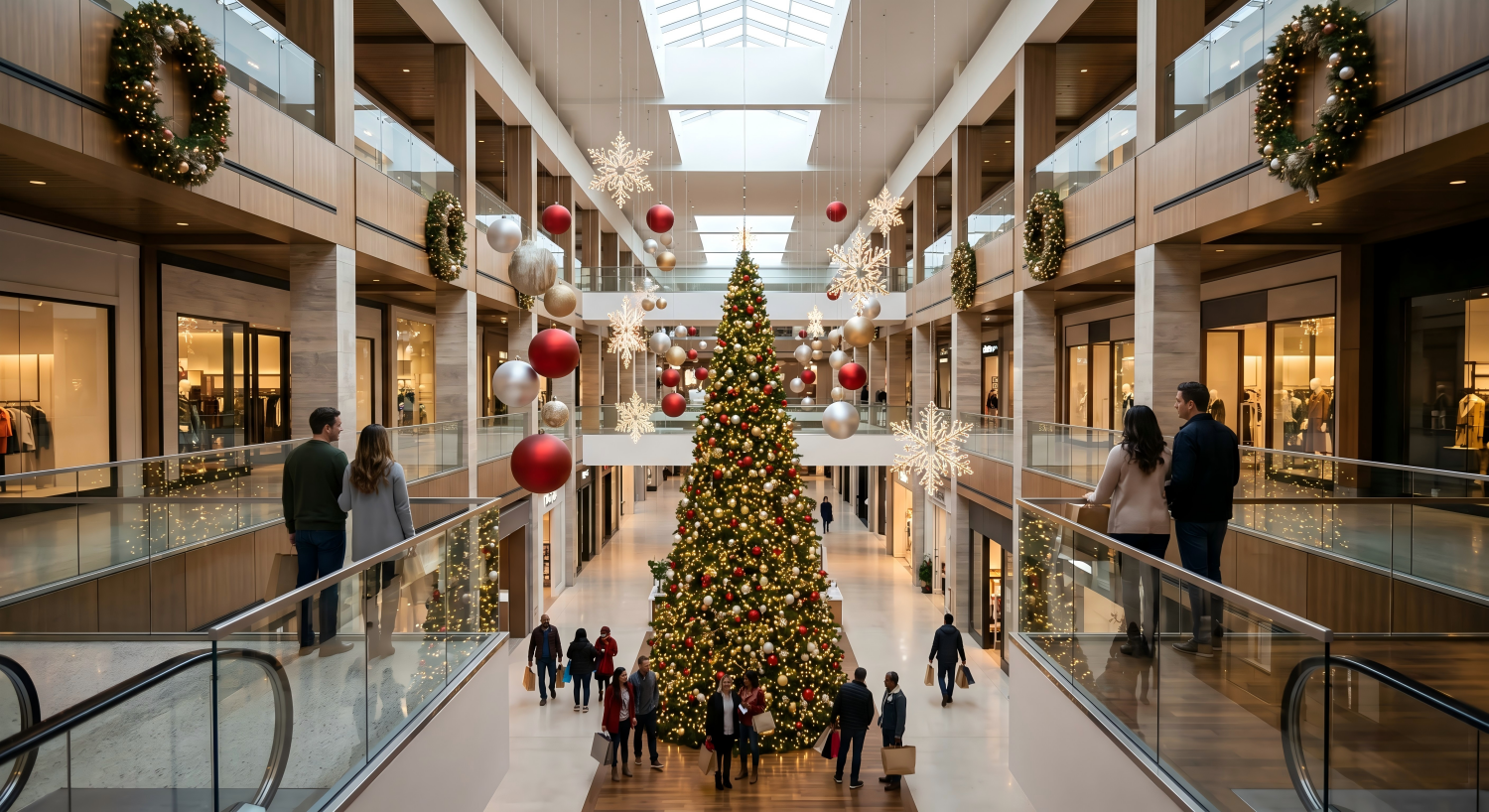
We have seen plenty of displays where the tree itself was not the problem at all. The tree was tall enough, bright enough, and visually strong enough. On paper, everything looked fine. In product photos, everything looked fine. But once it was actually installed in the mall atrium, the whole setup still felt a little empty. The tree was there, but the atmosphere had not fully landed. People walked by, maybe stopped for one quick photo, and then moved on.
That usually means the problem is not the tree.
The problem is what is missing around it.
A mall atrium is not a showroom. It is not a place where one large object in the middle is enough to carry the whole feeling. People do not just look at an atrium from far away. They walk through it. They slow down in it. They stand under it. They take photos in it. They experience it from very close range, and that changes everything.
A tree can give the space a center.
It cannot, by itself, give the space warmth, layers, or a reason to stay.
If you are still deciding on the main tree direction itself, you can also look at Custom Large Christmas Tree for Malls, Parks and City Squares. But once the main tree is decided, the next question becomes just as important: what should happen around it?
A tree creates focus, but not necessarily experience
This is where atrium projects are very different from outdoor plaza projects.
In a large outdoor plaza, a giant tree can already do a lot of the work just by being visible from far away. It can act like a landmark. Even if the lower part of the display is a little simple, the tree may still feel strong because the space itself is working in its favor.
A mall atrium is not like that.
In an atrium, people get close. Really close. They see the bottom of the tree. They notice what is happening in front of it. They notice whether the display feels full or unfinished. They notice whether there is actually somewhere natural to stand and take a photo. They notice whether the scene feels inviting or whether it just looks like one big decorated object dropped into the middle of the building.
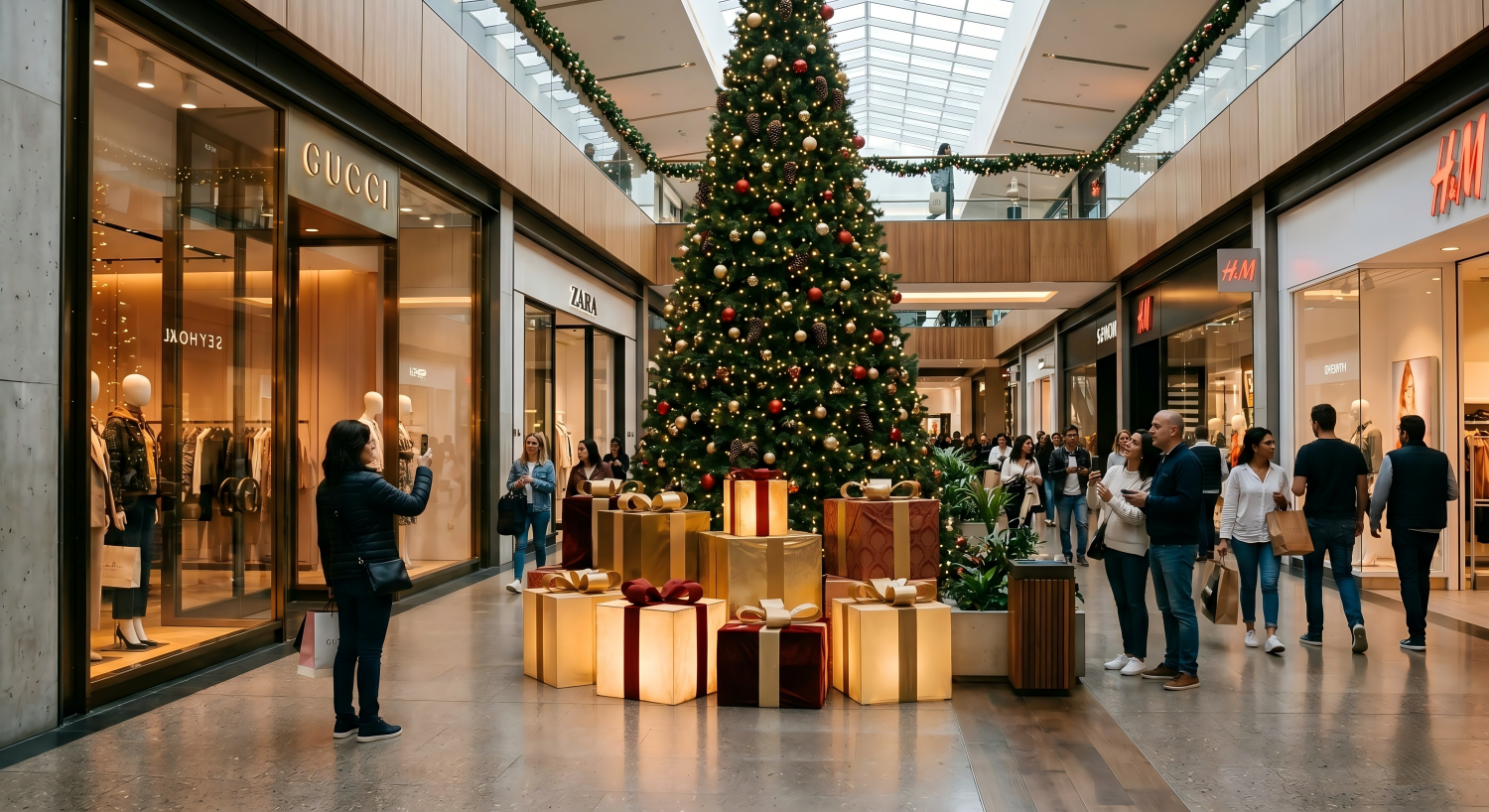
That is why a large tree on its own often feels weaker than people expect.
It gives you a focal point, yes. But it does not automatically give you depth. It does not automatically create a photo moment. It does not automatically make people want to stop.
And if you are running a shopping mall, that part matters a lot more than it sounds.
Because the real goal is not just to say, “We have a Christmas tree in the atrium.” The real goal is to create a space people want to walk toward, gather around, and photograph.
What the tree cannot do on its own
| What the scene needs | What the tree can do | What supporting decorations help with |
|---|---|---|
| A strong visual center | Yes | Usually not needed here — the tree already handles this |
| A grounded lower zone | Only partly | Gift boxes, low-level props, small ground decorations |
| A photo-friendly foreground | Not really | Reindeer, sleighs, benches, scenic foreground elements |
| A fuller festive atmosphere | Only partly | Wreaths, ornaments, snowflakes, huts, decorative layers |
| A reason to stop and stay | Not by itself | Layered scene design, photo points, walk-up visual interest |
Most atrium scenes fail quietly at the bottom
We often tell clients something very simple during planning: the taller the tree, the more important the base becomes.
That is one of those things that sounds obvious only after you have seen enough weak installations in real life.
A large tree can look rich and full from the middle upward, but if the area underneath it feels empty, the whole installation starts to look visually unsupported. It is hard to describe until you see it, but the tree can almost feel like it is floating. The crown has presence, but the base has no weight. And once that happens, the whole scene loses some of its comfort.
That is exactly why oversized gift boxes remain one of the safest and most useful supporting elements in mall atriums.
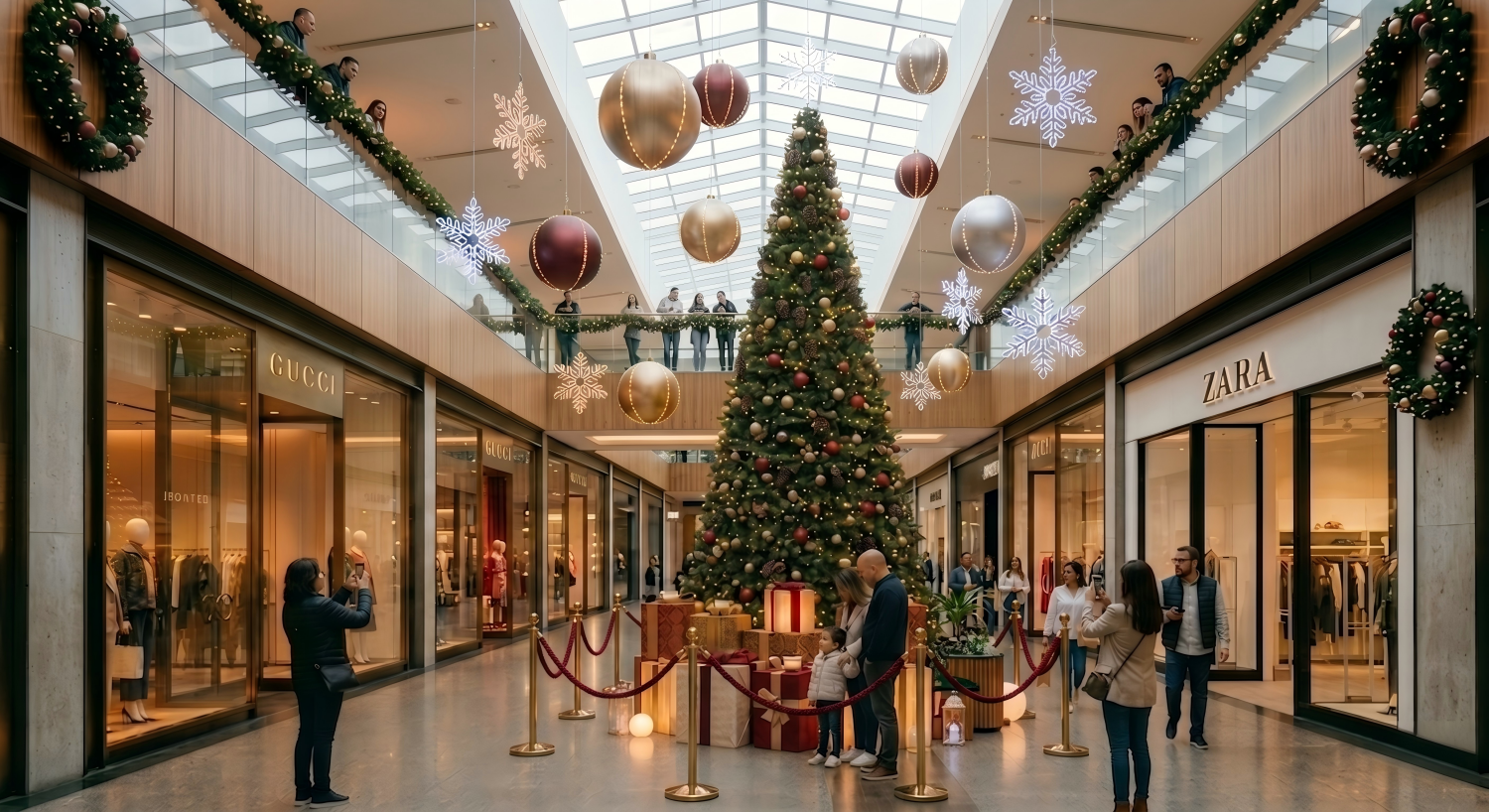
Some people think gift boxes are too common, or too safe, or not creative enough. But the reason they are used so often is not laziness. It is because they solve a very real problem.
They give the tree something to stand on, visually speaking.
They help fill the lower zone. They create a natural foreground for photos. They make the scene feel less exposed and less unfinished. Even before you add anything more expressive, well-scaled gift boxes can already make the whole Christmas setup feel much more grounded.
Gift boxes make the tree feel complete. Reindeer make the scene feel alive
Gift boxes are usually the safest place to begin, but they are not always enough to make the scene memorable.
That is where reindeer and sleigh elements often change the mood.
A tree is a symbol. It is strong, beautiful, and recognizable. But it is still mostly static. The moment you place a reindeer scene in front of it, the whole setup starts to feel more like a story and less like a single decorative object.
That shift matters more than people think.
Children react to reindeer immediately. Adults naturally use them as part of their photo composition. Even shoppers who were not planning to stop often slow down when the display feels like something is actually happening inside it.
That is why reindeer and sleighs work so well in mall Christmas scenes — not because they are just “cute,” but because they give the main tree a more human front layer. They help turn the display into something people can step into, not just look at.
If you want to explore this type of supporting product, you can look at commercial reindeer light sculptures or a reindeer sleigh display.
But this only works when the balance is right.
Too many reindeer, or a sleigh that is too dominant, can easily steal attention from the tree. In a mall atrium, that becomes a real problem very quickly. Unlike an outdoor plaza, an atrium usually depends on a more refined sense of hierarchy. The tree should still remain the main visual center. Reindeer and sleighs should act as foreground characters, not replace the tree as the main subject.
Some atriums do not just need decoration. They need a small holiday world
There are also cases where gift boxes and reindeer still do not feel like enough.
This usually happens in larger atriums, especially those with enough surrounding floor area to support a more immersive setup. In these spaces, the display often benefits from something more spatial — a Christmas hut, a gingerbread-house-style piece, or another scenic element that feels like a place rather than a prop.
That kind of addition changes the energy of the whole scene.
Without it, the display may still look like a tree with supporting decorations. Once a hut is added in the right way, the scene begins to feel more like a small Christmas environment. People no longer treat it only as a backdrop. They start treating it as a destination inside the atrium.
But this is also where judgment becomes important.
Not every atrium should have a hut.
If the space is not large enough, or if the tree already occupies too much of the floor visually, adding another bulky decorative structure can make the whole scene feel crowded and heavy. And that is one of the easiest mistakes to make when a client gets excited. Tree, gifts, reindeer, hut, arch, ornaments, snowflakes — everything sounds good on its own. But once too much is pushed into one atrium, the scene loses breathing room.
The middle layer is what many mall displays forget
There is another part of the atrium scene that often gets ignored in early planning, even though it makes a big difference once the project is installed.
That is the middle layer.
The tree handles the top of the visual composition. Gift boxes, reindeer, and low props handle the base and the foreground. But there is often still a gap between those two worlds. If that middle layer is empty, the whole scene can feel disconnected, even when all the main pieces are technically there.
This is where wreaths, oversized ornaments, snowflakes, stars, and similar elements become surprisingly important.
They are not supposed to compete with the tree. Their job is quieter than that. They help the festive language spread outward. They fill awkward gaps. They soften the transition between the centerpiece and the surrounding atrium. They make the whole setup feel less like a collection of products and more like one coordinated seasonal scene.
A well-placed oversized Christmas wreath, for example, often works better as a supporting layer than many clients expect.
Mall atriums are judged up close, not just from across the floor
This might be the most important difference of all.
Outdoor Christmas displays often win by looking strong from far away.
Atrium displays win only if they still feel convincing from close up.
That changes the whole design logic.
In a mall atrium, people notice proportion. They notice whether the tree base feels empty. They notice whether there is a nice foreground. They notice whether the display gives them somewhere natural to stand for a photo. They notice whether everything feels balanced, or whether the whole thing looks expensive in a slightly forced way.
So the challenge in an atrium is not only scale. It is intimacy.
A big tree gives you the first impression.
The layers around it are what make that impression hold up.
This is exactly why some expensive mall Christmas scenes still feel underwhelming once they are built. The budget went into the tree, but not enough went into the scene.
Most disappointing atrium displays do not have bad products. They have bad hierarchy
This is something we see all the time.
The products themselves are often fine. The tree is fine. The reindeer are fine. The gift boxes are fine. The wreaths are fine.
The real problem is that they are not being asked to do the right jobs.
Sometimes the tree has no support at the base. Sometimes all the decorative weight is piled right under the tree. Sometimes too many “hero” products are used at once, and nothing feels like the actual center anymore. Sometimes the display looks festive in a wide photo, but completely falls apart once someone tries to stand in front of it for a real picture.
Those are not really product problems. They are scene hierarchy problems.
A good atrium display works because every part has a role. One piece grounds the tree. One creates the photo foreground. One adds character. One fills the middle space. One helps connect the scene to the wider atrium.
Once those roles are clear, the whole display starts to feel much more natural.
From a mall operator’s point of view, the real value is not how much is installed — it is whether people actually stay
This is the part that matters most on the commercial side.
A mall is not buying a tree just to have a tree.
It is buying atmosphere.
It is buying dwell time.
It is buying photo value.
It is buying the chance that visitors will stop, gather, and remember the space.
And from that point of view, the tree is only doing part of the work.
The tree gives the atrium a center. The supporting decorations are what turn that center into something people want to approach. That is why putting the entire budget into the tree itself is often not the smartest move. A very expensive tree can still feel visually weak if the scene around it is too thin. On the other hand, a well-balanced combination of tree, base support, foreground, and surrounding festive details can feel much more valuable, even if each individual element is not the most expensive option on paper.
Shoppers may never say that out loud.
But they feel it immediately.
They know whether they want to walk closer. They know whether they want to stand there for a photo. They know whether the scene feels worth their attention.
And in the end, that is what the mall is really paying for.
Final Thoughts
So why can’t a shopping mall atrium Christmas scene rely on just a tree?
Because a tree can tell people Christmas has arrived.
But a tree alone cannot always make the space feel warm, layered, and worth stepping into.
The tree is the center, yes. But the center only works when the surrounding layers are doing their part. The base has to feel grounded. The foreground has to exist. The middle space has to connect. The photo experience has to feel natural. The atmosphere has to invite people in.
That is when an atrium stops feeling like it has one giant Christmas product in the middle of it.
That is when it starts to feel like a real Christmas scene.
Frequently Asked Questions
Why is a large tree alone often not enough for a mall atrium Christmas display?
Because the tree can create a strong center, but it usually cannot solve the lower visual layer, the photo foreground, or the overall sense of scene completeness on its own.
What is the safest supporting decoration to add around a mall atrium Christmas tree?
Oversized gift boxes are usually the safest place to start. They help ground the base of the tree, improve the lower visual layer, and create a more natural foreground for photos.
Do reindeer and sleighs work well in shopping mall atriums?
Yes, when they are used in moderation. They work especially well as foreground story elements and photo-friendly features, but they should support the tree rather than compete with it.
Are Christmas huts a good idea for all atrium displays?
Not always. They can be very effective in larger atriums with enough open space, but in smaller atriums they can easily make the whole setup feel crowded or visually heavy.
What makes a mall atrium Christmas scene feel more complete?
Usually it is the combination of layers: a strong tree, a grounded base, a usable photo foreground, and supporting decorative elements that connect the centerpiece to the surrounding space.