





In large holiday decoration projects, buyers often focus first on appearance, size, and unit price. But once a project moves from concept to delivery, the costs that grow fastest are often not the product costs alone. They are the logistics and storage costs behind the product.
A large commercial decoration may look manageable in a quotation sheet, yet become much more expensive once it enters the real workflow of export packing, container loading, unloading, site handling, seasonal removal, and off-season storage. This is especially true for oversized Christmas trees, illuminated reindeer, gift box tunnels, walk-through arches, and other large-format seasonal installations.
That is why experienced buyers no longer evaluate large holiday décor only by first-year purchase price. They look at total seasonal ownership cost, including transport volume, packaging efficiency, storage footprint, handling time, and repeat-use practicality. In many cases, a decoration that costs less to manufacture may still cost more over two or three seasons if it is difficult to pack, ship, store, or reinstall.
This article explains how to reduce shipping and storage costs for large holiday decorations by improving the logic behind product selection, structural design, packaging efficiency, and long-term reuse planning.
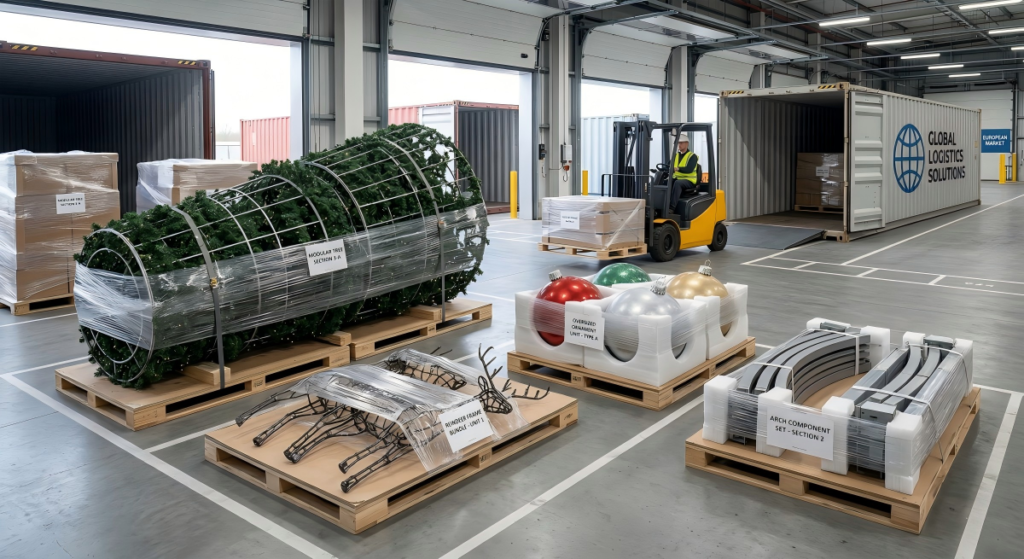
Why Shipping and Storage Costs Become So High in Large Holiday Decoration Projects
Large holiday decorations are different from standard retail seasonal products. They are usually low-frequency purchases, high-volume cargo, and strongly dependent on logistics. Their cost structure is shaped not only by materials and labor, but also by how efficiently they move through the full project cycle.
That cycle usually includes production, packing, loading, ocean or domestic transport, unloading, on-site installation, seasonal dismantling, warehouse return, and future reuse. If a decoration is inefficient at any one of these stages, the total cost rises quickly.
This is why buyers planning large-scale seasonal programs should think beyond visual effect and also ask whether a display is designed for practical movement and storage. For example, projects built around commercial Christmas trees often reveal that freight and storage efficiency can matter almost as much as the tree’s final appearance.
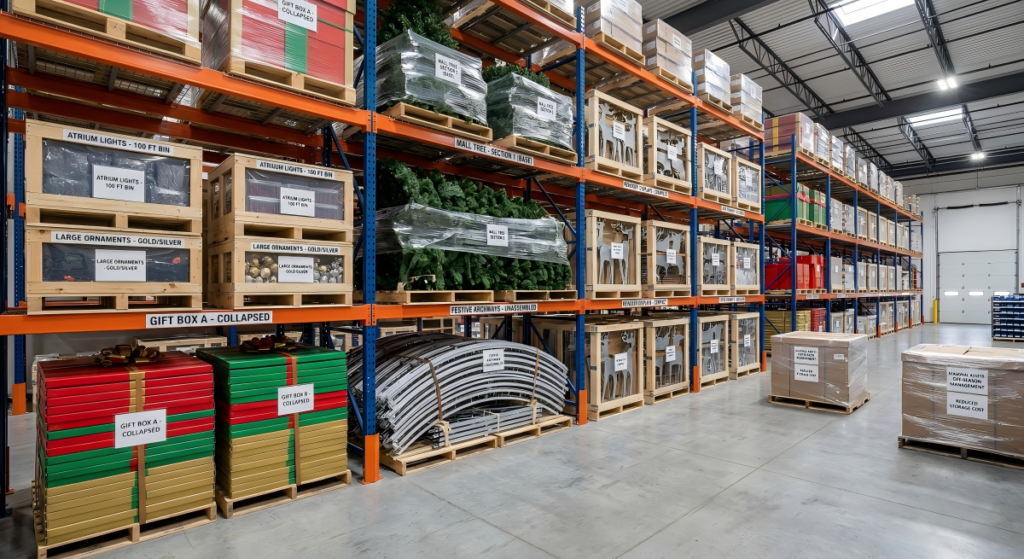
The Real Problem Is Often Not Product Size but Packaging Inefficiency
When freight costs are high, many buyers assume the reason is simple: the decoration is large. But in practice, freight cost is often driven less by display size in use and more by packaging volume in transport.
Two products of similar installed scale can produce very different shipping costs if one is packed efficiently and the other is not. A decoration becomes expensive to transport when it includes too much empty air inside the packed volume, cannot be broken into efficient sections, or contains large protruding shapes that reduce container loading efficiency.
Common problems include:
- Oversized one-piece structures that cannot be separated
- Irregular forms that create wasted cubic volume
- Rigid frame sections that cannot nest or stack efficiently
- Decorative parts fixed permanently to structural parts
- Packaging designs that protect the product but waste too much space
In other words, the shipping issue is often not “the product is too big,” but “the product is too inefficient when packed.”
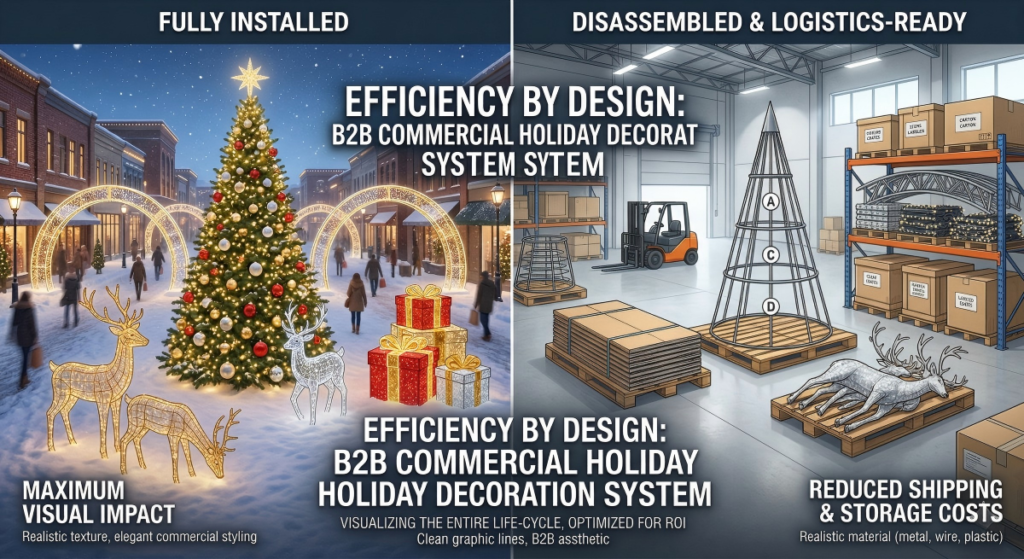
Modular Design Usually Saves More Money Than Simply Making a Product Lighter
Many discussions about cost reduction focus on lightweight construction, but for large seasonal décor, modular design is often more valuable than weight reduction alone.
A modular decoration can be separated into manageable sections for transport, installation, and storage. This improves not only freight efficiency, but also site handling, repair flexibility, and repeat-use organization.
Well-planned modular construction can help buyers reduce costs in several ways:
- More efficient use of container or truck space
- Lower risk of transport damage to oversized single pieces
- Faster on-site assembly and removal
- Easier warehouse organization after the season
- Simpler replacement of damaged sections instead of full-unit replacement
This is one reason many buyers now prefer display systems that are designed for repeat seasonal use rather than oversized one-piece installations. If you are already planning a larger scene with a main tree, deer, and entry elements, it is usually better to think in terms of a coordinated modular program rather than separate large objects purchased one by one.
Foldable and Collapsible Structures Can Lower Total Volume Significantly
Foldable and collapsible structures are another effective way to reduce both shipping and storage costs, especially when used in products that would otherwise occupy a large amount of warehouse space after the season.
For many large decorations, the most expensive space is not the installed space on site. It is the unused space occupied during shipping and storage. If a product can fold, flatten, or compress into a more compact transport form, the savings can continue year after year.
This is particularly useful for buyers handling:
- Large seasonal rollouts across multiple locations
- Commercial displays that must be reinstalled every year
- Warehouses with limited floor area
- Projects where return logistics matter as much as first delivery
However, collapsible design only creates real savings when it is balanced with structural reliability. Reducing packed size is helpful, but not if it makes installation difficult or compromises the finished appearance.
Good Cost Control Starts Before the Product Is Built
One of the biggest mistakes in holiday display purchasing is trying to cut logistics cost only after production decisions have already been made. In reality, the best time to reduce shipping and storage cost is during the design and specification stage.
Before production begins, buyers should be asking questions such as:
- What is the packed size of each module?
- How many modules make up the full decoration?
- Can the product be stacked or nested efficiently?
- Are decorative skins, ornaments, or lighting elements removable for packing?
- Can the original packaging be reused after the season?
These questions often reveal whether a decoration has been engineered for lifecycle efficiency or only for installed appearance.
Warehouse Cost Is Not Just About Floor Area
Storage cost is often underestimated because buyers ask only one basic question: can we fit it into the warehouse? But that is not the same as storing it efficiently.
A more useful storage evaluation asks:
- How much warehouse volume does the product occupy when off-season?
- Can the modules be stacked safely?
- Are the parts clearly labeled for next season?
- Can fragile decorative elements be separated from structural sections?
- Will the product be easy to inspect and count before reuse?
A decoration that technically fits in a warehouse may still be expensive to keep if it blocks too much space, cannot be stacked well, or creates confusion at the start of the next season.
Off-Season Reuse Planning Should Be Part of the Purchase Decision
For many commercial buyers, large holiday decorations are not one-season products. They are seasonal assets expected to return year after year. That means post-season recovery should be considered before the order is placed, not only after the display is removed.
Good reuse planning usually includes:
- Reusable packaging whenever possible
- Clear numbering and labeling of modules
- Separation of structural components and decorative accessories
- Protection plans for fragile or custom-finished pieces
- Simple reassembly logic for the next season
Buyers who plan this early usually spend less not only on storage, but also on labor, missing parts, and next-season preparation.
Product Mix Also Affects Freight and Storage Efficiency
Cost control is not only about selecting better individual products. It is also about selecting a smarter overall display mix.
For example, one project may use many different oversized irregular pieces, each with unique packaging requirements. Another may use one major focal piece supported by several more efficient modular decorations. Even if the second project has similar visual impact, it may cost less to transport, store, and reinstall.
This is why buyers should think of large holiday décor as a system. A well-planned display program usually has a clearer structure of main attraction, supporting features, and repeat-use assets. That system logic often reduces cost more effectively than negotiating small savings on individual product prices.
If your seasonal layout includes a focal tree and supporting motifs, it can help to study how your main structure relates to other long-term assets such as tree frame selection and structural planning, because structural decisions often influence freight and warehouse cost just as much as decoration choices do.
Large Decorations Should Be Evaluated by Total Ownership Cost, Not Just First-Year Price
A low purchase price can be misleading if the decoration creates high transport and storage pressure every season. A more reliable way to judge value is to estimate total ownership cost across multiple years.
That includes:
- Manufacturing price
- Freight cost
- Loading and unloading labor
- Installation and dismantling time
- Warehouse space cost
- Repair, replacement, and missing-part risk
- Ease of future reuse
When buyers look at cost this way, the most economical option is often not the cheapest product. It is the product that remains efficient through transport, storage, and repeat seasonal use.
Practical Questions Buyers Should Ask Before Ordering
If you want a simple checklist before buying large holiday decorations, start with these five questions:
- What is the real packed volume, not just the installed size?
- How many modules does the decoration break into?
- Can the original packaging be used again after the season?
- Will the parts be easy to identify and reassemble next year?
- Is the product optimized for long-term use or only for first installation?
These questions usually reveal whether a decoration will be easy to own or expensive to manage.
Conclusion
Reducing shipping and storage costs for large holiday decorations is not only a logistics issue. It is a product and project planning issue. The most effective cost savings usually come from smarter design logic, better packaging efficiency, modular structure, reusable storage planning, and more disciplined display planning.
For commercial buyers, the real goal is not just to reduce freight on one shipment. It is to build a seasonal decoration system that performs well on site and remains efficient through transport, warehousing, and repeat installation. When large holiday decorations are chosen with that full lifecycle in mind, they become easier to manage, easier to reuse, and far more cost-effective over time.
Frequently Asked Questions
Why are shipping costs so high for large holiday decorations?
Shipping costs are often high because large decorations create inefficient packed volume, especially when they cannot be broken into compact modules or stacked efficiently in transport.
What helps reduce storage costs for large seasonal decorations?
Modular construction, foldable structures, reusable packaging, clear part labeling, and stackable storage design all help reduce storage cost over multiple seasons.
Is modular design better than one-piece construction for commercial holiday décor?
In many cases, yes. Modular design usually improves freight efficiency, handling, installation, repair, and warehouse organization compared with large one-piece structures.
Should buyers evaluate holiday decorations by purchase price only?
No. A better approach is to evaluate total ownership cost, including freight, installation, storage, reuse efficiency, and maintenance over multiple seasons.
How can I make large holiday decorations easier to reuse next season?
Choose products with clear module separation, reusable packaging, labeled parts, and logical dismantling and reassembly processes.