





In street holiday lighting projects, many buyers first pay attention to whether a single motif light looks attractive. They may compare snowflakes, stars, gift boxes, Christmas trees, bells, or other festive elements and focus on which individual design seems more beautiful. But in real projects, what determines the final visual quality of an entire road is usually not the single motif itself. It is whether the motif lights, after being repeated along the whole route, create a sense of rhythm, order, and visual unity.
This is one of the most overlooked parts of festive street decoration. Pole motif lights are not just single decorative products. They function as a continuous festive identification system along a route. Even if one individual piece looks beautiful, the street can still feel messy, fragmented, or even cheap if the repetition logic is wrong. On the other hand, even a relatively simple motif can make an entire road look organized and festive when the spacing, rhythm, and scale are handled correctly.
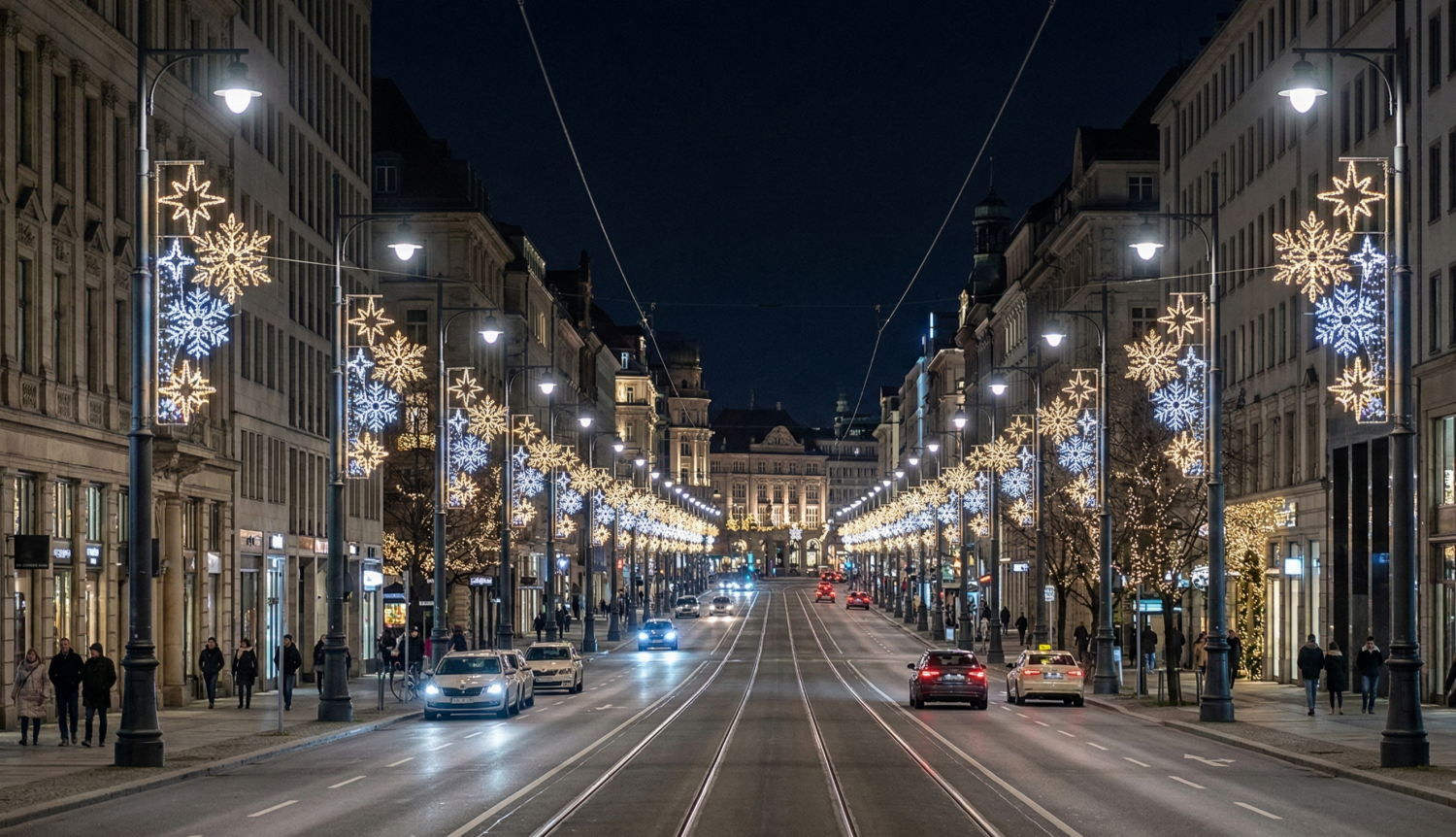
So for city roads, shopping streets, and scenic routes, the real challenge is not only choosing a beautiful motif. It is deciding how repeated pole motif lights should be planned so the final result is attractive, practical, easy to install, and easy to maintain over time.
If you are still deciding whether your route is better suited to pole-mounted motifs or overhead festive lighting, you can first read 2D Pole Motif Lights vs Cross-Street Holiday Lights: Which Street Decoration Solution Fits Your Project Better?.
Why Pole Motif Light Projects Should Not Start with a Single Beautiful Pattern
When buyers choose pole motif lights, they often begin with product photos or renderings. A snowflake design, a star pattern, or a gift-box motif may look attractive on its own, so the natural reaction is to apply it widely. But in real street projects, the question is never only whether one unit looks good. The more important question is what the entire route looks like after that unit is repeated dozens or even hundreds of times.
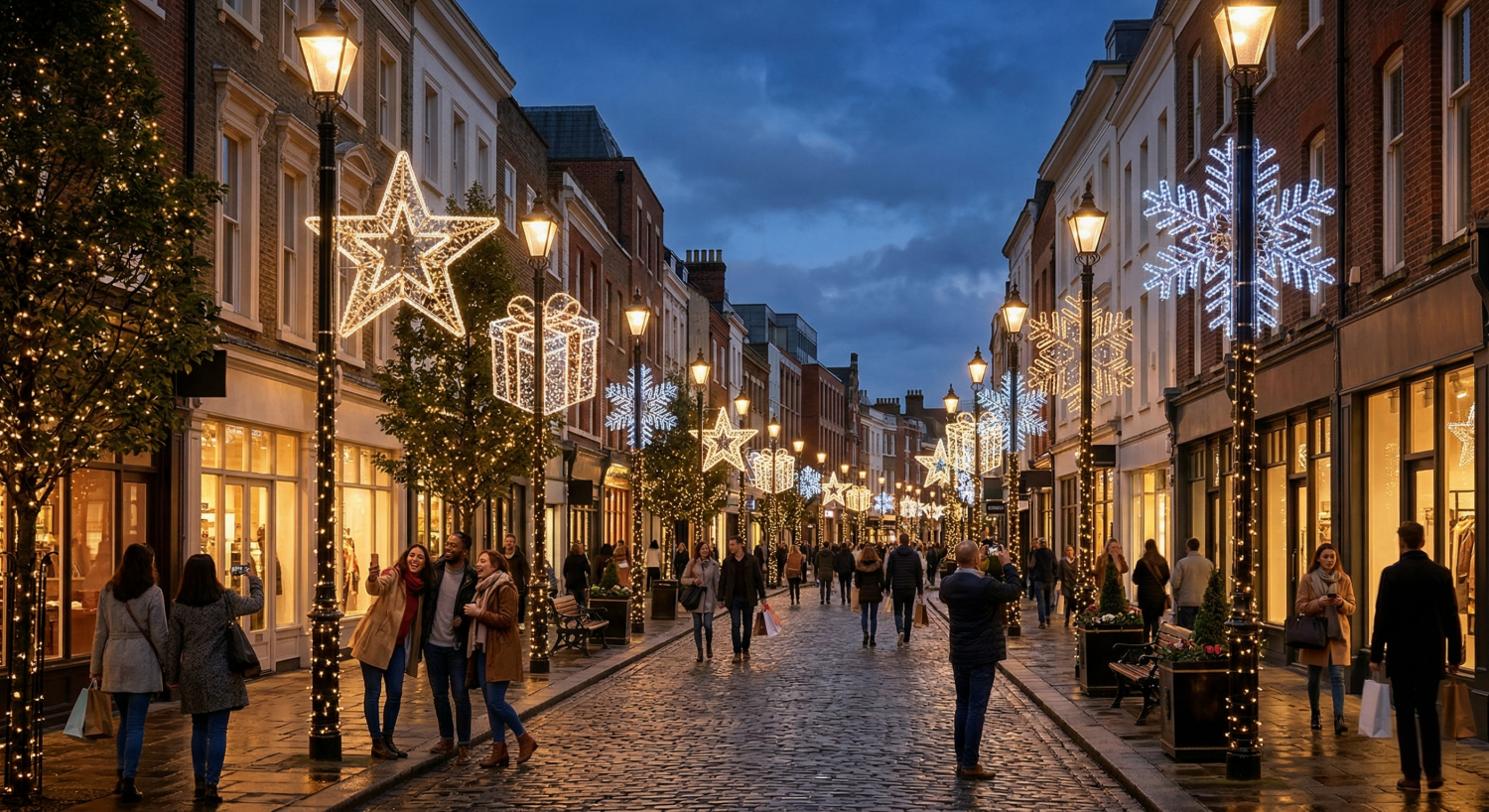
The real value of pole motif lights is not that one single decoration is extremely complex. Their real value is whether repeated installation can create a clear festive rhythm.
In simple terms:
- One motif light solves the problem of a single point.
- Repeated planning solves the problem of a line and a whole streetscape.
A successful street festive lighting project should make the entire route feel:
- visually unified
- continuous while moving through it
- recognizable from a distance
- effective both in daytime and at night
- balanced in visual rhythm
That is why, in pole motif light projects, understanding the road logic first is usually more important than selecting a single beautiful item first.
Decide the Road Type First, Then Decide the Repetition Logic
Different road types require different repetition strategies. The same motif light can create very different results on a city main road, a commercial street, or a scenic route.
City main roads: stronger emphasis on uniformity, order, and long-distance continuity
City main roads are usually wider, carry heavier traffic, and place greater importance on visual order and traffic efficiency. In these roads, pole motif lights are better used as a festive identity system for the entire road rather than as a place for too much variation.
The key goal is to let drivers and long-distance viewers recognize clearly that the entire road has entered a festive condition. Because of that, city main roads usually work better with:
- large-area repetition of the same motif
- only limited alternating patterns
- synchronized installation on both sides
- unified light color and rhythm
On roads like these, too much variation is usually not an advantage. It often weakens visual recognition and makes the route feel less disciplined.
Shopping streets: stronger emphasis on rhythm, atmosphere, and visual interest
Shopping streets and pedestrian streets work differently. Pedestrian flow is higher, visitors stay longer, and people have many more chances to look closely at the decorations. Because of that, shopping streets can accept a little more variety as long as the theme remains unified.
These spaces are usually more suitable for:
- a main motif plus one supporting motif
- A/B rhythmic alternation
- coordination with storefronts, windows, and tree lighting
- denser decoration at important nodes
A shopping street does not always have to use exactly one single pattern all the way through. But the visual language still needs to remain consistent. Without that consistency, variation quickly turns into disorder.
Scenic routes: stronger emphasis on theme, zoning, and story
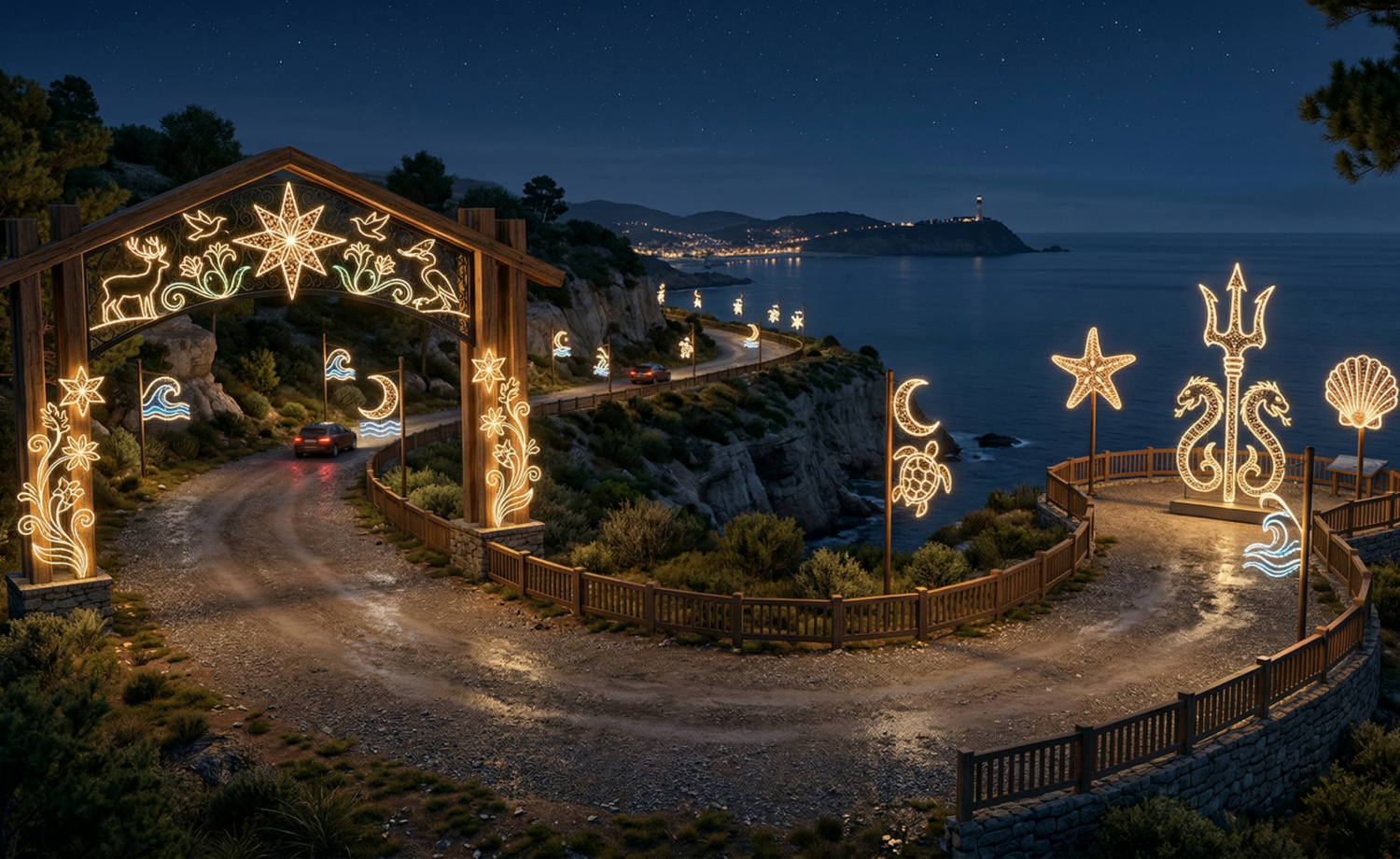
Scenic routes and night-tourism lines usually follow another logic. They do not always need the same motif repeated all the way through. In many cases, they work better when the route is divided into zones, such as:
- entry zone
- main visitor route
- key node zone
Scenic projects are often better when pole motif lights become part of the thematic story of the route. But change only works when there is still an overall visual logic. If every section feels completely unrelated, the project loses coherence.
The 4 Most Important Variables in Repeated Planning
The biggest question in a pole motif light project is not which motif to choose. It is how these four variables work together.
1. Spacing
Spacing is one of the strongest factors in determining the rhythm of a road.
- If the spacing is too dense, the road can feel visually crowded and heavy.
- If the spacing is too wide, the festive feeling becomes weak and disconnected.
Spacing should never be treated as a fixed number. It must be judged together with road width, pole height, motif size, and main viewing distance.
On wider roads with taller poles, visual impact is easier to lose. If the spacing is also too wide, the whole route becomes weak. On narrower shopping streets or community roads, overly dense repetition can create visual pressure.
2. Single-side or double-side installation
Double-side installation usually feels more complete and ceremonial. On city avenues, landscape roads, and important festive routes, synchronized installation on both sides often creates stronger visual order.
But not every road must be double-sided. On routes with limited budget, heavy obstruction, or difficult conditions on one side, single-side emphasis can still work.
The key question is not whether one side or two sides is always correct. The key question is:
- Are both sides really suitable for installation?
- Does double-side installation truly improve the effect?
- Would single-side installation create a serious visual imbalance?
- Does the budget support both sides?
3. Same motif repetition or alternating motifs
Main roads usually work better with repeated use of the same motif, because they value continuity and route recognition more than variety. Shopping streets can accept A/B alternation more naturally, such as snowflake and star combinations, or gift-box motifs paired with abstract festive linework. Scenic routes can go further by changing motifs between themed zones.
But variation should never mean too many unrelated patterns. Many routes look chaotic simply because too many motifs are used without a clear main language.
4. Motif size and proportion
The motif size must match the road, pole, and viewing condition.
- On wide roads with tall poles, motifs need to be larger and visually clearer.
- On narrow roads with more close-range viewing, motifs can be more refined.
- If motifs are too small, the environment will visually absorb them.
- If they are too large, they can feel heavy and awkward.
So motif size is never decided independently. It must be matched to road width, pole height, and viewing distance together.
What to Do When Pole Spacing Is Not Uniform
In real projects, road conditions are not always ideal. Especially in older urban areas, older commercial streets, or scenic routes, pole spacing is often irregular. In some cases, one side may have trees, the other side may have shop signs, and certain points may be blocked by buildings or street furniture.
In those situations, the goal should not be to force every pole into exactly the same logic. The first priority should be to preserve the overall rhythm of the route.
A more practical approach is usually to:
- protect the main visual continuity instead of forcing perfect equal spacing
- skip heavily blocked points instead of installing awkwardly
- balance irregular areas by slightly enlarging motifs or tightening local rhythm where necessary
- prioritize the main viewing direction so the road still feels orderly overall
Irregular spacing does not mean the project cannot work. It simply means the planning logic must shift from strict repetition to visual regularity.
Which Layout Logic Works Best for City Main Roads
The main goal of a city main road is not playful variation. It is visual order, unity, and long-distance continuity.
These roads usually work better with:
- large-area repetition of the same motif
- installation on both sides
- minimal motif switching
- unified light color temperature
- strong long-distance route identity
Because vehicle speed is higher and visual attention is shorter, the motifs must remain simple, clear, and easy to recognize. Excessive variation usually weakens the overall effect.
On roads like these, pole motif lights behave more like a visual language of the city road rather than a series of individual decorative moments.
Which Layout Logic Works Best for Shopping Streets and Pedestrian Streets
Shopping streets and pedestrian streets care more about atmosphere, interest, and visitor experience. Since pedestrian speed is lower and close viewing is common, the layout can allow more controlled variation.
These spaces are usually suitable for:
- a main motif plus a supporting motif
- local density increase at key nodes
- coordination with tree lighting, storefront decoration, and windows
- stronger photo opportunities
But even when variation is allowed, the whole street still needs one unified theme. For example, a route can alternate between snowflakes, stars, and gift-box elements, but the line style, color direction, and brightness rhythm should still feel consistent. That is how a street can feel lively without becoming disorderly.
Which Layout Logic Works Best for Scenic Routes and Night-Tourism Lines
Scenic routes usually work best with zoned planning rather than one single motif repeated mechanically from beginning to end.
For example:
- the entry zone can emphasize welcoming motifs
- the main visitor route can emphasize continuity and thematic expression
- the key node zone can have denser or more story-driven motifs
The advantage of scenic routes is that pole motif lights can become part of the route’s thematic storytelling. But even when there is variation between sections, the visual logic must remain unified. Otherwise the route loses overall identity.
How to Plan More Efficiently When the Budget Is Limited
When the budget is limited, a very common mistake is to want too many changes and too much complexity across the whole route. This usually raises costs without guaranteeing a better final result.
A more efficient strategy is usually to:
- protect the main visual continuity first
- reduce the number of motif types
- establish order and repetition before adding local variation
- increase density only at important nodes
- keep ordinary road sections more standardized
For road-based projects, uniformity itself often creates a premium feeling. In many cases, simple but well-planned repetition works better than complex but disorganized variation.
Main Visual Sections and Ordinary Sections Do Not Need the Same Density
A practical way to improve results without overspending is to divide the project into:
- primary visual sections
- ordinary extension sections
Primary visual sections usually include:
- main entrances
- important intersections
- core commercial zones
- areas where people stop, take photos, or share images
These sections are better suited to:
- denser rhythm
- stronger motif completeness
- a main motif plus a supporting motif
- coordination with storefront decoration, tree lighting, or node-based installations
Ordinary extension sections can stay more standardized, with fewer motif types and stronger emphasis on continuity.
This approach helps concentrate the budget where it creates the most visible value, while still keeping the full route visually unified.
White-Day Outline Matters More Than Many Buyers Expect
Many buyers focus mainly on how the lights look at night. But on road projects, daytime outline matters too. Some streets serve as important public-facing urban space even in daylight. If the daytime outline is too weak, the whole project can feel incomplete.
In general:
- main roads and wider routes need motifs with clearer outlines and stronger direct shapes
- shopping streets and closer-view environments can accept more refined detailing
- thin-line designs with weak outline presence often disappear on wide roads
- very small motifs may still light up at night but feel visually weak in daytime
So pole motif lights should not be judged only by whether they glow beautifully at night. They must also be judged by whether they still hold enough visible outline in daytime.
Long-Term Reuse Projects Need a Different Planning Logic
If the project is meant for multi-year reuse, the early planning logic should not focus only on how good it looks this season. It should also consider future disassembly, storage, and reinstalling.
Long-term reuse projects usually work better when they:
- use classic motifs that will not become outdated quickly
- prioritize snowflakes, stars, gift boxes, or abstract festive lines
- establish good numbering and section management
- plan packaging and warehouse logic in advance
- avoid relying too heavily on short-term trendy motifs
Frame material is also important here.
Aluminum frames: better for repeated long-term use
If the budget is stronger and the project clearly aims for multi-year reuse, aluminum frames are usually the better choice. Aluminum is lighter, less likely to rust, and easier for repeated handling.
Steel frames: better for short-term or budget-sensitive projects
If the project is more temporary, or if the route goes through repeated tender processes where future continuation is uncertain, steel frames are often more realistic because of the lower initial cost.
So the key question is not only which frame is better, but whether the route is a one-time seasonal project or a reusable long-term festive asset.
If you also need to compare route-wide pole lighting with overhead street lighting before confirming a final layout, you can review 2D Pole Motif Lights vs Cross-Street Holiday Lights. And if your team is evaluating long-term procurement value, it is also useful to read Commercial Holiday Decoration Procurement Checklist for Project Owners and Contractors.
Common Mistakes Buyers Make in Pole Motif Light Layout Planning
One common mistake is looking only at one single motif and not at the effect of the whole road.
Another is using too many motif types in one project and losing visual unity.
A third is choosing motifs that are too small for wide roads and tall poles.
A fourth is wanting too much variation while the budget is still limited.
A fifth is applying the same layout logic to city main roads, shopping streets, and scenic routes even though their roles are different.
A sixth is ignoring the difference between daytime outline and nighttime lighting effect.
These mistakes often look like design problems, but in reality they usually come from missing layout logic.
What Buyers Should Confirm Before Ordering
- total route length
- whether pole spacing is uniform
- pole height and pole style
- road width
- whether both sides are available for installation
- whether trees, signs, or buildings create heavy obstruction
- whether the main viewers are drivers or pedestrians
- whether the project is short-term or intended for repeated reuse
- whether the budget is more focused on one-time installation or long-term asset value
- whether aluminum or steel frame logic is more suitable
- whether the route needs section-based thematic variation
- whether there are restricted installation windows or night-work conditions
The earlier these conditions are clear, the easier it becomes to produce a layout that is visually strong and practically realistic.
Final Thoughts
The real challenge in pole motif light projects is not choosing one beautiful motif. It is arranging a whole line of lighting units so that the entire road still feels rhythmic, ordered, and thematically consistent.
Main roads need stronger uniformity. Shopping streets need stronger atmosphere. Scenic routes need stronger theme logic. Once the road logic is clear, repeated planning becomes much easier to do well.
In festive street projects, the single motif light is only the beginning. The repetition logic is what determines whether the whole route finally feels professional, premium, and unified — or fragmented, messy, and difficult to implement.
Frequently Asked Questions
In repeated pole motif light planning, what matters more: pattern or spacing?
Usually it is not only the pattern. The final result depends on the pattern, spacing, size, and road condition together.
Are multiple motif types suitable for city main roads?
Usually not too many. Main roads are better with the same motif or only limited alternation, because continuity and route recognition matter more.
Can shopping streets use more variation in pole motif lights?
Yes. Shopping streets usually work well with controlled variation under one unified theme, because that improves atmosphere and photo appeal.
If the budget is limited, how can pole motif lights be planned more efficiently?
Protect the main visual continuity first, reduce motif types, keep ordinary sections standardized, and concentrate stronger treatment only in key zones.
Which frame material is better for multi-year reuse?
Usually aluminum is better for long-term reuse because it is lighter, less likely to rust, and easier to manage over repeated installation cycles.