





C7 vs. C9 Christmas Lights: How Malls, Hotels, and Commercial Streets Should Choose
C7 and C9 are familiar Christmas-light shape labels, but the difference is not a complete product specification. C9 is generally the larger bulb form and C7 the smaller. That visible scale may influence how a light line reads from a particular position, yet it does not tell a buyer which option is brighter, uses more power, is suitable outdoors or will fit an existing socket.
For a commercial project, the useful question is not “Which size is better?” It is “Which exact candidate fits this visual task, this viewing context and this approved system?” A mall entrance, hotel arrival, commercial-street outline and decorated tree can require different visual priorities even within one property.
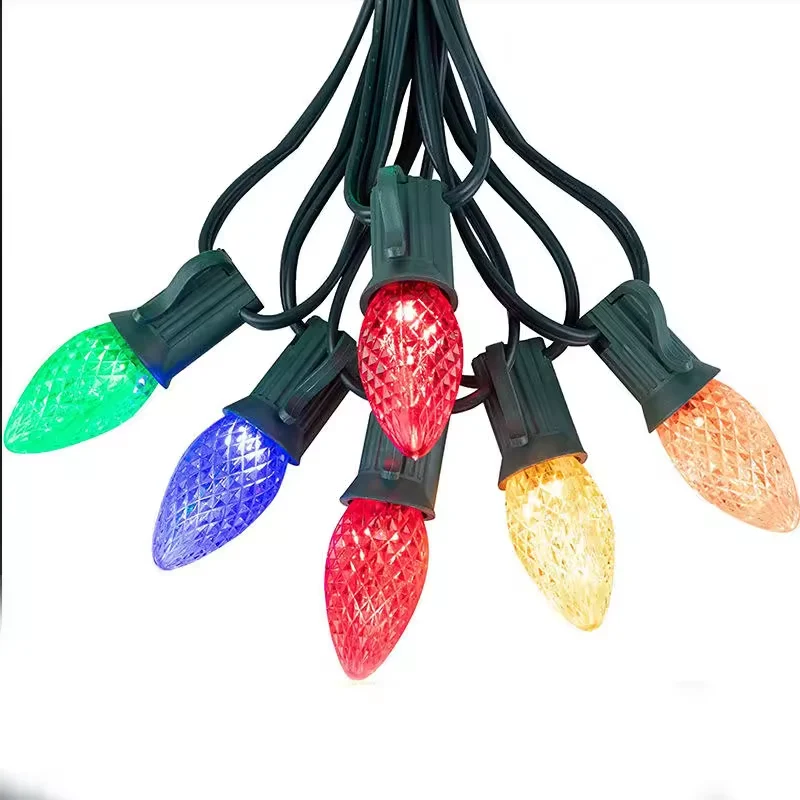
The Short Answer: Compare Form, Role and System Separately
Use the C7/C9 label first to distinguish visible form factor. Then make three separate checks:
- Visual role: Is the line meant to read as a fine repeated detail, a stronger perimeter, a tree layer or an entrance accent?
- Viewing context: Where will people normally see it, and what other lighting or decorations surround it?
- Exact system: Is the candidate a removable-bulb and socket system, or an integrated/pre-lamped string? What evidence confirms compatibility and project requirements?
Keeping these questions separate prevents the larger outline from being mistaken for greater brightness or outdoor suitability. Those are different product facts that require their own evidence.
C7 vs. C9 at a Glance
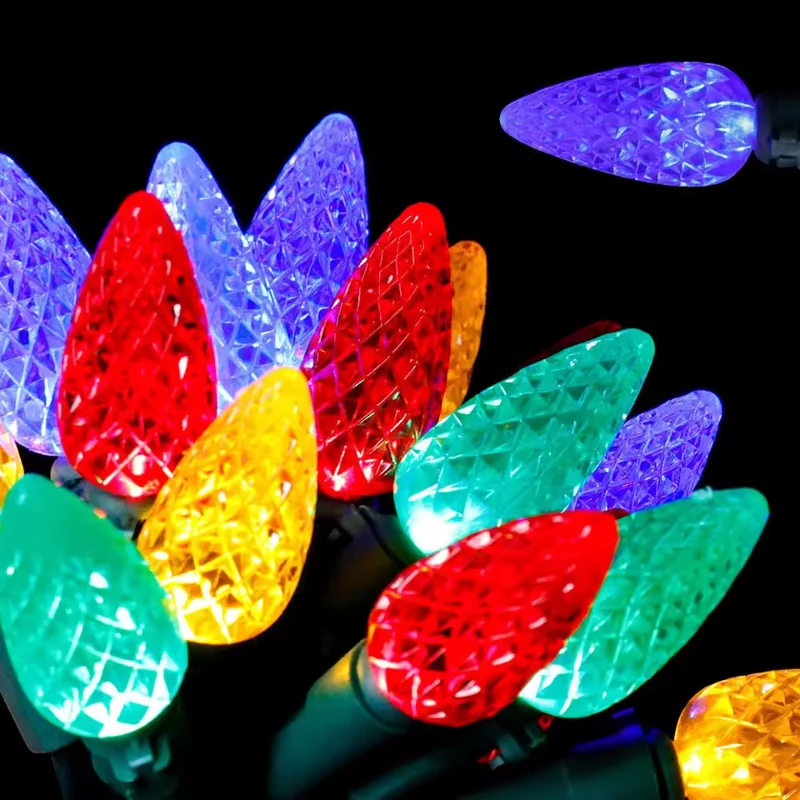
| Comparison point | C7 | C9 | What the buyer must still confirm |
|---|---|---|---|
| Relative bulb form | Generally the smaller of the two traditional forms | Generally the larger of the two traditional forms | Exact dimensions for the candidate; do not rely on the label alone |
| Visual task to explore | Finer repeated points, closer-detail roles or supporting layers | Larger repeated points, stronger edge definition or more distant visual roles | Actual appearance in the intended position and surrounding ambient light |
| Common removable-bulb pairing | Commonly associated with an E12 candelabra base | Commonly associated with an E17 intermediate base | Exact lamp base, socket and manufacturer compatibility for the candidate |
| Integrated/pre-lamped versions | May use a fixed, non-removable construction | May use a fixed, non-removable construction | Whether the bulb is replaceable and whether a named socket base applies at all |
| Not established by the label | Brightness, wattage, voltage, spacing, LED or incandescent technology, rating, weather exposure, control or service life | The same facts remain unproven | Current product data and review by the responsible project parties |
This table is a buyer-screening tool, not a universal specification. Suppliers can use the same C7 or C9 language for products with materially different construction and operating details.
Choose by Position and Viewing Context
“Exterior” or “tree” is too broad to support a choice. Name the exact position and the principal view before comparing C7 and C9 candidates.
Façades and repeated commercial-street positions
For a façade edge or repeated street line seen from a longer approach, test whether the larger C9 form gives the intended visual rhythm. For a closer view or a finer supporting detail, C7 may be the better proportion. Compare the same candidate against current site photographs and ambient lighting; the label does not decide spacing, attachment, electrical design or installation.
Entrances and hotel arrival points
An entrance or hotel canopy may be seen from a vehicle, at walking distance and close up. Identify the view that matters most. A form that looks strong in a close product photograph may read differently beside a bright canopy, glazed façade or other illuminated decorations.
Commercial trees and small decorative forms
For a smaller tree or small decorative floral form, C7 may preserve the intended proportion, while C9 may appear oversized. This is a composition decision, not a universal rule. Review the candidate with branches, ornaments and other visible layers. The commercial Christmas tree lighting guide covers the wider whole-tree task.
Do Not Use Bulb Size as a Substitute for Performance Data
A recurring buyer misunderstanding is to move directly from “larger bulb” to “brighter, higher power or better outdoors.” Those conclusions do not follow from the C9 label. Two exact C7 and C9 candidates may use light sources with similar output even though their visible forms differ, so compare current product data rather than the outline alone. Power depends on the exact product and system. Outdoor use depends on current evidence for the candidate, its actual exposure and the applicable destination requirements.
The C7/C9 choice is also separate from LED versus incandescent technology. If the light-source decision is still open, use the LED versus incandescent commercial Christmas lights guide and bring the result back to the C7/C9 candidate record. Do not assume that either shape label identifies the technology.
Color is a separate decision as well. Warm white, cool white and colored products can look different across exact suppliers and product families. Use the warm white versus cool white commercial Christmas lights guide when the project still needs to approve a white-light direction.
Check Replaceable and Integrated Products Differently
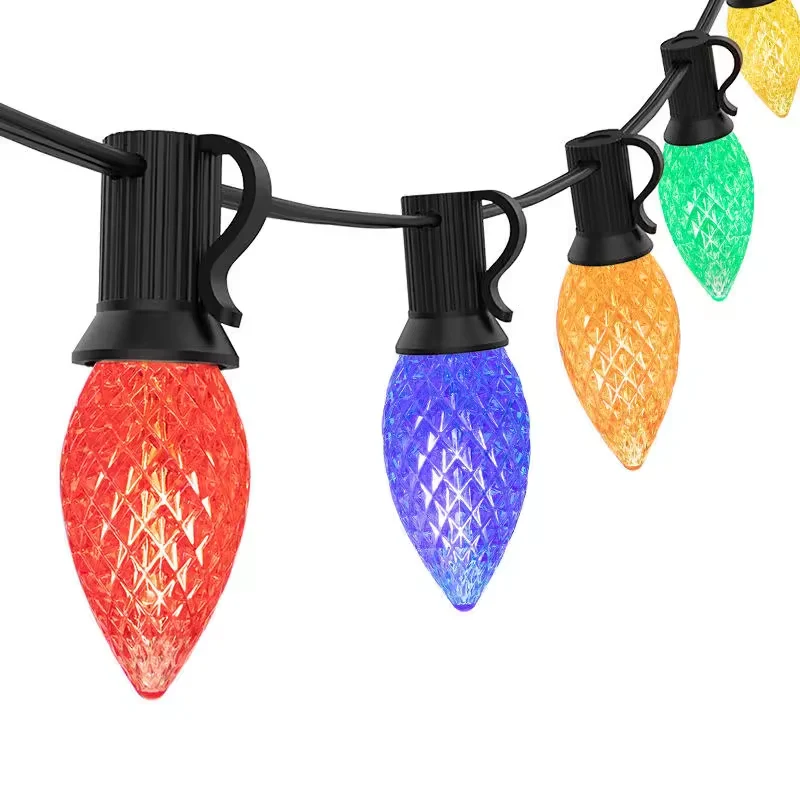
In many removable-bulb systems, C7 lamps are paired with E12 candelabra sockets and C9 lamps with E17 intermediate sockets. Treat that as a common configuration to verify, not a promise about every product using the C7 or C9 name.
An integrated or pre-lamped string may have bulbs fixed into the line and may not accept a separate replaceable lamp. In that case, calling the product “C7” or “C9” may describe its visible form rather than an E12 or E17 replacement interface. Ask the supplier to state the construction clearly.
If replacing one failed lamp is an important maintenance priority, a buyer may prefer a removable-bulb construction, subject to exact compatibility and project requirements. That preference is not proof that every integrated product is lower quality. It simply changes the maintenance question that must be answered for the exact candidate.
En commercial C7 and C9 LED string lights product page can be included as a candidate reference in an inquiry. Its URL alone does not confirm dimensions, output, outdoor suitability, included components or replaceable construction; request the current product-specific evidence before deciding.
Use One Format or Both?
A project can explore one consistent bulb form or use C7 and C9 forms in different visual roles. Mixing them is useful only when the hierarchy is deliberate—for example, one form for a principal edge and another for a supporting tree or entrance detail. Do not mix components physically because their names sound related. Each exact product and system must remain within its documented compatibility and approved scope.
Before approval, compare the proposed roles on one page. Include a day view, a night view or sample where relevant, and the principal viewing positions. If the distinction is not visible or does not support the brief, adding a second format may create complexity without a clear visual purpose.
Copyable C7/C9 Candidate Record
| Campo de registro | Registro de comprador |
|---|---|
| Position ID and exact location | |
| Función visual | |
| Principal viewing positions | |
| Current day/night site photographs | |
| Exact supplier product/SKU | |
| C7 or C9 form label | |
| Replaceable or integrated/pre-lamped construction and maintenance preference | |
| Documented base/socket, if applicable | |
| Confirmed included, optional and excluded components | |
| Current visual sample or reference | |
| Product data, exposure evidence and replacement reference still required | |
| Site/destination questions and responsible reviewer | |
| Compatibility decision | OPEN / CONFIRMED FOR THIS CANDIDATE / HOLD |
| Version and date |
Complete this record for each candidate. If the product reference, position or system construction changes, update the record instead of carrying the previous conclusion forward.
Supplier Inquiry Checklist
Send the completed candidate record with the materials already available:
- current photographs from the principal viewing positions;
- the exact position and intended visual role;
- candidate links or SKUs and any existing components involved;
- the buyer’s construction and maintenance preference; and
- the missing evidence and open questions that require a supplier response.
Ask each supplier to complete the same missing fields. This keeps responses comparable without repeating the full record in a second checklist.
Preguntas frecuentes
Is C9 always brighter than C7?
No. C9 is generally the larger form, but brightness depends on the exact light source and product data. Compare the candidates rather than inferring output from the label.
Does C9 always use more electricity?
Not necessarily. Power depends on the exact product and system, not the C7 or C9 name. Use current data for the candidate.
Are C7 and C9 bulbs always E12 and E17?
They are common pairings in removable-bulb systems, but not a rule for every product. An integrated string may have no replaceable base interface, so confirm the exact construction.
Which is better for a shopping mall or hotel?
Neither is universally better. Use the main viewing position and intended visual role to compare exact candidates; an arrival line and a smaller lobby tree may justify different choices.
Can C7 and C9 be used in the same commercial display?
Yes, when each has a deliberate visual role. Their components are not automatically interchangeable, so keep each product within its documented system.
Does the C7 or C9 label prove outdoor suitability?
No. It identifies a bulb form, not an outdoor rating. Review current evidence for the exact candidate, actual exposure and destination requirements.
Prepare the Position and Candidate Evidence Before Inquiry
The practical C7-versus-C9 decision begins with a defined position, viewing task and exact candidate—not a universal rule that one form is better. Record the visual role, system construction, current evidence and open responsibilities before comparing supplier responses.
When those inputs are ready, use the HYCLight contact page to share the position references, site photographs, candidate links and unresolved questions for a project-specific product discussion. An inquiry does not confirm availability, compatibility, design, price, production, delivery, installation, suitability or approval.