




Commercial Christmas Tree Light Calculator: How Many Lights You Really Need
On a large commercial Christmas tree, the number of lights is driven by the tree’s surface area and the way the lamps are installed, not by a simple rule of thumb per foot of height. At HOYECHI we use two factory methods for these builds. A luxury branch-wrapped tree carries roughly 30 lamps per 0.1 m² — about 300 lamps per square metre — fixed directly onto the branches for an even, dense finish. A simple top-hung tree uses strands pulled vertically from the top at about 10–12 lamps per 0.1 m², or roughly 100–120 lamps per square metre.
This calculator converts a tree height and shape into a cone surface area, then applies the density that matches the chosen method so project buyers can set a realistic quantity and budget before the inquiry. The figures are planning estimates; the final connected load, circuit layout, cable rating and controller limits must be confirmed against the product datasheet and the project drawings by a qualified installer.
1. Interactive Christmas Tree Light Calculator
Enter the tree height, the base-width ratio and the lighting method. The calculator works out the cone’s lateral surface area and the lamp count, then rounds to practical blocks of 50 and adds a 10% spare allowance.
Planning estimate for budgeting only. The calculator uses the cone’s lateral surface area (π r l) and the two factory density standards: 300 lamps per m² for branch-wrapped luxury builds and about 110 per m² (100–120) for top-hung simple builds. Confirm connected wattage, circuits, cable rating and controller limits against the datasheet and project drawings.
2. The Two Factory Lighting Methods
The same tree can be lit in two structurally different ways, and the choice is the single biggest factor in the lamp count.
Luxury method — wrapped on the branches
Lamps are bound onto the individual branches so the light follows every section of the cone. The factory density is about 30 lamps per 0.1 m², or 300 lamps/m² (roughly 28 lamps per square foot). The result is uniform, three-dimensional and gap-free, with no dark patches when viewed from any angle — the standard choice for premium mall atrium, hotel and municipal focal trees.
Simple method — hanging from the top
Strands are suspended from the top and run vertically down the cone rather than being wrapped branch by branch. The density is far lower, at about 10–12 lamps per 0.1 m², or 100–120 lamps/m² (around 10 lamps per square foot). This is a faster, more economical build that still reads as a full tree at a distance, suited to budget-conscious projects and long sightlines.

3. Calculating the Cone Surface Area
Because density is defined per unit of surface area, the estimate starts from the cone’s lateral (curved) surface. Treating the tree as a cone with base radius r and slant height l:
Slant height l = √(r² + h²)
Lateral surface area A = π × r × l
The radius is half the base width. For estimating, the base width is expressed as a proportion of the tree height:
| Tree shape | Base width ÷ height | Typical use |
|---|---|---|
| Slim | 0.42 | Narrow footprint, restricted floor space |
| Standard | 0.47 | Our standard factory build |
| Full / broad | 0.52 | Wider focal displays |
Once the surface area is known, multiply by the method density:
Lamp count = surface area (m²) × 300 (luxury) or ~110 (simple)
4. Lights by Tree Height
The table below uses our standard 0.47 base-width ratio and shows both methods. The ratio normally runs from 0.42 to 0.52; select a slim or full ratio in the calculator to adjust the area for the actual tree, and we can build to a customer-specified ratio outside that range.
| Tree height | Surface area (m²) | Luxury wrapped (300/m²) | Simple hung (110/m²) |
|---|---|---|---|
| 7.5 ft | 4.0 | 1,200 | 450 |
| 10 ft | 7.0 | 2,150 | 800 |
| 12 ft | 10.1 | 3,050 | 1,150 |
| 15 ft | 15.9 | 4,800 | 1,750 |
| 20 ft | 28.2 | 8,500 | 3,150 |
| 25 ft | 44.0 | 13,250 | 4,850 |
| 30 ft | 63.4 | 19,050 | 7,000 |
| 35 ft | 86.3 | 25,900 | 9,500 |
| 40 ft | 112.7 | 33,850 | 12,450 |

5. Worked Examples
Example A — 20 ft standard tree, luxury branch-wrapped
Height 6.10 m, radius 1.43 m, slant height 6.26 m, giving a surface area of about 28.2 m². At 300 lamps/m² that is roughly 8,500 lamps, about 85 strands of 100 lamps, an illuminated string length near 2,830 ft, and around 9,350 lamps with a 10% spare allowance.
Example B — 20 ft standard tree, simple top-hung
The same 28.2 m² surface at about 110 lamps/m² gives roughly 3,150 lamps, about 32 strands, around 1,050 ft of string, and roughly 3,450 lamps with spares — under 40% of the luxury quantity for the same frame.
Example C — 7.5 ft standard tree, luxury branch-wrapped
Surface area about 4.0 m²; at 300 lamps/m² the count is about 1,200 lamps (12 strands), or about 450 lamps if the simple method is chosen instead.
6. From Estimate to Inquiry
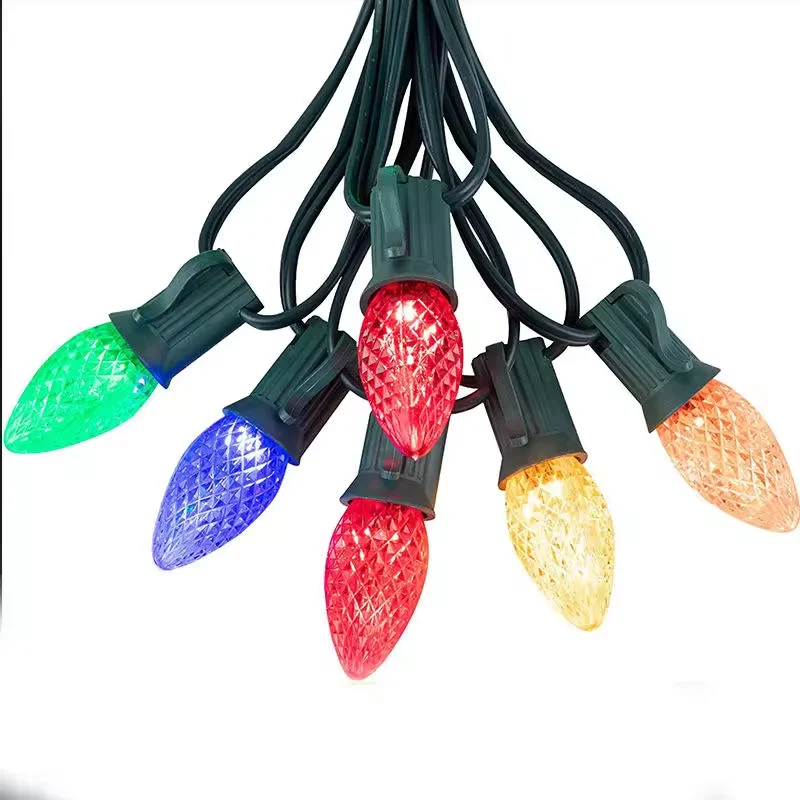
With the lamp count set, confirm the strand format and electrical details rather than ordering on count alone. Check the bulbs per strand, lead-wire length and connectors, the wattage and maximum sets per circuit, and how the display is sectioned for installation and reuse. For the heavy-duty formats, the commercial C7/C9 LED string lights and C3 LED string lights pages list the lamps used on these builds; RGB LED strip lights suit programmable scenes.
For the structures themselves, the 30 ft Christmas tree, the 35 m DMX512 pixel tree and the custom giant tree for city squares and malls show the scale these quantities are planned around.
FAQ
Why is the count based on surface area rather than tree height?
Lamps are distributed across the curved face of the cone, so two trees of the same height but different base widths have different surface areas and need different quantities. Working from area and installation density gives an accurate count; a fixed per-foot rule does not.
What is the difference between the luxury and simple methods?
The luxury method wraps about 300 lamps/m² directly onto the branches for a uniform, gap-free finish. The simple method hangs strands vertically from the top at roughly 100–120 lamps/m², a faster and more economical build that looks full at a distance.
Can the simple method be upgraded to the luxury method later?
The same frame can support branch-wrapped lighting, but upgrading is a re-installation rather than an addition: the lamps are fixed differently and the density and power distribution change. Specify the method at the planning stage rather than converting on site.
How should I round the final number?
Round up to the nearest block of 50 lamps and to whole strands, then add about 10% for spares. Ordering in practical blocks avoids a shortfall and keeps replacement lamps consistent.
How does this estimate differ from the final lighting plan?
The calculator produces a quantity for budgeting. The final plan adds the circuit layout, connected wattage, controller and cable specification, and fixing details, confirmed against the project drawings and the selected product datasheet.
Final Word
A measured lamp count protects both the visual result and the budget. Use the calculator and tables to set the quantity for the chosen method, then contact our engineering team with the tree height, shape, venue photographs and timing for a confirmed quote with strand counts, circuit guidance and a delivery schedule.