





Every holiday season, when malls, hotels, plazas, and scenic destinations begin planning their Christmas displays, the first thing most teams lock in is the tree.
That makes sense. A large Christmas tree is usually the visual anchor of the whole installation. It is the part clients notice first in a rendering, the part visitors photograph first on site, and often the part that takes the largest share of the budget.
But anyone who has worked on real projects knows something that does not always show up in a product image: a large tree, by itself, is rarely enough.
A tree can be tall, bright, and beautifully decorated, yet still feel unfinished after installation. From a distance, it may look impressive. Up close, though, the space around it can still feel empty. People walk over, take a quick photo, and leave. The tree is there, but the atmosphere has not fully landed. This happens especially often in large atriums, open plazas, hotel forecourts, and scenic public spaces, where the centerpiece is strong but the scene around it is too weak.
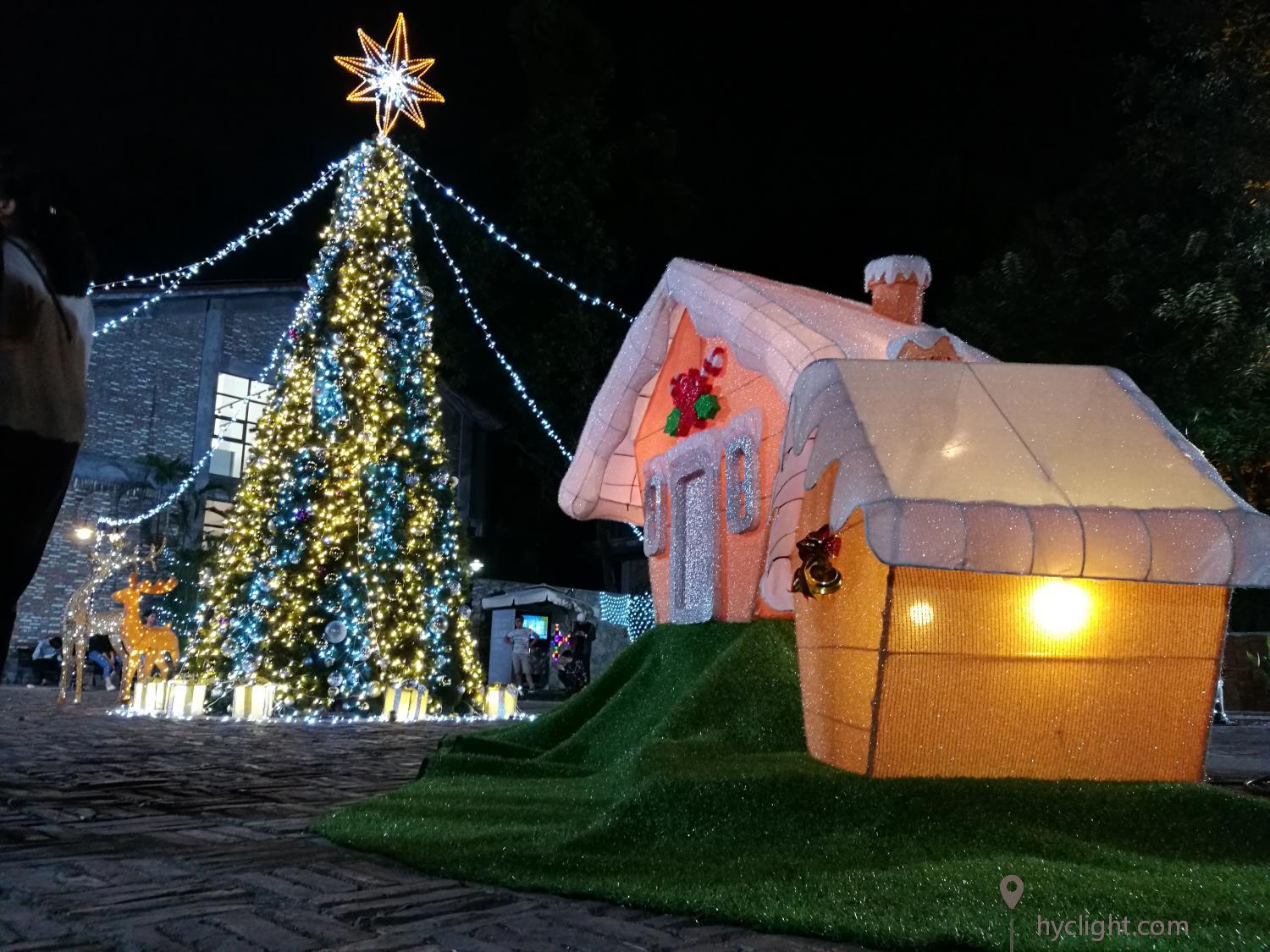
In many cases, the problem is not the tree.
The problem is everything around it.
A large commercial Christmas tree standing alone is still just a large standalone object. Once the right supporting decorations are added around it, the tree starts to become part of a complete holiday environment. People do not just see it. They approach it, stay longer, interact with it, and photograph it more naturally. That is usually where the commercial value of the installation begins to grow.
If you are still choosing the tree itself, you can also read Custom Large Christmas Tree for Malls, Parks and City Squares first, because the right supporting decorations depend heavily on the role, scale, and location of the tree.
Before adding more products, ask what the tree is missing
One of the most common mistakes in holiday display planning is assuming that if the area around the tree feels empty, the solution is simply to add more items.
That often leads to a familiar result. More gift boxes are added. Then reindeer. Then a sleigh. Then a wreath. Then some oversized ornaments. Then maybe a decorative hut. The scene becomes fuller, but not necessarily better. Instead of building around the tree, the supporting decorations begin competing with it.
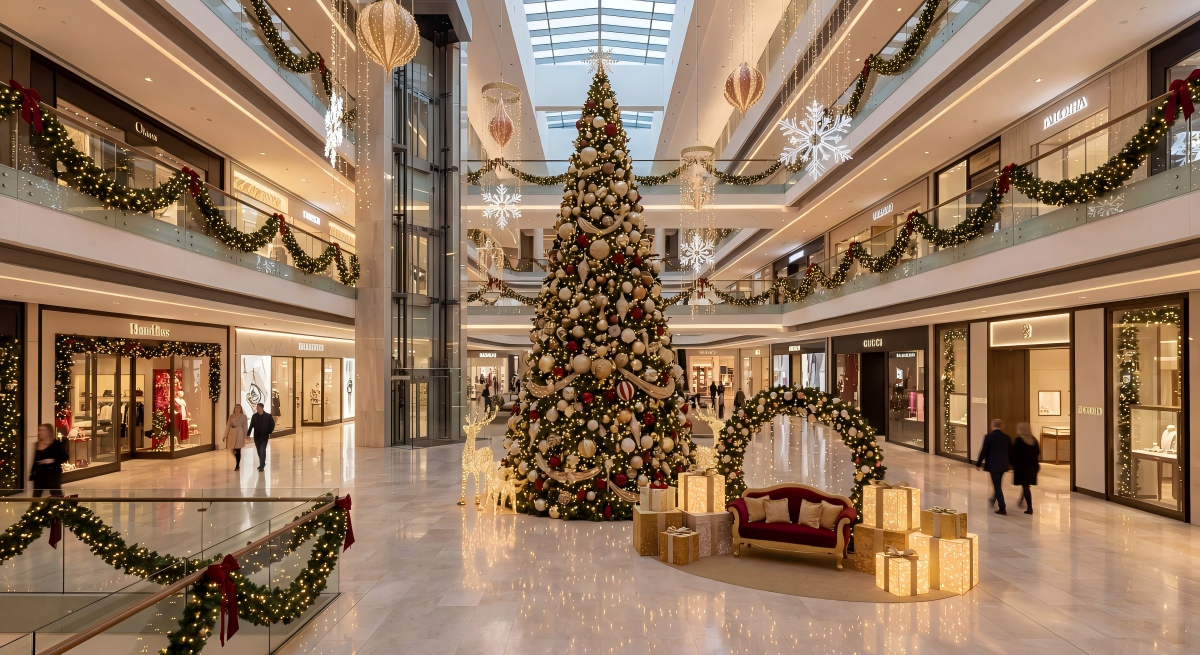
That is why the right place to start is not with the question, “Which supporting products look best?” The better question is this:
What is this tree actually lacking right now?
Sometimes the tree feels visually empty at the base. The crown is rich and impressive, but the lower area underneath it has no weight, so the whole installation looks as though it is floating.
Sometimes the problem is not the base but the photo experience. From far away, the tree works well as a landmark, but once visitors walk up to it, there is nothing in front of it to help create a good foreground.
Sometimes the issue is broader. The tree looks fine, but it has no relationship with the surrounding space. It feels like an object that has been placed in the middle of the site rather than something that belongs there.
Supporting decorations work best when they are solving one of those problems. Some fill the empty base. Some create foreground layers. Some add story. Some connect the tree to the wider environment. Their job is not to replace the tree or compete with it. Their job is to help the tree feel complete.
The safest place to start is usually with oversized gift boxes
If there is one category of supporting decoration that is the most flexible, the most reliable, and the least likely to go wrong, it is probably oversized gift boxes.
That is not because they are unusual. In fact, it is the opposite. They work because they are so naturally connected to the idea of Christmas. A tree and gift boxes already belong to the same visual language. Whether the project is in a shopping mall atrium, a hotel entrance, an outdoor plaza, or a scenic holiday zone, gift boxes almost always make sense.
More importantly, gift boxes are one of the best ways to solve the most common visual problem around a large tree: an empty lower zone.
A large tree can look strong in height but weak at the bottom. The taller the tree and the more open the site, the more obvious that weakness becomes. Once gift boxes are placed around the base in the right scale and combination, the tree immediately looks more grounded. The installation feels more stable, and the photo composition starts to work better because there is now something between the visitor and the tree itself.
Gift boxes also scale up or down easily. In a budget-sensitive project, they can act as the core supporting element and still do a lot of visual work. In a larger project, they can become part of a richer composition together with ornaments, reindeer, low glowing props, or scenic structures.
A tree with gift boxes feels more complete. A tree with reindeer starts to feel alive
If oversized gift boxes are the safest base layer, reindeer and sleigh elements are often what bring the scene to life.
A Christmas tree is already a strong symbol, but the moment reindeer enter the composition, the display begins to feel more narrative. It no longer says only, “There is a tree here.” It begins to suggest that a Christmas story is happening in this space. People respond naturally to that kind of scene, especially in public commercial environments.
That is why reindeer sculptures work so well in plazas, hotel forecourts, outdoor promotional spaces, and scenic visitor areas. The reason is not simply that reindeer are festive. It is that they are excellent foreground characters. The tree works as the background. The reindeer create scale, emotion, and interaction in front of it. A photo with both the tree and the reindeer almost always feels more complete than a photo of the tree alone.
If you want to explore this type of supporting product in more detail, see Outdoor LED Christmas Reindeer Light Sculpture for Holiday Displays and Giant LED Light-Up Reindeer Sleigh Decoration for Outdoor Christmas Display.
But reindeer also need restraint. One of the most common design mistakes is adding too many of them. A few well-placed reindeer can strengthen the story and create strong photo value. Too many scattered across the entire area can weaken the tree and confuse the hierarchy of the scene.
The tree should remain the center. The reindeer should help support that center, not compete with it.
Some spaces do not only need decoration. They need a small holiday world
Gift boxes and reindeer do a great job of supporting the base, the foreground, and the emotional tone of a large tree. But in some spaces, especially plazas, scenic tourism zones, and outdoor event areas, that still may not be enough.
In those cases, the installation may need something more spatial — something that people can approach as part of the environment rather than just look at from outside.
This is where Christmas huts, gingerbread-house-style structures, and market-style decorative features become extremely valuable. These elements are different from gift boxes and reindeer. Gift boxes are decorative fillers. Reindeer are festive characters. Small houses behave more like spatial anchors. Once one is added, the installation begins to shift from “tree plus supporting decorations” into something closer to a small holiday environment.
This matters especially in projects where the goal is not only to impress from a distance, but also to keep people in the area longer. Visitors do not just photograph the tree. They walk around, look closer, pause in front of different elements, and experience the display as a place rather than as a single object.
When the tree already works, medium-scale decorations help the whole scene feel finished
Once the tree, the base, and the foreground are working, many installations are already functional. But if the goal is to make the whole space feel more complete and more deliberately designed, there is often still one missing layer: the festive language around the centerpiece.
This is where oversized wreaths, giant ornaments, snowflake pieces, star elements, and similar mid-scale decorative products become useful.
These are not there to become the main attraction. Their role is subtler. They help complete the visual vocabulary around the tree. If the tree is the center and gift boxes or reindeer are the foreground, then wreaths, baubles, and snowflake elements often work as the middle layer or the surrounding connectors.
They can sit beside the tree, define the edge of the scene, enrich a nearby wall, or help fill awkward transition spaces around the installation. When used carefully, they make the whole project feel more composed — less like a group of separate products and more like one deliberate festive environment.
A good example of this kind of supporting product is an oversized wreath. See Oversized Outdoor Christmas Wreath with Lights for Commercial Holiday Displays.
If the tree has a relationship with an entrance or a walkway, arches become much more important
In some projects, the tree is not standing in the middle of an isolated square. It is part of a sequence. Visitors enter the site from one direction, move through a forecourt, and only then arrive at the tree.
Whenever that is the case, arches and entrance-style decorative elements become much more valuable.
This is because visitors do not appear magically in front of the tree. They approach it. If there is no festive transition between the entry point and the main tree, the atmosphere can feel disconnected. The tree itself may be beautiful, but the journey toward it feels abrupt.
Arches help solve that. A festive arch or a walk-through decorative feature creates a visual threshold. It starts preparing the visitor before they even arrive at the tree. In that sense, the tree is the climax, and the arch is part of the build-up. Without that build-up, the main scene can feel as though it starts too suddenly.
In many large-tree projects, the real weakness is not the centerpiece. It is the ground layer
This is one of the most common issues in large-scale Christmas displays.
The bigger the tree, the more important the ground layer becomes.
The tree handles the vertical center of the composition. But what people actually engage with when they stand in the space is the lower zone — the area around eye level and below. If that area feels empty, visually weak, or disconnected from the tree, the whole display can feel top-heavy. From far away, it may still look impressive. Up close, it can lose its power.
That is why low-level glowing elements, floor-based ornaments, small illuminated props, snow-themed ground pieces, festive signboards, and other low decorative features can be surprisingly important. They may not be expensive statement pieces, but they are often what stabilizes the whole visual composition.
They should not steal attention from the tree. Their role is to fill the space between the visitor and the centerpiece so that the tree feels supported from the ground up.
Different spaces need different support logic
A very common mistake is assuming that because one tree scene worked somewhere else, the same supporting product combination can simply be copied into a new site.
In reality, the right supporting logic changes significantly depending on the setting.
A shopping mall atrium usually values close-up visual quality, photo experience, and refinement. That makes it more suitable for carefully scaled gift boxes, medium-sized reindeer, refined ornaments, and decorative snowflake elements. A mall atrium often does not need bulky structural additions. It needs finish and detail.
An outdoor plaza is different. Space is larger, and the tree is more likely to look empty if it is not supported well. Larger gift boxes, reindeer groups, sleighs, huts, medium-to-large ground sculptures, and even entry arches may all make sense here. Outdoor plazas usually need more visual weight.
Hotel front areas often require another kind of judgment. Hotels still need festive atmosphere, but they usually need it in a more controlled and elegant way. In those spaces, supporting products often need to feel more symmetrical, more refined, and less crowded.
Scenic zones and night-tourism environments are usually the most scene-based. In these projects, the tree is just one part of a broader visitor journey. Supporting elements around it should not only look good — they should help people slow down, enter the space, and experience it more fully.
If your project is not only about the tree itself but about the broader holiday environment, you may also want to explore Custom Commercial Christmas Trees for Malls, Parks, Cities & Holiday Events.
The biggest mistake is often not using too few products. It is using the wrong ones in the wrong way
Many projects that fail visually do not fail because there are not enough supporting elements. They fail because the support logic is wrong.
Some projects install only the tree and leave everything else empty, so the whole space feels unfinished.
Some projects add too many “main character” items and lose the hierarchy completely.
Some plan only for daytime display and forget that the foreground also needs to work for night photography.
Some place every product directly under the tree and ignore the front, the sides, the entrance relationship, and the movement path of visitors.
The problem is rarely quantity alone. The problem is whether each supporting element is actually doing the job it should be doing.
A supporting product should know its role. It should either ground the tree, build the foreground, add story, or connect the tree to the wider space. Once every element is doing the right kind of work, the entire display starts to feel much more natural.
Final Thoughts
There is no single fixed answer to the question of what supporting decorations work best around a large commercial Christmas tree.
What matters is not how many products are added. What matters is whether those products help the tree solve the real challenges of the site — space, atmosphere, photo value, visitor flow, and visual completeness.
In some projects, oversized gift boxes may be enough.
In others, reindeer and sleighs are what make the tree feel alive.
In larger or more immersive environments, Christmas huts, arches, oversized ornaments, wreaths, snowflake features, and low-level glowing props can all become valuable parts of the composition.
At the end of the day, the large Christmas tree is only the center. The real question is whether everything around that center has been chosen well enough to let it become a scene, not just an object.
Frequently Asked Questions
What is the most basic and versatile supporting decoration for a large commercial Christmas tree?
Oversized gift boxes are usually the most versatile starting point. They naturally match the Christmas tree theme, help fill the empty base area, and work well as foreground elements for photos.
Are reindeer and sleigh decorations suitable for every large Christmas tree project?
Not always. They work best in projects that need more story value, emotional appeal, and photo interaction, such as plazas, outdoor display areas, hotel forecourts, and scenic spaces.
Does every large Christmas tree need decorative huts or gingerbread-house elements?
No. Hut-style decorative structures are more suitable for larger spaces and immersive holiday scenes. In smaller spaces, gift boxes, reindeer, ornaments, and lower decorative props may be more practical.
Do more supporting decorations always create a better result?
Not necessarily. Supporting decorations should strengthen the tree, not compete with it. The best scenes usually come from clear hierarchy, not from adding as many products as possible.
Do indoor atrium trees and outdoor plaza trees need the same supporting products?
Usually not. Atrium trees often need more refined, close-view decorative support, while outdoor plaza trees usually need stronger visual weight, clearer foregrounds, and more spatial support around the base.