





In street holiday lighting projects, many buyers first focus on visual renderings or simply ask which option will look more festive. But in real projects, what determines whether the scheme can actually be implemented, maintained, and controlled within budget is not only whether the pattern looks attractive. The more important question is whether the road is better suited to 2D pole motif lights or cross-street holiday lights.
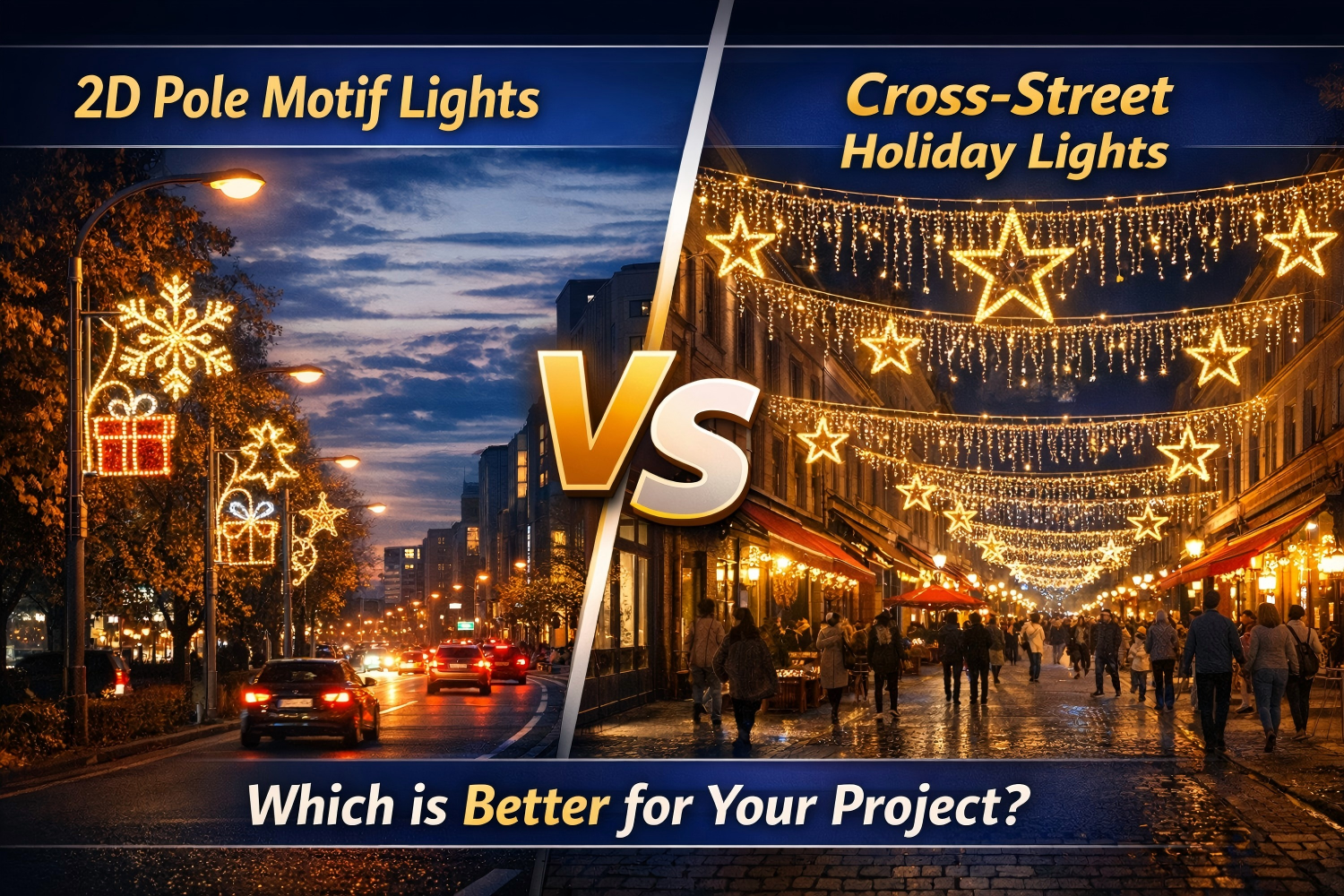
Although both belong to street festive lighting, they follow two very different project logics. One is more suitable for repeated installation, standardized replication, and fast deployment along a route. The other is more suitable for creating a stronger overhead festive atmosphere, a more immersive street experience, and a more dramatic upgrade for a key district.
If the wrong solution is chosen at the beginning, later approval, installation, budgeting, maintenance, and even the final visual effect can all become problematic. In many cases, the issue is not that the product is wrong, but that the road conditions and project goals do not match the lighting method.
If you are still defining the broader decoration direction of the project, it also helps to read How to Choose Commercial Holiday Decorations for Malls, Parks, and City Projects, because street motif lighting usually works best when it fits the wider festive plan of the site.
Why Street Holiday Lighting Should Not Be Chosen by Pattern Alone
In many projects, buyers are first attracted by renderings. The same snowflake, star, gift, or Christmas element may look good both on poles and across the street. But once the project moves into real planning, the question is no longer only whether the motif looks beautiful. The real questions are:
- How wide is the road?
- Is it a vehicle road or a pedestrian street?
- Is there enough clearance height?
- Are there existing poles, columns, or buildings that can be used for fixing?
- Is vehicle traffic or pedestrian traffic the dominant condition?
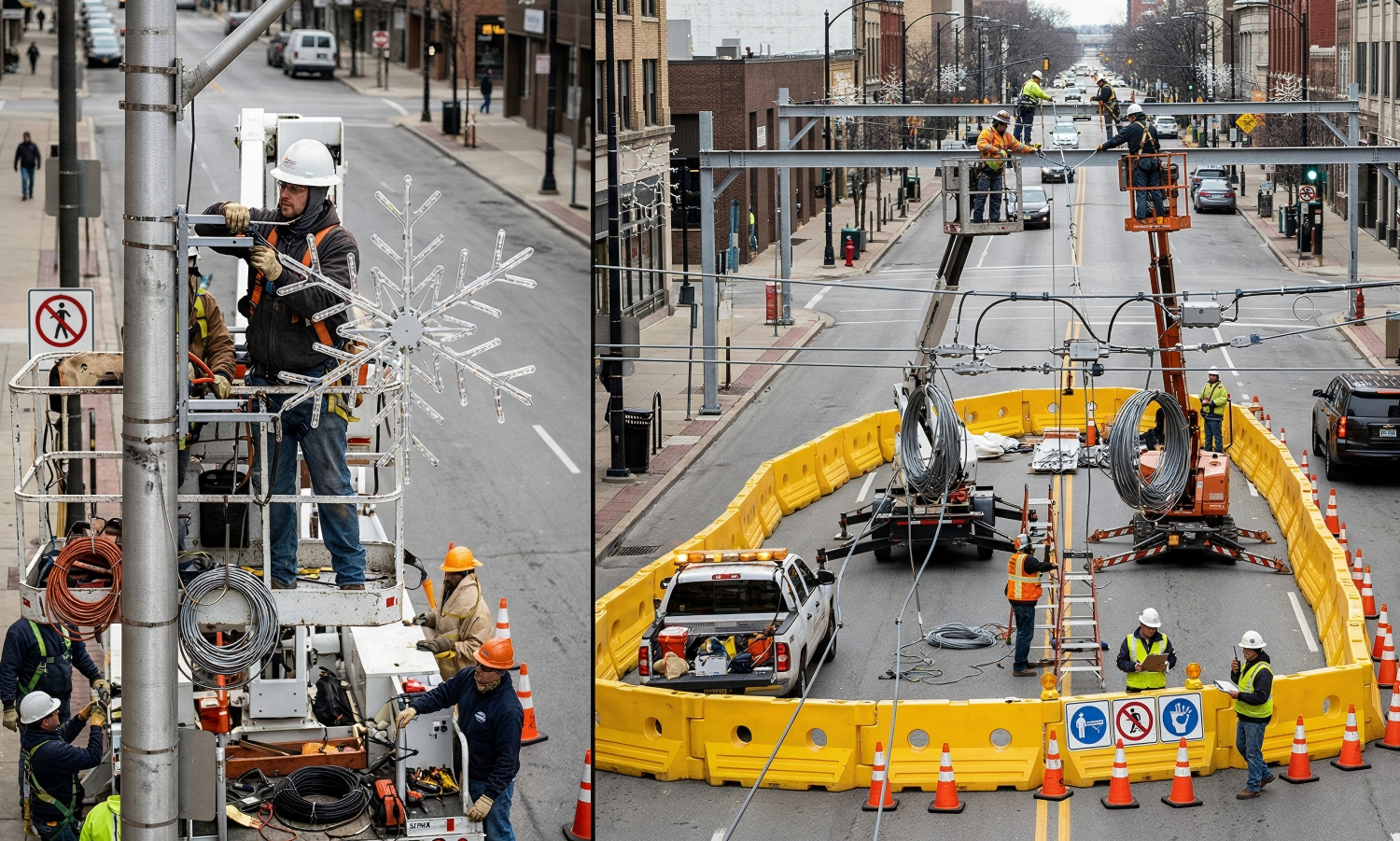
- Is temporary road closure allowed during installation?
- Is the project aiming for orderly visual repetition or for a stronger festive atmosphere in a key district?
Street decoration is not just a product choice. It is a system for expressing a festive identity along an entire road or district. The same holiday element creates very different effects when it is mounted on poles versus when it is suspended above the street, and the implementation logic is also very different.
So the first question should not be which pattern to use. It should be which lighting method fits the road conditions and the project goal more logically.
What Are 2D Pole Motif Lights?
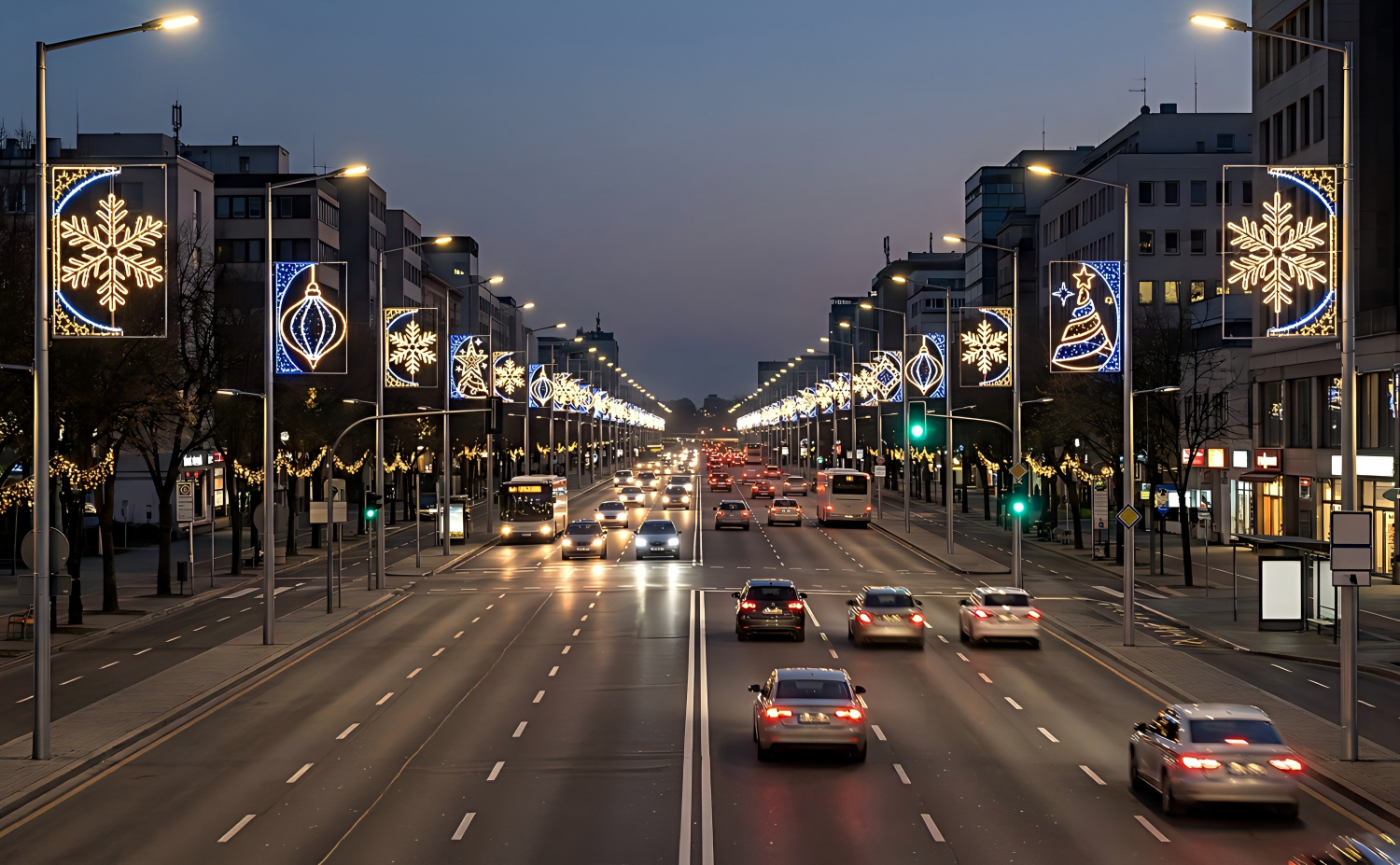
2D pole motif lights are usually mounted on existing lamp posts, decorative poles, or columns. They are commonly designed as flat or slightly dimensional festive shapes and can be repeated continuously along a road, street, or route.
From a project perspective, pole motif lights work like a linear festive identification system. Their advantage is not that one individual piece creates a huge visual shock. Their advantage is that, through one-pole-one-unit repetition, they can quickly give an entire road a unified, orderly, and recognizable festive character.
For projects that need large-scale replication, fast execution, and standardized installation, pole motif lights are usually the more stable choice. If you want to review a product-based example first, you can also see Ornamental 2D Pole Motif Lights for Outdoor Streetscape and Festive Displays.
What Are Cross-Street Holiday Lights?
Cross-street holiday lights are festive lighting structures suspended above a road or pedestrian street, usually connected between two buildings, poles, or specially prepared structural fixing points. Their visual emphasis is not on the sides of the road, but on the overhead space.
From a project perspective, cross-street lighting works more like an overhead festive streetscape system. Its strongest advantage is that it more easily creates the feeling that the entire street has entered a holiday environment. At night in particular, it can create a strong overhead visual impact and a more immersive festive atmosphere.
If a project emphasizes visitor experience, upward visual engagement, photo-taking, and the image of a key commercial or tourism street, cross-street lighting is often more attractive.
The Core Visual Difference Between the Two Solutions
Pole motif lights are better for eye-level repetition and route recognition
Because pole motif lights are installed along both sides of the road, drivers and pedestrians repeatedly see festive elements as they move forward. This makes them especially suitable for creating an orderly, rhythmic, and continuous festive identity. Their key strength is repetition and consistency.
If a road is long, or if the goal is to give an entire street a festive look quickly and clearly, pole motif lights are usually more direct and easier to manage visually.
Cross-street lights are better for overhead atmosphere and key-district impact
The main advantage of cross-street lighting lies in the overhead space. It is much easier to create the feeling of an immersive festive canopy, a holiday avenue, or an entire street wrapped in a seasonal atmosphere. In commercial pedestrian streets, tourism districts, and night-tourism routes, cross-street lighting usually creates a stronger festive atmosphere.
That means pole motif lights function more like a linear identification system, while cross-street lighting functions more like a full overhead festive scene.
Daytime and nighttime performance are also different
In daytime, pole motif lights usually have clearer outlines and stronger visual order, so the festive rhythm of the road is easier to understand. Cross-street lighting depends more on overall structural proportion, material treatment, and overhead composition. If the design is too simple, its daytime presence can feel weaker.
At night, cross-street lighting more easily creates a festive ceiling effect and stronger visual drama overhead, while pole motif lights are better for expressing clean, repeated, rhythm-based road lighting.
Which Roads Are Better Suited to 2D Pole Motif Lights?
In real projects, the following road types are usually better suited to pole motif lights:
- city main roads
- secondary roads
- municipal roads with heavy vehicle traffic
- ordinary branch roads
- residential community roads
- park or campus roads
- bridges, tunnel-adjacent areas, and routes with strict clearance and safety requirements
- busy roads where long-term lane occupation or repeated road closure is not practical
- roads where the goal is lower cost, faster deployment, and large-scale replication
The common feature of these roads is that they prioritize traffic efficiency, order, and standardized construction. In these cases, pole motif lights are easier to install one by one, their logic is clear, their installation speed is high, and their impact on road movement is more controllable.
So if a project emphasizes long-route repetition, unified festive identity over a wide area, fast installation, controllable budget, easier long-term maintenance, and roads that are not suitable for overhead structures, then pole motif lights are usually the better choice.
Which Roads Are Better Suited to Cross-Street Holiday Lights?
The following routes are usually better suited to cross-street lighting:
- commercial pedestrian streets
- tourism districts
- scenic-area main entry avenues
- seasonal markets
- temple fair streets
- core night-economy streets
- landscape roads with moderate width, sufficient clearance, and controllable traffic
- key districts where the goal is to create an immersive festive canopy or holiday avenue effect
- roads where short-term closure is allowed and approval coordination is relatively manageable
The common feature of these roads is that they emphasize experience, visitor dwell time, and festive spatial atmosphere more than pure traffic throughput.
If a project emphasizes upward visual experience, festive overhead enclosure, visitor photography, key district image enhancement, and immersive night atmosphere, then cross-street lighting is usually the more suitable solution.
What Are the Most Common Differences in Approval and Installation?
This is one of the areas buyers most often underestimate. In renderings, both solutions may look like simple lighting installations. But once the project moves into implementation, the approval and construction differences become very clear.
Common issues with pole motif lights
- unclear ownership of the poles, requiring coordination among municipal, landscape, and urban management departments
- existing poles with insufficient load-bearing capacity or poor condition, requiring reinforcement or replacement
- inconvenient cable routing and power access, with some roads not allowing external power lines
So pole motif lights are not free of coordination difficulty. Their main challenge lies in existing infrastructure conditions.
Common issues with cross-street lights
- road width or clearance height not meeting safety regulations, causing direct rejection
- stronger wind-load and structural safety requirements, requiring professional structural calculations and approval drawings
- road-crossing installation that requires lane closure and traffic control, increasing coordination time and complexity
- conflicts with high-voltage lines, communication cables, or other overhead utilities
So it is not that cross-street lighting cannot be used. It is that it is more suitable for mature, high-priority districts where stronger coordination is realistic, rather than for every road by default.
Where Do the Budget Differences Usually Come From?
Many buyers ask which option is more expensive. In practice, they cannot be compared simply by asking which one is more high-end, because their cost focus is completely different.
Cost logic of pole motif lights
The cost of pole motif lights is usually more distributed across:
- individual lighting units
- mounting clamps and accessories
- a large number of points
- standardized batch production
- multi-point simultaneous installation labor
The key characteristic is that the single unit structure is relatively simple, but the total quantity is large. So it behaves like a long-route replication budget.
Cost logic of cross-street lights
The cost of cross-street lighting is usually more concentrated in:
- structural main beams
- tension cables
- foundations and wind-resistance reinforcement
- cranes, traffic control, and road closure
- higher design and acceptance requirements
- construction coordination and approval cost
That means cross-street lighting behaves more like a key-space budget. The total number of units may be lower, but each span is larger, structurally more complex, and usually more expensive per section.
If your team is also reviewing broader street-decor budget planning, you can continue reading How to Budget a Commercial Christmas Decoration Project for a Mall, Park, or City.
Frame Material Also Strongly Affects Cost and Reuse Value
Besides the lighting method itself, frame material is another major factor that affects both budget and long-term reuse value. In real projects, the most common frame material choices are aluminum frames and steel frames.
Aluminum frames: better for long-term repeated use
If the budget is more comfortable, or if the project clearly aims to reuse the same lighting system for many years, aluminum is usually the better choice. Aluminum is less likely to rust, is lighter, and is easier for installation and removal. Over long-term use, it also reduces maintenance pressure.
For long-term municipal lighting programs, mature commercial streets, and festive projects intended for repeated multi-season use, the advantage of aluminum becomes very clear. Although the initial cost is higher, it is often more economical over time.
Steel frames: better for short-term or budget-sensitive projects
Steel frames are relatively more affordable. So for projects with limited budgets, temporary seasonal events, short-term festivals, or cases where tenders are repeated each year and future winning certainty is low, steel frames are often the more practical choice.
If a project is short-term in nature, or if the buyer cares more about controlling this year’s cost rather than building a reusable long-term asset, steel is often the more realistic option.
The key question is not which one is better, but which one matches the project logic
So in street festive lighting projects, aluminum and steel do not represent a simple hierarchy. They represent two different project logics:
- Higher budget, strong reuse goal, long-term stability: aluminum frame is usually more suitable
- Short-term use, budget sensitivity, uncertain project continuity: steel frame is usually more practical
Many buyers look only at single-cycle cost at the beginning, without first deciding whether the project is meant for one season or for repeated use over several years. That is often where later judgment becomes distorted.
Which Option Has Better Maintenance and Reuse Logic?
Pole motif lights are better for standardized removal and multi-route reuse
Pole motif lights usually have an advantage in numbering, disassembly, single-unit replacement, and reuse across multiple routes. Because the logic is one pole to one unit, management and replacement are more direct. This is especially useful when the same lighting system will be reused over different roads in future seasons.
Cross-street lighting creates stronger overall atmosphere, but maintenance coordination is usually more demanding
Cross-street lighting creates stronger visual impact as a whole, but it is generally more suitable as a seasonal installation for key streets. It can also be designed as a reusable system, but the effort required for maintenance, reinstallation, and site coordination is usually higher than with pole motif lights.
Frame material also directly affects reuse performance
If the frame uses aluminum, long-term reuse usually becomes easier because the structure is lighter, less likely to rust, and easier to handle repeatedly. For projects that expect annual installation over many seasons, aluminum is usually more suitable.
If the frame uses steel, it often makes more sense in short-term, budget-control-focused projects. For one-time events, temporary festive programs, or yearly tender-based projects with uncertain continuity, steel frames are often the more realistic choice.
So from a reuse perspective, the real question is not simply which material is better. The real question is: Is this project short-term, or is it intended to become a long-term reusable festive asset?
If your team also needs to confirm specifications before ordering, it is useful to review Commercial Holiday Decoration Procurement Checklist for Project Owners and Contractors.
The 3 Most Common Buyer Misunderstandings
First, many buyers assume that cross-street lighting is always more advanced and always produces a better effect, while ignoring whether the road conditions actually support it.
Second, many buyers think pole motif lights create a weak atmosphere. In reality, when arranged properly, they can create a strong festive rhythm while being safer and more suitable for large-scale replication.
Third, many buyers judge only by attractive renderings and do not consider road width, clearance, traffic intensity, approval difficulty, and construction restrictions. This often leads to a scheme that looks good on paper but cannot actually be implemented.
These misunderstandings usually do not happen because the buyer does not understand the product. They happen because the road conditions and project goals were never clearly defined first.
What Should Buyers Confirm Before Ordering?
- road width
- whether there are existing poles, columns, or buildings suitable for fixing
- whether the route is a vehicle road or a pedestrian street
- whether vehicle traffic or pedestrian flow is stronger
- whether cross-street installation is even allowed
- whether the project emphasizes route-wide consistency or key-zone atmosphere
- whether the system needs to be reused for multiple years
- whether the project is a one-time seasonal event or a long-term repeated program
- whether steel or aluminum frame logic is more suitable
- the available installation window and any night-work restrictions
- whether there are clearance, wind-load, or safety approval requirements
- whether the budget is better spent on full-route replication or on key-district enhancement
- whether the budget is focused more on single-cycle cost control or on long-term reuse value
The earlier these points are confirmed, the less likely the final scheme will drift away from practical reality.
Final Thoughts
There is no absolute hierarchy between 2D pole motif lights and cross-street holiday lights. The first is better suited to creating a unified festive identification system along an entire road, while the second is better suited to building an immersive festive atmosphere in a key street district.
The most important question is not which one looks more attractive in an image, but which one fits the road conditions, project target, and implementation logic more realistically.
If the project emphasizes long-route replication, fast delivery, and standardized management, pole motif lights are usually the more practical choice. If the project emphasizes key-district atmosphere, overhead festive impact, and visitor dwell-time experience, cross-street lighting usually offers more value.
And even within the same solution type, frame material matters. If the budget is stronger and the project clearly aims for long-term reuse, an aluminum frame is often the better choice. If the project is short-term, budget-sensitive, or subject to repeated tender uncertainty, a steel frame is often the more realistic option.
Frequently Asked Questions
What is the biggest difference between pole motif lights and cross-street holiday lights?
The biggest difference is usually the spatial expression. Pole motif lights are better for repeated installation along a route, while cross-street lights are better for creating overhead festive atmosphere and stronger impact in key districts.
Which option is usually better for city main roads?
In many cases, pole motif lights are more suitable because they are easier to standardize, replicate in quantity, and maintain, while causing less disruption to traffic.
Which option is usually better for commercial pedestrian streets?
Commercial pedestrian streets are often better suited to cross-street lights because they create stronger overhead festive atmosphere and a better photo experience for visitors.
Are cross-street holiday lights always more expensive than pole motif lights?
Not necessarily. Their cost focus is different. Pole motif lights are more about distributed point-based quantity cost, while cross-street lights are more about span structure, reinforcement, and coordination cost.
Which option is better for multi-year reuse?
Both can be reused, but pole motif lights usually have an advantage in numbering, disassembly, replacement, and reuse across multiple roads.
How should buyers choose between aluminum frames and steel frames?
If the project has a stronger budget and clearly aims for long-term reuse, aluminum frames are usually more suitable because they are lighter, less likely to rust, and easier to handle repeatedly. If the project is short-term, budget-sensitive, or continuity is uncertain, steel frames are often more practical.