





For large shopping malls and commercial plazas, Christmas decorations are no longer just about making a space look festive. A truly effective mall Christmas display should encourage people to stop, take photos, share the experience, and build a stronger seasonal memory around the venue. In other words, successful Christmas decoration does not only serve visual atmosphere. It also supports foot traffic flow, dwell time, and social sharing during the holiday season.
Many malls make one common mistake when planning Christmas decorations: individual pieces may look attractive on their own, but the overall space lacks one clear logic. The atrium follows one visual style, the entrance follows another, the escalator area and outdoor plaza go in different directions, and the final result feels fragmented. Even with a reasonable budget, the overall impact and shareability may remain weak. A mature mall Christmas decoration plan is not just a collection of products. It is a unified spatial design built around one central theme.
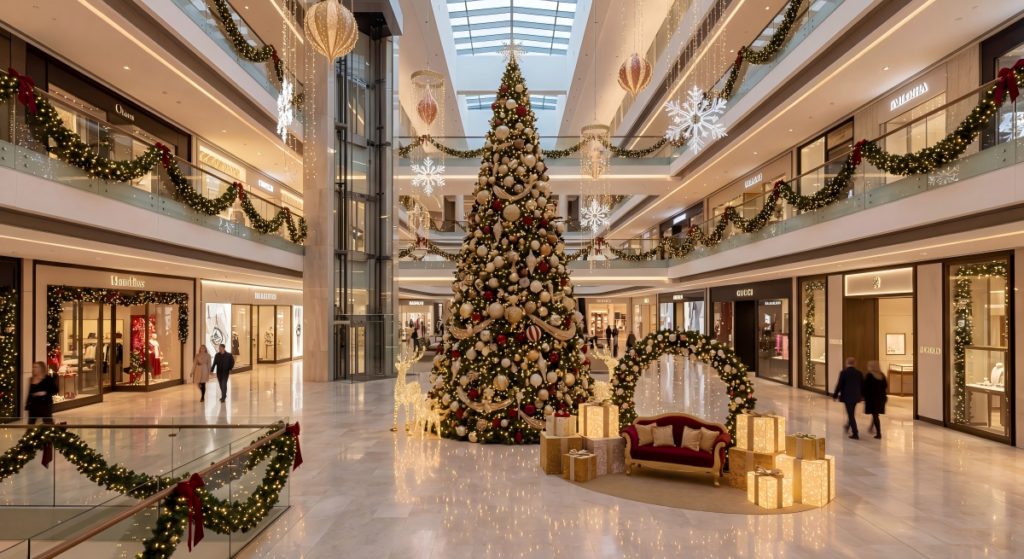
For a large commercial plaza, Christmas decoration should usually begin with the overall theme, then extend into the atrium, main entrance, escalator zones, walkways, dining areas, and outdoor plaza. Once the main visual language is clear, every zone becomes easier to coordinate, and the whole mall becomes more likely to deliver a stronger and more memorable holiday experience.
If you are still defining the right direction for your project, it also helps to read How to Choose Commercial Holiday Decorations for Malls, Parks, and City Projects, because mall decoration ideas work best when the overall project goal is already clear.
Why Mall Christmas Decorations Matter Beyond Visual Appeal
From an operational point of view, mall Christmas decoration is a form of spatial content. Its value is not isolated. It works together with holiday traffic, visitor behavior, event atmosphere, and the emotional experience of the space. A truly effective seasonal display usually turns a visitor from simply passing by into stopping, from stopping into taking photos, and from taking photos into sharing. That sharing, in turn, can amplify the mall’s holiday identity far beyond the physical site itself.
This is one reason why some malls generate much more social buzz than others, even without having the largest budgets. Their displays are not only visually attractive. They usually have a clear visual centerpiece, photo-friendly locations, stronger layering, and a more complete holiday story. For a shopping mall, that makes Christmas decoration more than a seasonal expense. It becomes a practical tool for holiday-space operation.
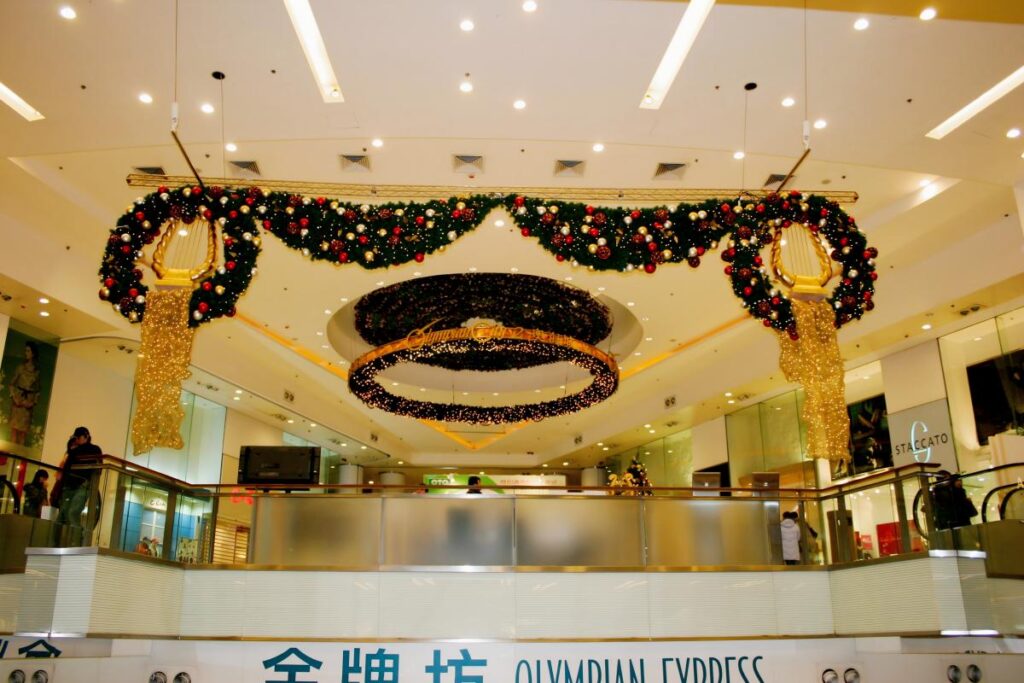
That is why the real question is not simply whether a mall should install a large tree. The better question is how the space can be designed to increase visitor dwell time, photo-taking, and seasonal engagement.
A Unified Theme Is the Starting Point for Large Mall Christmas Decoration
For large commercial plazas, the first step in Christmas decoration planning is not choosing products. It is choosing the theme. That theme becomes the main melody of the whole holiday environment. The visual language, color system, decorative elements, and scene combinations across every zone should all follow it.
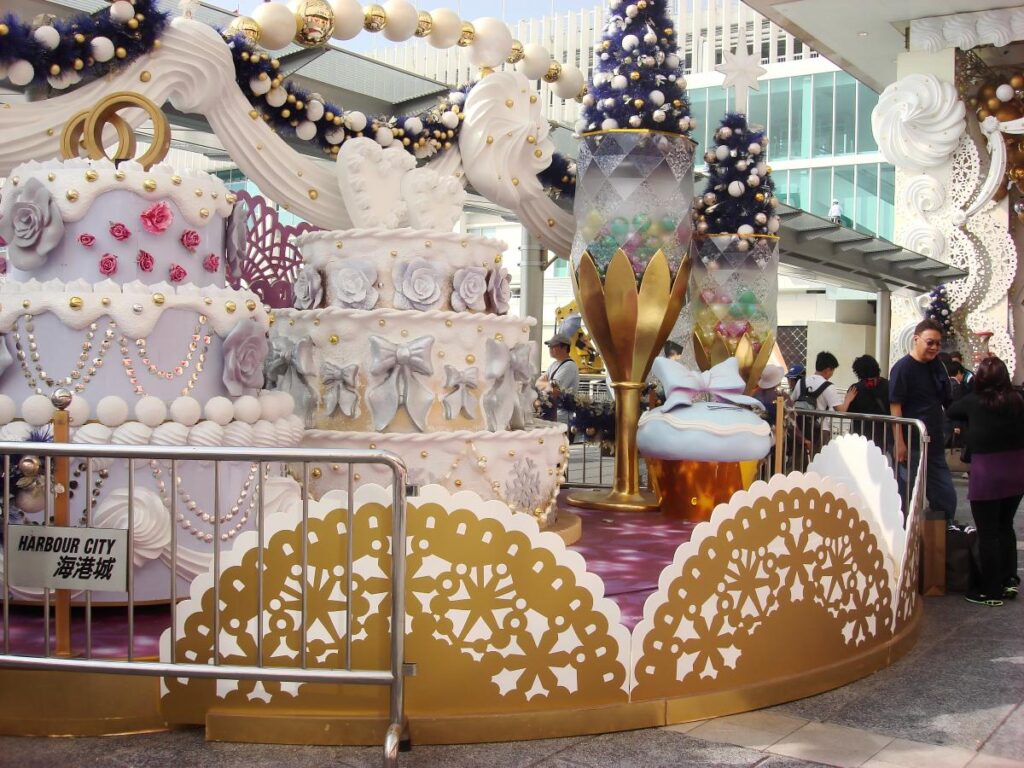
The theme might be a classic red-and-gold Christmas, a dreamy silver-white winter look, a woodland holiday story, a gingerbread-style festive village, a snow-and-ice fantasy, a gift workshop concept, or a more premium and minimal commercial Christmas direction. Once the theme is defined, it becomes much easier to decide what belongs in the atrium, how the entrance should feel, how the walkways should continue the mood, and how the outdoor plaza should create long-distance impact.
Large malls often fail when every area is designed separately and no clear theme connects them. Once the central theme is set, the atrium, entrance, escalator areas, walkways, dining zones, and outdoor plaza can all work together to form a much stronger and more memorable seasonal experience.
What Makes a Mall Christmas Display More Likely to Increase Dwell Time and Photo Sharing
From a visitor-behavior perspective, the displays that most successfully encourage people to stop and take photos usually share several features.
First, they have a clear visual centerpiece. When visitors enter the space, they immediately understand where the main holiday focus is. Without that, the decoration easily becomes background rather than destination.
Second, they provide something that works at close range. Many large decorations look impressive from a distance but are not actually suitable for photo-taking when people stand near them. If people cannot enter the frame comfortably, the social value drops.
Third, the display has layering. A single tall tree may create impact, but photo-friendly spaces usually work better when there is foreground, middle ground, and background, or a combination of primary and secondary visual points.
Fourth, the display works both during the day and at night. Shopping malls are all-day environments. Some visitors take photos in bright daylight, while others respond more strongly to evening lighting. A display that only works in one condition limits its own sharing potential.
Fifth, the design should consider smartphone photography. Most visitors use phones, not professional cameras. That means a display needs to work for vertical framing, group photos, family photos, and close-range portrait-style shots. A huge structure alone is not enough. The composition has to be usable.
In other words, the most shareable mall Christmas displays are not always the biggest ones. They are the ones that understand how visitors enter the space, enter the frame, and interact with the scene.
Best Christmas Decoration Ideas for Shopping Malls
1. A tall centerpiece Christmas tree in the atrium
For most large shopping malls, the atrium is the core of the Christmas display. The most common and usually the most effective solution is still a large Christmas tree. Its value is not only that it immediately signals “Christmas,” but that it naturally functions as a visual centerpiece.
However, an atrium tree is most effective when it is not treated as a single object. Mature mall projects usually combine the main tree with ground-level gift boxes, ornaments, seasonal props, themed set pieces, or interactive photo elements. The upper space of the atrium can also be used for suspended decorations that visually connect with the scene below. This makes the atrium more than just a place to look at a tree. It becomes a complete holiday environment.
If you are evaluating tree options for a mall centerpiece, you can also review a commercial Christmas tree project page together with What Affects the Price of a Large Commercial Christmas Tree? to compare structure, size logic, and display impact more clearly.
2. Walk-through arches and entrance features
The main entrance is where visitors first feel the holiday atmosphere. In many large commercial plazas, the entrance is decorated with garlands, wreath-based structures, and festive arches built around traditional Christmas greenery. The goal is not to make the entrance the most complex zone, but to communicate clearly that people are entering a holiday space.
When entrance decoration is done well, the Christmas experience begins before visitors even fully enter the mall. Arches, welcoming frames, and festive gateway structures are especially effective because they create a natural first photo point while guiding people visually toward the interior holiday focal area.
3. Escalator zones and walkways that extend the atmosphere
Escalator zones and walkways are not always the most dramatic parts of the mall, but in large commercial spaces they are very important because they extend the Christmas atmosphere through movement. Many malls decorate escalator edges, surrounding rails, or nearby columns with garlands, wreaths, and lights so that visitors continue to feel the seasonal mood as they move through the building.
Above walkways, suspended Christmas elements such as ornaments, snowflakes, stars, or gift-themed hanging pieces are often effective because they create vertical layering without obstructing circulation. In most cases, the walkway floor should remain clear of large decoration items so that traffic flow and safety are not compromised. These zones are not meant to compete with the main centerpiece. They are meant to keep the Christmas story continuous.
4. Photo-friendly gift boxes and ornament clusters
Oversized gift boxes and large ornament clusters are highly practical decoration elements in shopping malls because they create accessible photo opportunities without requiring a full large-scale build. They work especially well for family photos, casual phone photos, and social-media moments because they are easy to approach and easy to understand visually.
These types of installations can function as secondary photo points around the main atrium tree or in smaller open areas throughout the mall. They are flexible, relatively friendly in spatial terms, and useful for creating a festive environment that feels active without becoming visually overwhelming.
5. Dining-area decorations that encourage slower, softer engagement
Dining areas operate differently from atriums. Visitors already spend more time there, so the decoration does not need to compete for attention in the same way. Instead, these zones often benefit from softer, more detailed, and more intimate seasonal decoration.
Common solutions include Christmas-themed window graphics on glass, suspended decorative elements above shared areas, and smaller themed display sets centered around mini trees, ornaments, gift props, or subtle winter elements. These spaces are ideal for “stay and photograph” moments rather than large-scale spectacle. They may not drive the biggest traffic flow, but they often create warm and memorable holiday atmosphere around rest, dining, and social interaction.
6. The outdoor plaza as the strongest landmark zone
For a large commercial plaza, the outdoor square is often the biggest visual highlight and one of the most important budget zones. Its function is not only to serve people already inside the mall, but also to attract attention from further away and create a holiday landmark that can be seen before people even enter the venue.
Depending on the site and budget, one of the most common and effective solutions is a giant signature Christmas tree. Around the main tree, malls often add Christmas cabins, gingerbread houses, snowmen, gift props, giant ornaments, and snowflake-themed elements to form a complete ground-level holiday scene. This combination works well because it creates both long-distance visibility and close-range photo value.
From a social-sharing perspective, the outdoor plaza often creates a stronger landmark memory than indoor areas. From a traffic perspective, it works as the public-facing holiday identity of the entire mall.
How to Match Decoration Ideas with Mall Layout
The most important principle in large shopping mall Christmas decoration is not whether one individual zone looks impressive, but whether all zones work together. The atrium, entrance, escalator areas, walkways, dining areas, and outdoor plaza all serve different functions, but they should all serve the same theme.
A stronger planning approach is usually this: the atrium carries the primary visual centerpiece, the entrance creates the welcoming transition, the escalator and walkway zones continue the seasonal feeling, the dining area supports longer and softer dwell-time moments, and the outdoor plaza creates landmark-scale attraction and long-distance identity.
As long as the theme remains unified, these areas do not compete with one another. Instead, they reinforce the same holiday experience from different angles. But if the atrium uses one style, the entrance another, and the outdoor plaza a completely different one, the result may feel busy without becoming memorable. Strong mall Christmas decoration is not about pushing every area separately. It is about making every area support the same main visual rhythm.
How Decoration Design Affects Dwell Time
Whether visitors stop or continue walking is rarely determined by budget alone. It is usually determined by whether the space feels worth staying in. A tall Christmas tree may attract a quick look, but visitors are much more likely to stop when the main tree is supported by nearby elements that are easy to enter, easy to photograph, and easy to enjoy from close distance.
For example, when a large main tree is combined with gift props, snowmen, cabins, and standing photo areas, people are more likely to pause. If suspended decorations and lower-level interactive elements are also added, the entire scene gains depth and immersion. By contrast, a single tall tree without foreground or secondary touchpoints may still look impressive, but it more easily becomes something people glance at and move past.
In simple terms, increasing dwell time is not only about building larger decorations. It is about creating more reasons for people to step into the space.
How to Encourage Photo Sharing Without Disrupting Traffic Flow
In mall decoration planning, one of the biggest concerns is not only how to create photo points, but how to do so without blocking walkways, escalators, or storefronts. The most effective approach is usually not to concentrate all photo value in one single point. A better method is to use one dominant visual centerpiece supported by several secondary photo zones.
For example, the atrium tree acts as the main visual anchor, the entrance arch functions as the first photo point, and gift-box sets or themed decorative clusters act as smaller local photo stops. Suspended decorations in transition zones continue the festive atmosphere without physically interfering with circulation.
Photo zones should also include enough foreground space so that visitors can step back and frame the shot comfortably. A good photo point is not only one that looks attractive. It is one that allows visitors to take pictures without disrupting traffic flow or creating safety and crowd-management issues.
Indoor Material, Lighting, and Safety Considerations for Mall Installations
Shopping malls are indoor public environments, which means decoration planning must consider more than appearance alone. Flame-retardant materials, property-management requirements, installation windows, power access, and on-site working restrictions all matter.
Mall projects often need to be installed during limited night-work periods, and some sites have strict rules on lifting access, floor protection, hanging points, and public-safety clearance. Materials also need to perform well at close range, because visitors will view the display from short distance rather than only from far away.
If procurement planning is still in progress, you can also review Commercial Holiday Decoration Procurement Checklist for Project Owners and Contractors before finalizing the installation scope, especially for site conditions, safety requirements, packaging, and pre-installation expectations.
Budget-Friendly vs Premium Mall Decoration Ideas
If the budget is limited, the safest approach is usually to concentrate resources on one key area, such as a centerpiece atrium tree or an entrance feature with one compact photo zone. This will not cover the entire mall, but it gives the project at least one clear focus rather than a scattered result.
For a mid-range budget, a more common solution is a combination of an atrium tree, an entrance arch or welcome feature, selected gift-box and ornament clusters, and suspended decorations in key walkways. This usually creates a stronger sense of continuity and works well for many large shopping malls.
When the budget is more generous, the decoration strategy can become a full seasonal spatial system: atrium centerpiece tree, hanging decorations above, entrance welcome installation, extended walkway atmosphere, smaller dining-area scene sets, and a landmark outdoor plaza composition. For large commercial plazas, this type of planning creates the strongest shareable identity and often the strongest holiday-season memory.
For early-stage budgeting logic, you can also read How to Budget a Commercial Christmas Decoration Project for a Mall, Park, or City.
Common Mistakes in Mall Christmas Decoration Planning
- Failing to define the theme first, which leads to inconsistent styles across different mall zones
- Using only one large tree without building supporting scenes around it
- Creating displays that work for long-distance viewing only, but not for close-range photography
- Placing too many decoration items on walkway floors and affecting circulation
- Creating lighting that feels visually messy or unclean in photos
- Failing to balance daytime appearance and nighttime appearance
- Spending almost the entire budget on the main tree while neglecting entrances, walkways, and secondary photo points
- Not fully considering property-management rules, flame-retardant standards, installation windows, and practical site limits
Final Thoughts
The real value of Christmas decoration in a shopping mall is not just making the space look festive. It lies in using a stronger visual centerpiece, more thoughtful spatial distribution, better photo opportunities, and a more unified thematic expression to increase dwell time, photo sharing, and seasonal memory.
For large commercial plazas, the most effective method is usually not to pile up decorative products. It is to define a clear theme first, then develop the atrium, entrance, escalator zones, walkways, dining areas, and outdoor plaza around that one main idea. Once the main visual rhythm is clear, the entire mall becomes more likely to create a unified experience and turn seasonal traffic into real spatial value and public visibility.
Frequently Asked Questions
What Christmas decorations work best in shopping malls?
The most effective options usually include a large atrium Christmas tree, entrance arches, oversized gift boxes, ornament clusters, suspended decorations, and a landmark outdoor tree or themed plaza scene.
How do mall Christmas decorations increase dwell time?
Well-planned decorations create clear visual centers, photo-friendly zones, and spaces that visitors can enter, approach, and enjoy from close range. These features make people more likely to stop, stay, and interact with the scene.
What makes a mall Christmas display more photo-friendly?
Displays become more photo-friendly when they have a clear theme, strong layering, enough foreground space, comfortable visitor standing areas, and proportions that work well for smartphone photography in both daytime and nighttime conditions.
Are large Christmas trees enough for mall holiday decoration?
Usually not. A large tree is important, but it works much better when combined with entrance features, suspended decorations, gift-box clusters, and secondary photo points that create a fuller seasonal experience.
What should malls confirm before installing Christmas decorations?
Malls should confirm ceiling height, access routes, power locations, fire-safety requirements, flame-retardant materials, installation windows, property-management rules, and how the display will affect circulation and photo-taking space.