





Before the holiday season begins, shopping malls, parks, scenic areas, hotels, and public spaces all move into preparation mode for seasonal decoration projects. For many buyers and project teams, commercial Christmas decorations are not simply about making a venue look festive. They are part of a broader investment tied to visitor experience, brand image, foot traffic, and the overall value of the space.
In practice, one of the first questions buyers often ask is simple: “How much does a tree cost?” “How much is one light display?” “What is the budget for a full project?” These are reasonable questions, but when budgeting starts and ends with product pricing alone, projects often run into avoidable problems later. Installation may cost more than expected, shipping may become inefficient, the display may not match the original visual goal, or the entire system may be difficult to reuse the following season.
A well-planned commercial Christmas decoration budget should cover much more than the display itself. It usually includes design planning, structural considerations, electrical systems, transportation, installation, maintenance, dismantling, and off-season storage. For large holiday trees, entrance features, street decorations, plaza displays, and photo-focused installations, budgeting is never just about one number. It is about building a workable framework for the whole project.
If you are still defining the right product strategy for your venue, it also helps to read How to Choose Commercial Holiday Decorations for Malls, Parks, and City Projects alongside this guide, so the budgeting logic and decoration planning logic support each other from the start.
Why Budget Planning Matters in Commercial Christmas Projects
In many projects, budgeting is discussed only after the design direction is already taking shape. On the surface, this may seem flexible. Teams look at concepts first and decide later how much to spend. In reality, this approach often increases revision time and makes project execution more difficult.
Commercial Christmas decoration is not a simple retail purchase. It is a project with a defined goal, a real site condition, and multiple operational constraints. Budget directly affects the size of the display, the complexity of the theme, the material level, the lighting density, the packaging method, the transport plan, and the installation schedule. Without a clear budget framework at the beginning, design proposals can easily drift away from practical limits, which leads to cuts, redesigns, substitutions, and weaker final results.
For shopping malls, budget decisions influence centerpiece placement, entrance impact, and customer photo zones. For parks and scenic areas, they affect route length, the number of visual nodes, and seasonal maintenance workload. For city streets and public installations, they influence standardization, safety, and installation efficiency across multiple locations. In every case, budgeting is not there to limit creativity. It is there to make creativity more realistic and more executable.
Define the Goal Before You Define the Budget
One of the most common mistakes in commercial holiday projects is trying to calculate the budget before defining what the project is supposed to achieve. Budget should serve the objective. Without a clear objective, even a detailed cost table becomes little more than a collection of numbers.
Commercial Christmas projects are not all designed for the same purpose. Some are meant to strengthen brand image through a premium seasonal atmosphere. Others aim to increase visitor dwell time through large trees, entrance arches, and photo-friendly focal points. Some public or tourism-oriented spaces use festive lighting to extend evening activity, improve circulation, and create additional consumer value through dining, ticketing, or event participation.
Different goals naturally create different budget priorities. A project that focuses on premium visual identity may allocate more budget to centerpiece quality, refined materials, and decorative detail. A project built around visitor engagement may prioritize entrance impact, social sharing potential, and traffic flow planning. A project designed for reuse across multiple seasons may place greater weight on durability, modular construction, compact packaging, and storage efficiency.
In other words, a bigger budget does not automatically mean a better project. A better budget is one that matches the real purpose of the project.
What Is Usually Included in a Commercial Christmas Decoration Budget
Many first-time buyers assume the budget for a holiday project is mainly the purchase cost of the display items. In reality, the display itself is only one part of the total budget. A practical commercial Christmas decoration budget usually includes the following categories.
1. Design and early planning
Commercial projects usually require more than simply selecting products from a catalog. Layout planning, theme coordination, site dimensions, visitor sightlines, entry relationships, electrical access, and display hierarchy all need to be considered in advance. The clearer the design stage is, the lower the chance of costly revisions later.
2. Main display elements
This is the most visible part of the budget and typically includes large commercial Christmas trees, illuminated arches, gift box features, reindeer displays, snowflake motifs, entrance installations, plaza focal pieces, and photo zones.
One of the most common centerpiece solutions for malls, parks, and public squares is a large commercial Christmas tree. Budget variation in this category usually depends on height, structural method, branch density, lighting level, decoration complexity, installation environment, and the degree of customization required.
3. Lighting and electrical system
The visual success of a commercial Christmas display depends heavily on lighting, but lighting is not simply a matter of adding strings of LEDs. Buyers also need to consider light density, control systems, power supply layout, low-voltage safety, connector protection, waterproof performance, and site-based electrical distribution.
For outdoor projects, electrical planning is especially important. The display does not just need to light up. It needs to run reliably over time, remain safe in public use, and stay manageable if maintenance is required during the season.
4. Structure and safety
For outdoor use, structural safety should never be treated as an optional upgrade. Holiday trees, pole-mounted motifs, arches, sculptures, and walk-through features may all be exposed to wind load, long-term outdoor conditions, and real public interaction.
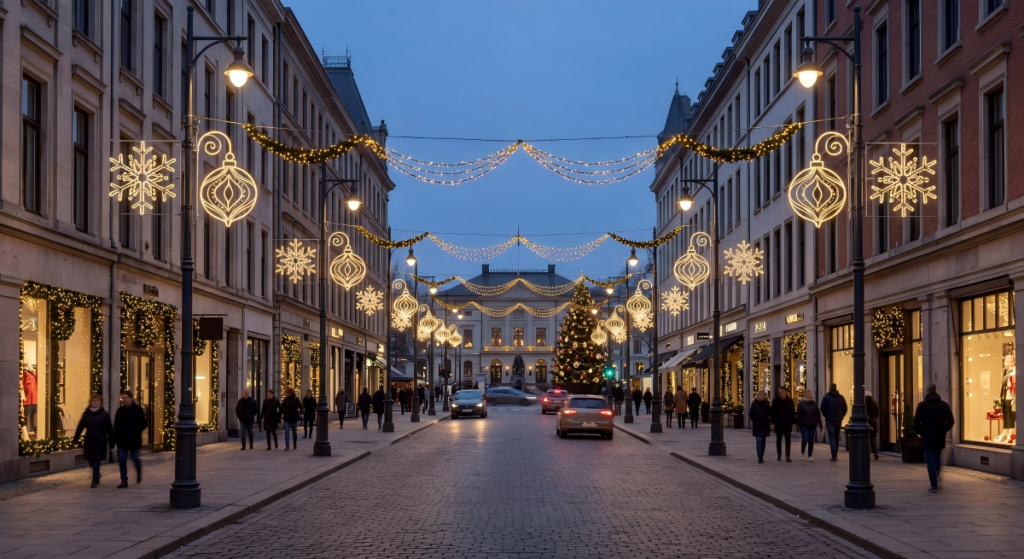
For city streets, shopping districts, and public space programs, pole-mounted elements are a good example of this. Products such as street pole motif lights for festive and urban decoration should be evaluated not only for appearance, but also for bracket strength, attachment method, batch consistency, installation speed, and maintenance convenience.
5. Shipping and packaging
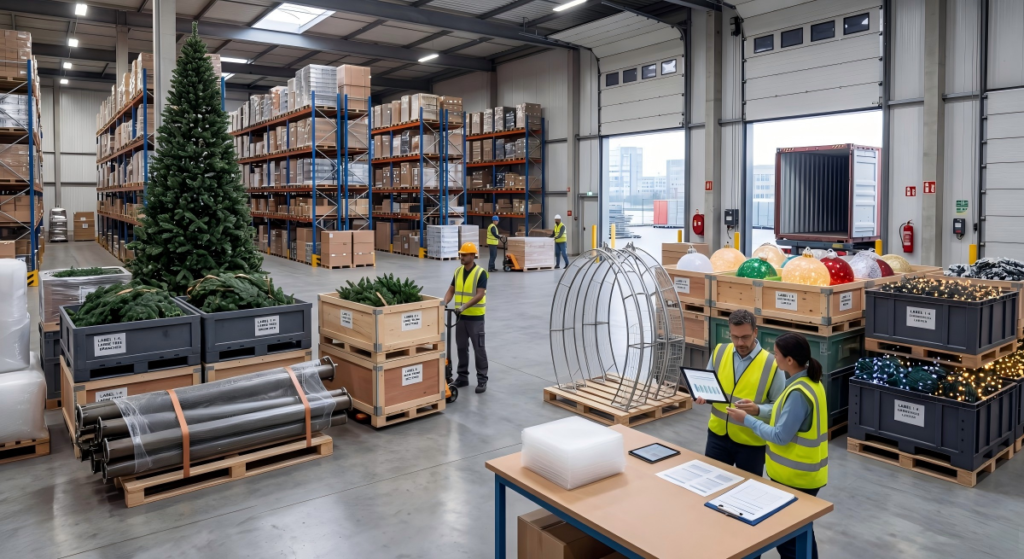
Shipping is one of the most underestimated parts of the budget. Large trees, irregular decorative structures, and oversized seasonal features may create high logistics costs if they cannot be separated efficiently or packed in a compact way.
This is why budget planning should consider not just how a product looks when installed, but how it behaves when packed, transported, and stored. Modular construction, collapsible structures, and efficient packaging logic can change the total project cost significantly. For a deeper look at this issue, see How to Reduce Shipping and Storage Costs for Large Holiday Decorations.
6. Installation and site labor
Large commercial Christmas decoration projects rarely involve simple placement. Installation may include lifting equipment, on-site assembly, cable routing, structural fixing, lighting tests, and schedule coordination around site operations.
Installation cost usually depends on project height, quantity, site complexity, access conditions, point distribution, and available working hours. Mall installations may need to avoid business peaks. Street projects may require night work. Parks and scenic venues may involve long routes or uneven terrain. If these conditions are not budgeted early, overruns are very likely.
7. Seasonal maintenance
A holiday project does not end once the lights are turned on. As long as the display remains active on site, maintenance may be needed. Typical maintenance issues include light failure, loose connections, weather-related checks, power troubleshooting, and replacement of small components.
For short-term events, maintenance budgets may remain limited. For longer-running public displays, however, maintenance should be considered part of the normal operating cost.
8. Dismantling and off-season storage
Many buyers focus on buying and installing, but forget to budget for dismantling and storage. Over the long term, these stages strongly influence reuse efficiency.
If a display is difficult to dismantle, hard to sort, or inefficient to repack, the next season will require more labor, more time, and often more money. By contrast, a modular and well-organized system makes repeat installation much more practical over multiple years.
Why Budget Priorities Change by Project Type
Shopping malls: focal impact and photo value matter more
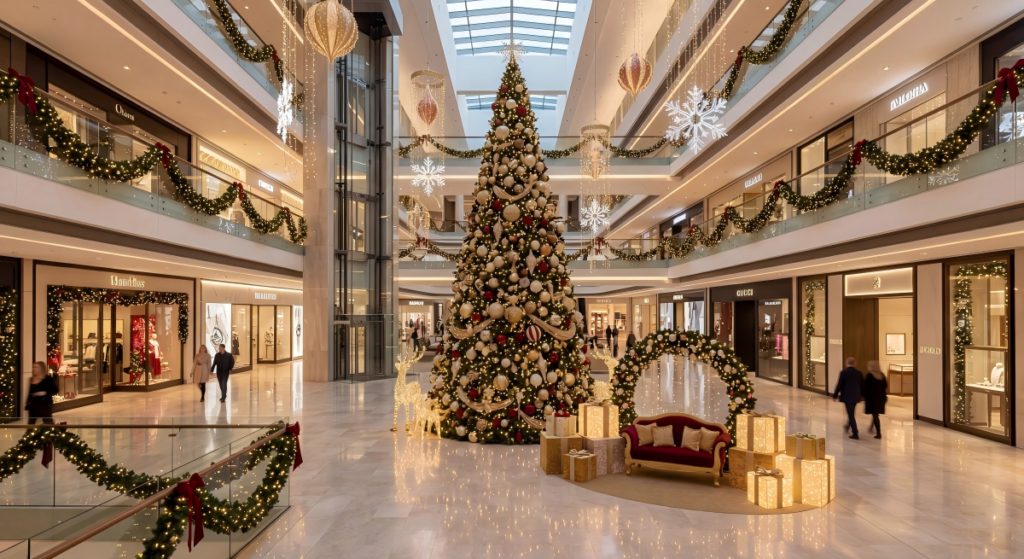
Mall projects usually concentrate budget around centerpiece displays. Main trees, entrance features, escalator-adjacent decoration, photo spots, and seasonal gift-box compositions often carry the strongest visual responsibility. Malls generally need decoration that is not only attractive, but also memorable and shareable.
As a result, mall budgets often focus more on centerpiece quality, decorative detail, and visual hierarchy than on simply covering a large area with volume.
Parks and scenic areas: route experience and durability matter more
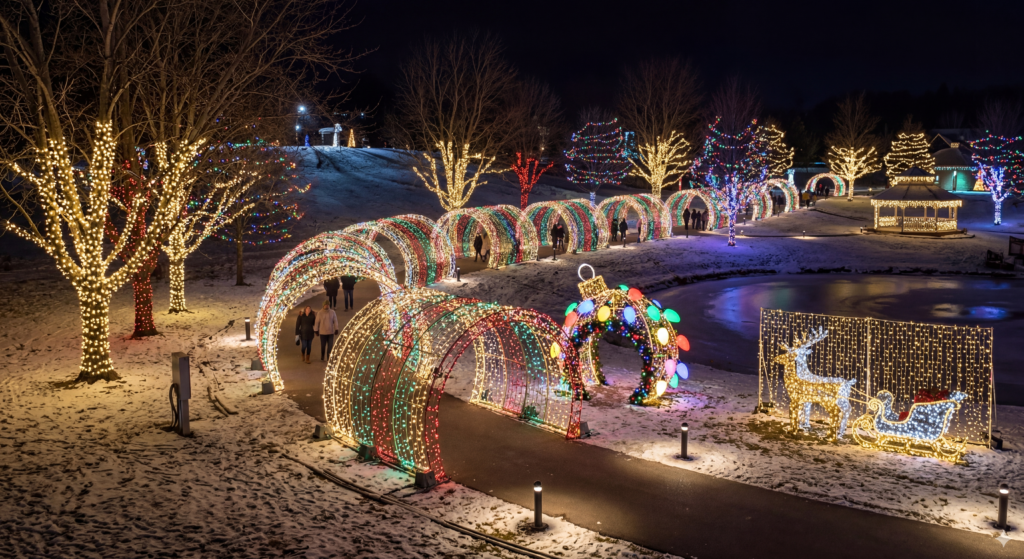
Parks, outdoor attractions, and tourism-oriented venues often work as multi-node journeys rather than single-point displays. Budget is commonly spread across entrances, route segments, plaza moments, transition areas, and key photo locations.
Because these projects often stay outdoors for longer periods and face higher public interaction, durability, maintenance access, and operational efficiency become central budget concerns.
City streets and public spaces: standardization and installation efficiency matter more
Municipal and street-based holiday programs often include repeated installations across multiple roads, poles, blocks, or public nodes. In these cases, budget logic is shaped by repeatability, consistency, fitting speed, and public safety compliance.
That means the cost of a single element is only part of the picture. Installation method, attachment hardware, standardized dimensions, and site efficiency often matter just as much.
Hotels and resorts: atmosphere and brand alignment matter more
Hotel projects often value refinement over quantity. Entrance zones, lobbies, reception areas, and key welcome spaces usually receive the most attention. These venues do not always need the largest displays, but they often need cohesive seasonal styling that supports the venue’s identity.
Why Buyers Should Look Beyond Purchase Price
For commercial Christmas decoration projects, first purchase price is only the surface number. The more important question is the total cost of ownership.
Total cost of ownership includes the full lifecycle of the display: purchase, transport, installation, operation, maintenance, dismantling, and storage. A lower initial price may look attractive, but if the structure is inefficient to ship, difficult to install, expensive to maintain, or hard to reuse, the true cost over multiple seasons may be much higher than expected.
This is especially important for large outdoor trees and structural holiday features. Modular assembly, durable materials, compact packing, and maintainable lighting systems may increase the first investment slightly, but often create better long-term value across several seasons.
How to Build a Practical Budget Framework
For buyers without extensive project experience, the most useful approach is not to chase perfect numbers at the beginning. It is better to build a budget framework that is practical and adjustable.
Step 1: Set a realistic budget range
Even a rough range helps define the scale of the concept and makes design proposals more grounded. A useful starting point is to identify whether the project is basic, standard, or centerpiece-driven.
Step 2: Define the must-have focal points
A main tree, an entrance feature, a signature photo area, or a highlighted route segment can often determine the success of the whole visual plan. These focal points should be prioritized before supporting decoration is expanded.
Step 3: Separate core visuals from optional additions
Budget control becomes easier when the project distinguishes between essential display components and optional decorative upgrades. This helps teams avoid treating every element as equally important.
Step 4: Reserve budget for freight, installation, and storage
These categories are not always the most visible, but they are among the easiest to underestimate. In large seasonal projects, they should never be treated as afterthoughts.
Step 5: Plan for reuse from the beginning
If the display is expected to return for future seasons, decisions about structure, packing, labeling, and dismantling should be made at the beginning, not at the end.
Common Budget Mistakes in Commercial Christmas Projects
- Focusing only on product price instead of total project cost.
- Ignoring site installation complexity and labor conditions.
- Underestimating the impact of shipping volume and packaging.
- Choosing display sizes before proper site planning is complete.
- Skipping maintenance and off-season storage planning.
- Over-customizing without a clear return objective.
When Custom Design Makes Sense and When Standard Solutions Work Better
Customization is not automatically better than standard products. The right decision depends on the real project context.
If a venue has a distinctive architectural entrance, a strong branded theme, or a landmark public identity, custom design may create more value because it can integrate more naturally with the site and produce a more memorable result.
However, if the schedule is tight, the budget is clearly defined, the number of installation points is large, or repeat-use efficiency matters most, standard or semi-custom solutions are often the more practical choice. In many successful projects, the best balance comes from using standard elements for cost and timing control, then adding customization only at the most visible key points.
What Buyers Should Prepare Before Requesting a Quote
To receive a budget estimate that is closer to real project conditions, buyers should prepare a few key pieces of information in advance:
- The project type, such as mall, park, city street, hotel, or scenic venue
- The approximate size of the site or the dimensions of key zones
- Whether the display is for indoor or outdoor use
- The preferred holiday theme or visual style
- The number of main focal points required
- The expected duration of use
- Whether the system is intended for reuse in future seasons
- The approximate budget range
- The preferred completion or installation timeline
- Whether custom design support is required
Final Thoughts
Budgeting a commercial Christmas decoration project is not simply a matter of comparing prices. It is a decision-making process that balances visual goals, venue type, safety requirements, shipping efficiency, installation practicality, and long-term value.
Whether the project is for a mall, park, scenic route, hotel, or city street, the earlier a clear budget structure is established, the smoother the design, purchasing, and implementation process becomes. For buyers who want holiday decoration to function as a meaningful seasonal investment rather than a short-term expense, budget planning is not a side task. It is the starting point of a successful project.
Frequently Asked Questions
What is usually included in a commercial Christmas decoration budget?
A commercial Christmas decoration budget often includes design planning, main display elements, lighting and electrical systems, structure and safety, shipping and packaging, installation labor, seasonal maintenance, dismantling, and off-season storage.
How much should a mall or park budget for Christmas decorations?
There is no single fixed number for every venue. The budget depends on project scale, decoration density, site conditions, customization level, installation complexity, and whether the display is intended for multi-season reuse.
Why do shipping costs become so high in large holiday decoration projects?
Shipping costs increase quickly when products are oversized, inefficiently packed, or difficult to break into compact modules. Large-volume decorative structures often create logistics costs that are easy to underestimate during early planning.
Is it better to choose custom decorations or standard models?
That depends on the project goal. Custom design makes more sense for landmark spaces, branding-focused environments, and special architectural conditions. Standard or semi-custom models are often more practical when timing, cost control, and installation efficiency are the main priorities.
How can buyers reduce long-term holiday decoration costs?
Long-term cost is usually reduced by choosing durable materials, modular structures, efficient packaging, easier installation methods, practical maintenance access, and storage-friendly designs that improve repeat use over multiple seasons.
。