





A commercial Christmas tree is often evaluated by its overall height, lighting effects, and decorative style. However, one of the most important yet frequently overlooked factors is branch quality. In large outdoor holiday installations, branch structure affects fullness, visual realism, storage performance, flame resistance, color stability, and long-term maintenance. For buyers, contractors, and planners working on malls, parks, plazas, hotels, and public displays, knowing how to identify quality branches is essential before choosing a tree system.
This article explains how to distinguish low-quality branches from high-quality simulated branches on a commercial Christmas tree. Rather than focusing on branding or sales language, the goal is to provide a practical comparison based on material type, branch density, leaf dimensions, appearance, odor, safety characteristics, and outdoor durability.
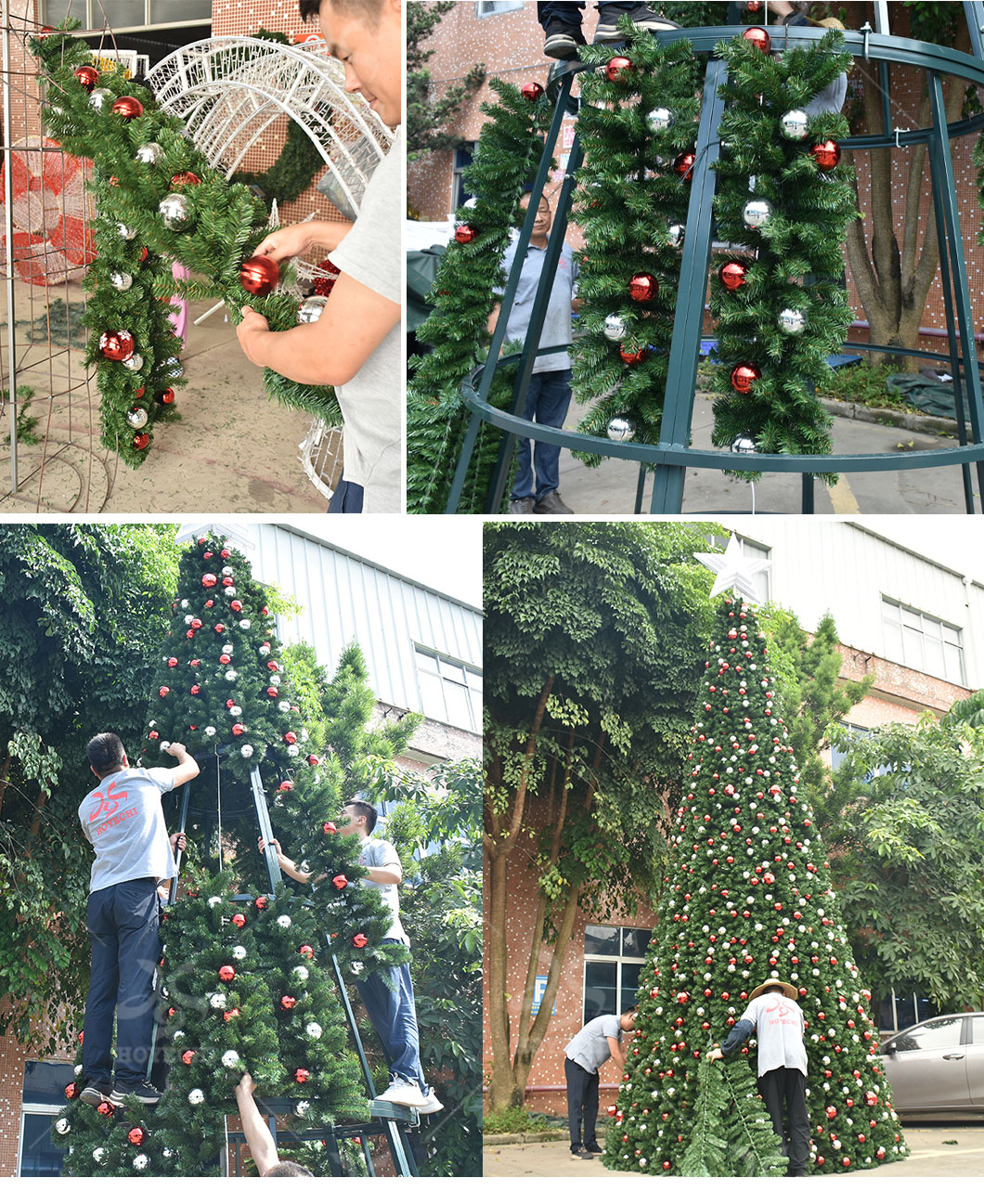
Why Branch Quality Matters in a Commercial Christmas Tree
In a large holiday tree, branches do much more than fill empty space. They shape the silhouette of the tree, support ornaments, influence how lighting is perceived, and determine whether the structure looks natural or artificial during daytime viewing. On large-scale installations, weak branches can make even a tall tree appear thin, flat, or poorly proportioned. By contrast, dense and well-formed branches help create stronger volume, cleaner layering, and a more stable decorative surface.
Branch quality also affects practical issues beyond appearance. Trees used in commercial settings are often assembled, dismantled, packed, stored, and reinstalled over multiple seasons. If the branch material is too soft, too thin, or made from unstable raw material, it may curl, fade, deform, or lose surface quality after storage or short-term outdoor exposure. This can increase maintenance costs and reduce the usable lifespan of the tree.
Common Problems Found in Low-Quality Christmas Tree Branches
Low-quality branches are often made from recycled PVC. At first glance, they may seem acceptable, but the differences become clear after unfolding, handling, and short-term outdoor use. A typical low-grade branch may have a total length of 1 meter but only around 90 leaves, with leaf length around 14 cm and an opposite spread of about 28 cm. Although the leaf strips may exceed 2 cm in length, the overall density is usually limited, making the branch look sparse after assembly.
Material softness is another clear issue. Recycled PVC branches are more likely to bend or curl after storage, especially when packed tightly for extended periods. The leaves may not spring back into shape easily, which affects the fullness of the finished tree. Color is often darker and less vivid, creating a duller daytime appearance. In some cases, the material may have a noticeable odor, and surface instability can lead to color transfer or irritation during handling.
Outdoor performance is usually where these differences become most obvious. Low-quality recycled material may not be flame retardant, may have no traceable certification, and may fade quickly under sunlight. In some cases, visible color fading can begin after around 10 days of exposure. If the raw material comes from unverified low-end supply chains, consistency is also harder to control from batch to batch.
What Defines a High-Quality Simulated Christmas Tree Branch
High-quality simulated branches are usually made from virgin PVC rather than recycled material. A branch of the same total length, such as 1 meter, may contain around 110 leaves, with leaf length around 18 cm and an opposite spread closer to 36 cm. Leaf strip length above 2.8 cm helps create a denser and more dimensional surface, which improves the visual fullness of the entire tree.
One of the main advantages of higher-grade material is shape retention. Better branches tend to remain straighter after unpacking, with clearer layering and less curling. This helps the tree look fuller and more organized with less manual reshaping during installation. The color is typically brighter and more natural, making the tree more attractive in daylight before the lights are even turned on.
High-quality branches also perform better in storage and seasonal reuse. They usually have less noticeable odor, better oxidation resistance, and basic UV resistance suitable for controlled outdoor use. Flame-retardant performance is also an important distinguishing factor, especially for projects in public or commercial environments. When the raw material comes from more established suppliers, consistency and documentation are easier to verify.
Side-by-Side Comparison of Low-Quality and High-Quality Branches
The difference between low-quality and high-quality branches can be summarized across several technical and visual points.
- Raw material: low-quality branches often use recycled PVC, while high-quality branches typically use virgin PVC.
- Leaf quantity per 1 m branch: around 90 leaves on low-grade branches versus around 110 leaves on better branches.
- Leaf length: around 14 cm on low-grade branches versus around 18 cm on better branches.
- Opposite spread: approximately 28 cm on low-grade branches versus approximately 36 cm on better branches.
- Shape retention: lower-grade material tends to be softer and easier to curl, while better material stays straighter.
- Color: low-grade branches often appear darker and duller, while high-grade branches tend to look brighter and more natural.
- Odor: recycled material may carry stronger odor, while higher-grade material usually has little or no obvious smell.
- Flame resistance: low-grade branches may lack flame-retardant performance, while better branches are more likely to meet that requirement.
- Outdoor stability: low-grade branches can fade quickly in sunlight, while better branches have stronger oxidation resistance and weak UV resistance.
- Certification and traceability: low-grade branches may have no clear documentation, while higher-grade material is more likely to come with certifiable sourcing.
How Branch Density Changes the Visual Effect of a Large Christmas Tree
For a large tree, branch density directly affects how much of the internal structure remains visible. Sparse branches expose the frame too easily, especially during daylight, which reduces the visual realism of the installation. This becomes more noticeable on taller trees where the eye expects even coverage from lower sections to upper layers.
Higher-density branches improve surface coverage and help ornaments sit more naturally. They also create better light diffusion around decorative elements, because the branches provide background texture rather than leaving empty gaps. For a commercial Christmas tree for malls and parks, this matters because the tree must maintain a balanced appearance both at close range and from a long viewing distance.
Branch density is also closely linked to daytime performance. Many outdoor holiday trees are judged before sunset, when visitors, operators, and clients can clearly see material quality. A tree that looks dense and natural in daylight usually creates a stronger overall impression than one that depends only on lighting effects at night.
How to Inspect Branch Quality Before Ordering
When evaluating a large tree, buyers should not rely only on overall dimensions or total light count. Branch quality should be checked as a separate point during sampling, specification review, or production discussion.
A practical inspection process can include the following questions:
- Is the branch made from recycled PVC or virgin PVC?
- How many leaves are included per standard branch length?
- What is the leaf length and unfolded spread?
- Do the leaves remain straight after unpacking, or do they curl easily?
- Is there any strong odor from the branch material?
- Does the surface show signs of unstable color or easy staining?
- Is the material flame retardant?
- Is there any information on oxidation resistance or outdoor exposure performance?
- Are raw material source and certifications traceable?
These questions are especially useful when comparing several suppliers or when reviewing samples that appear similar in photos but perform differently in actual handling.
Why Branch Material Affects Long-Term Maintenance
In commercial and municipal projects, the maintenance burden of a tree is often underestimated during the purchasing stage. Lower-grade branches may appear to reduce initial cost, but they can increase labor and replacement requirements later. Soft branches may require more reshaping during installation. Faded or curled branches can reduce the value of the overall display. Weak material may also shorten the period during which the tree remains visually acceptable.
By contrast, stable and better-formed branches generally reduce setup correction, improve repeat-use performance, and maintain a more consistent appearance over time. For projects that also involve dynamic lighting systems such as a DMX programmable outdoor Christmas tree, surface quality still matters because lighting cannot fully compensate for poor daytime branch appearance or uneven branch volume.
Branch Quality and the Relationship Between Structure and Decoration
Branches also function as a support layer for ornaments, ribbons, baubles, garlands, and secondary lighting accessories. If the branch material is too soft or too sparse, decorative elements may not sit evenly, and the final tree can look irregular even when the frame is well made. A dense and stable branch system helps maintain visual rhythm from the lower skirt to the top section of the tree.
This is also relevant when comparing fully branched trees with more structural lighting forms such as a Christmas tree motif light. The two types serve different visual purposes, but in a traditional branched commercial tree, branch quality remains a defining feature of realism and daytime texture.
Conclusion
To evaluate a commercial Christmas tree properly, buyers should look beyond tree height, frame size, or lighting quantity. Branch quality is one of the clearest indicators of long-term visual performance. Material type, leaf quantity, leaf length, unfolded spread, color stability, odor, flame resistance, and storage recovery all influence whether a large tree will continue to look full, clean, and structurally convincing over time.
In practical terms, low-quality recycled branches are more likely to be soft, dull, unstable, and prone to fading or curling, while higher-quality virgin PVC branches tend to offer better density, straighter form, stronger color, lower odor, better safety characteristics, and more reliable seasonal reuse. For anyone selecting a large outdoor tree for public or commercial use, branch inspection should be treated as a core evaluation standard rather than a minor detail.
FAQ
1. What is the difference between low-quality and high-quality Christmas tree branches?
Low-quality branches are commonly made from recycled PVC and may have fewer leaves, shorter leaf length, darker color, stronger odor, weaker shape retention, and faster fading under sunlight. High-quality branches are more often made from virgin PVC and usually provide better density, straighter form, brighter color, lower odor, and improved flame resistance.
2. Why does branch density matter on a commercial Christmas tree?
Branch density affects fullness, frame coverage, ornament support, and the daytime realism of the tree. Sparse branches can expose the internal structure too easily, while denser branches help create better volume and a more balanced overall appearance.
3. Are PVC Christmas tree branches suitable for outdoor use?
PVC branches can be suitable for outdoor use when the material quality is stable and the product is designed for seasonal exposure. However, not all PVC performs the same way. Recycled low-grade material may fade, curl, or smell more easily, while better-grade material generally offers stronger oxidation resistance and more stable performance.
4. How can buyers inspect branch quality before ordering a large Christmas tree?
Buyers can inspect the raw material type, leaf quantity, leaf length, branch spread, straightness after unpacking, odor, color stability, flame-retardant properties, and any available certification or sourcing documents. Physical samples are especially useful when comparing suppliers.
5. Why do some artificial branches fade, curl, or smell bad over time?
These issues are often related to unstable raw material, especially lower-grade recycled PVC. Poor material quality can lead to weak shape retention, faster oxidation, strong odor, color transfer, and visible fading after short-term exposure to sunlight or storage pressure.