




Al evaluar un árbol de Navidad comercial, Muchos compradores se fijan primero en los efectos luminosos, la densidad de las ramas, el estilo decorativo y el impacto visual general. Sin embargo, la parte que realmente determina si un árbol de gran tamaño es estable, duradero, seguro y adecuado para su uso a largo plazo en exteriores es la estructura interna del armazón.
Para centros comerciales, plazas, parques, hoteles, espacios municipales y eventos festivos temáticos, un gran árbol de Navidad comercial no es sólo una decoración de temporada. También es una estructura de ingeniería que debe equilibrar fuerza, resistencia al viento, durabilidad a la intemperie, eficiencia de instalación y valor de reutilización a largo plazo. Cuanto más alto es el árbol, más importante es la estructura principal. Especialmente en árboles de más de 10 metros, una mala selección de materiales puede provocar sacudidas, deformaciones, óxido, dificultad de instalación, mantenimiento frecuente o incluso riesgos para la seguridad.
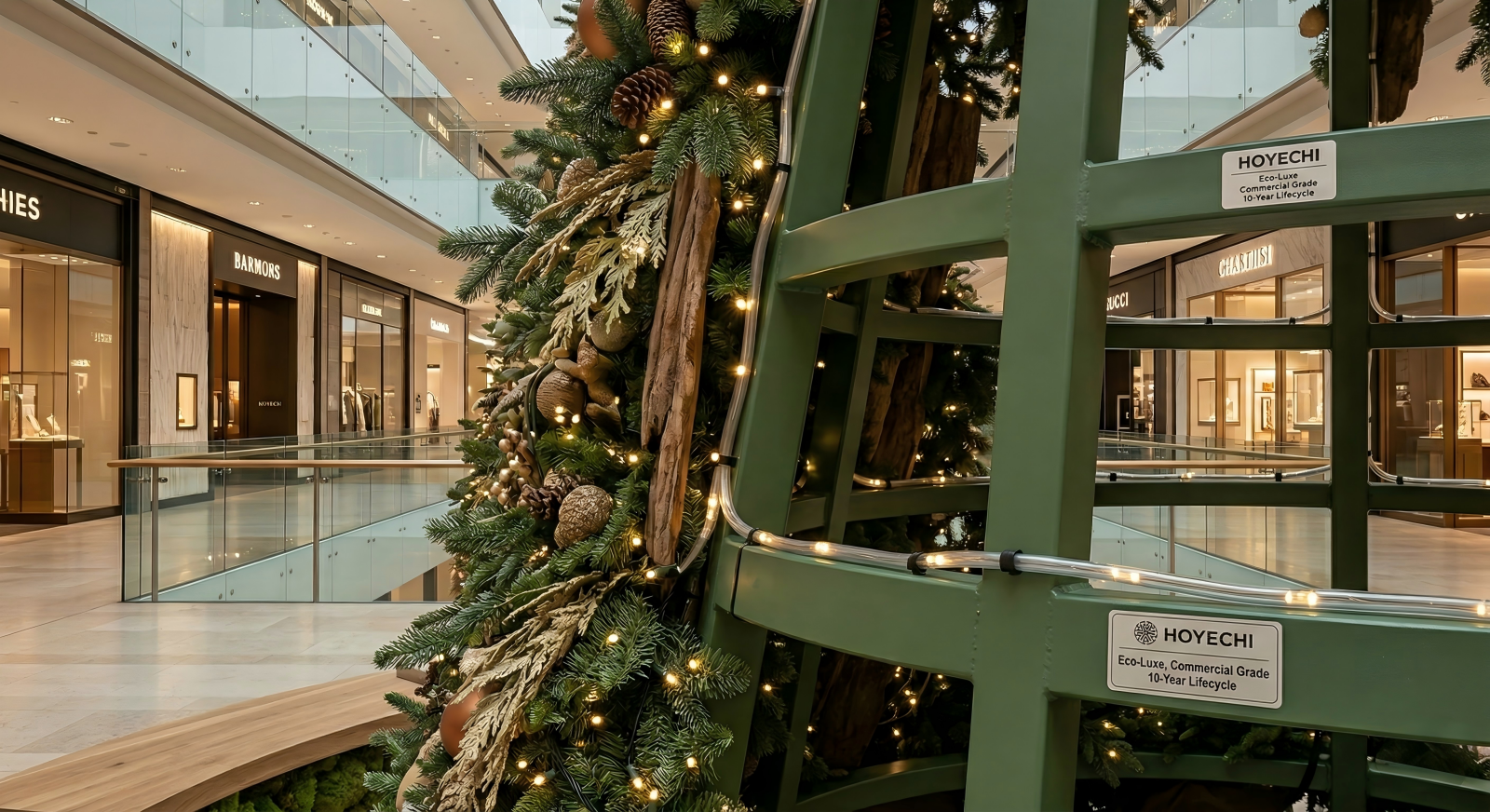
Por eso, a la hora de elegir un árbol de Navidad comercial, es importante mirar más allá de la apariencia y los detalles decorativos. El material del bastidor principal, el tratamiento de las superficies, la calidad de las soldaduras, el método de conexión y el diseño estructural general merecen especial atención.
Por qué es importante el material del armazón principal en un árbol de Navidad comercial
El efecto exterior de un gran árbol de Navidad lo crean las ramas, las luces, los adornos y los acabados decorativos. Pero la parte que realmente soporta el peso, mantiene la forma, resiste el ambiente exterior y mantiene estable la estructura es el sistema de armazón interno.
Un marco bien diseñado debe ser capaz de:
- Soportan el peso total del cuerpo del árbol, las ramas, las luces y los adornos
- Soporta el viento exterior, la luz solar, la humedad y los cambios de temperatura
- Facilitan la instalación, el desmontaje, el transporte y la reutilización
- Reduce el riesgo de oxidación, deformación y problemas de mantenimiento a largo plazo
- Mantener la estabilidad en entornos comerciales públicos
En otras palabras, para un gran árbol de Navidad comercial, El marco no es un detalle oculto que pueda pasarse por alto. Es uno de los factores clave que afectan tanto al rendimiento de la instalación como a la seguridad a largo plazo.
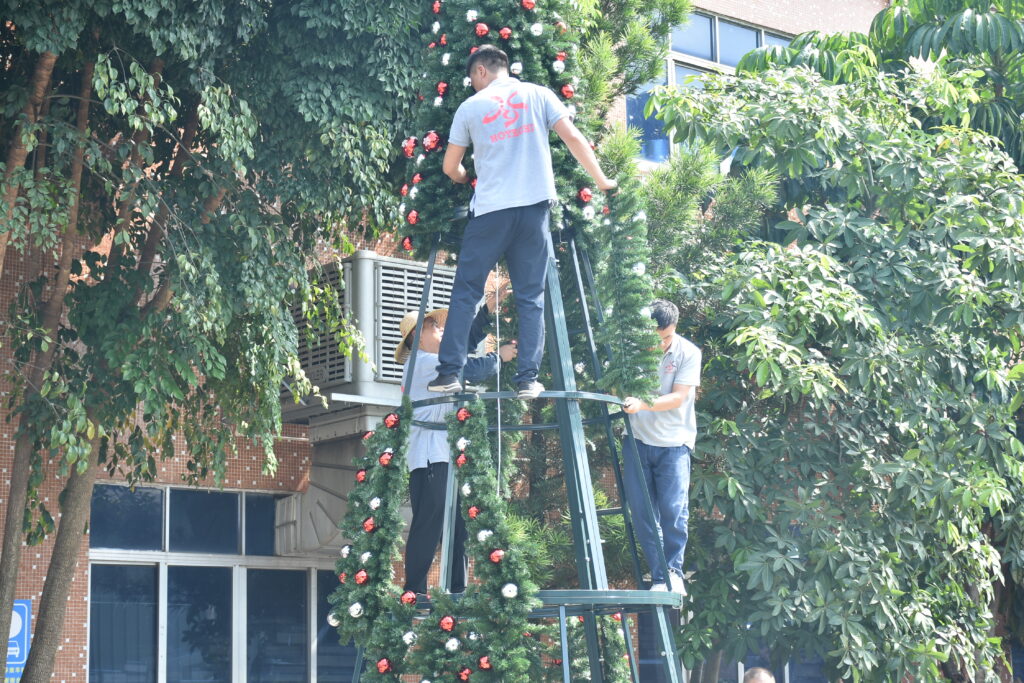
Materiales comunes de la estructura principal de los grandes árboles de Navidad comerciales
En la práctica, la estructura principal de un árbol de Navidad comercial suele construirse con varios materiales metálicos comunes. Cada opción tiene características diferentes en cuanto a resistencia, peso, resistencia a la corrosión, dificultad de procesamiento y coste.
1. Tubo cuadrado galvanizado o tubo redondo: La opción más común
Para grandes árbol de Navidad comercial proyectos, el material de armazón más utilizado suele ser tubo cuadrado galvanizado o tubo redondo galvanizado. Normalmente se basa en Acero bajo en carbono Q235 galvanizado en caliente, Los tamaños de 30×30 mm, 40×40 mm y 50×50 mm se utilizan a menudo en aplicaciones estructurales.
Este material es muy utilizado porque ofrece un buen equilibrio entre solidez, resistencia a la corrosión, soldabilidad, facilidad de fabricación y coste. Para la mayoría de los árboles de gran tamaño de exterior, el acero galvanizado en caliente puede satisfacer tanto los requisitos estructurales como los de resistencia a la intemperie.
Entre sus ventajas más comunes figuran:
- Gran resistencia estructural para árboles grandes y de gran tamaño
- Fuerte protección contra la oxidación tras el galvanizado en caliente
- Facilidad de corte, soldadura y montaje
- Coste global razonable para proyectos comerciales
- Más adecuado para un uso prolongado en exteriores
Su principal limitación es el peso. En árboles extra altos de más de 20 metros, el peso propio del acero se vuelve más significativo, por lo que la carga de los cimientos, los métodos de elevación, la segmentación modular y la eficiencia de la instalación también deben considerarse cuidadosamente.
2. Ángulo de acero galvanizado en caliente y acero plano: Común para soporte auxiliar
Además de los tubos, ángulo de acero galvanizado en caliente y acero plano galvanizado también se utilizan habitualmente en grandes árbol de Navidad comercial estructuras. Estos materiales se aplican a menudo en piezas estructurales auxiliares como:
- Anillos circulares en capas
- Arriostramiento diagonal
- Placas de conexión
- Miembros tensores
- Componentes de refuerzo local
La ventaja de estos materiales es que ofrecen buena rigidez, flexibilidad de corte y perforación y un coste relativamente económico. En muchos proyectos, no soportan solos toda la carga, sino que colaboran con tubos cuadrados y redondos para mejorar la estabilidad general del bastidor.
3. Aleación de aluminio: Adecuado para algunos proyectos ligeros o de montaje frecuente
Otra opción utilizada en algunos árbol de Navidad comercial proyectos es Aleación de aluminio 6061 o 6063. Comparado con el acero, el aluminio es más ligero y más resistente a la corrosión, lo que puede facilitar el transporte y la instalación.
Las principales ventajas del aluminio son:
- Peso más ligero para facilitar su manejo y transporte
- Mayor resistencia a la corrosión natural
- Apto para montaje y desmontaje repetidos
- Útil en proyectos en los que es importante reducir el peso estructural
Sin embargo, el aluminio no siempre es la mejor opción para cada gran árbol de Navidad comercial. Comparado con el acero galvanizado en caliente, el aluminio suele costar más, requiere procesos de soldadura más exigentes y suele tener una rigidez ligeramente inferior. En instalaciones exteriores más altas, pesadas y de larga duración, puede no ser la opción más práctica.
En muchos casos, los árboles de menos de 10 metros son más adecuados para soluciones de aluminio porque estos proyectos suelen valorar un peso más ligero y una instalación más rápida. Para árboles más altos, el acero sigue siendo más habitual debido a su mayor resistencia y estabilidad estructural.
4. 4. Acero negro o acero al carbono no galvanizado: No son ideales para un uso prolongado en exteriores
Algunas estructuras de bajo coste utilizan acero negro o acero al carbono no galvanizado, pero estos materiales no suelen ser adecuados para exteriores. árbol de Navidad comercial proyectos. Los problemas más comunes son:
- Mayor riesgo de oxidación
- Protección superficial débil
- Vida útil más corta
- Mantenimiento más frecuente
- Impacto a largo plazo tanto en la estructura como en el aspecto
Aunque el acero sin tratar puede parecer más barato al principio, suele generar mayores costes de mantenimiento y sustitución más adelante. Para exposiciones públicas y comerciales al aire libre, no suele ser una opción eficiente a largo plazo.
Cómo juzgar la calidad de un marco de árbol de Navidad comercial
Una forma práctica de evaluar la estructura de un árbol de Navidad comercial es comprobar tres aspectos clave: material, mano de obra y diseño estructural.
1. Compruebe el material y el tratamiento de la superficie
El primer paso es confirmar si el propio material es adecuado para un uso prolongado en exteriores.
Mira el método de galvanización. En general, la protección contra la corrosión puede entenderse en este orden:
Galvanizado en caliente > electrogalvanizado > acero pintado o acero desnudo
El acero galvanizado en caliente suele tener un aspecto gris plateado con una capa de zinc más gruesa y uniforme. El acero electrogalvanizado puede tener un aspecto más brillante, pero la capa suele ser más fina y menos duradera en exteriores. El acero pintado sin galvanizar ofrece aún menos protección.
Compruebe el grosor de la pared. Si el material es demasiado fino, puede doblarse, sacudirse o deformarse durante el transporte y la instalación. Si es demasiado grueso, añade un peso innecesario. En muchos proyectos, los valores de referencia habituales son:
- Columna vertical principal: al menos 1,5 mm de grosor de pared
- Tirante diagonal: al menos 1,2 mm de grosor de pared
Compruebe la correcta identificación del material. Los materiales fiables suelen estar marcados con especificaciones claras, como el grado Q235, el tamaño del tubo y la información sobre el galvanizado. Los materiales sin marcar o mezclados deben comprobarse con más cuidado.
2. Comprobar la mano de obra y la calidad de fabricación
Incluso cuando se utiliza el mismo acero, una calidad de fabricación diferente puede dar lugar a resultados muy distintos. Una buena mano de obra tiene un impacto directo en la vida estructural y el rendimiento de la instalación.
Comprobar la calidad de la soldadura. Suele aparecer un marco fiable:
- Soldadura completa y suficiente
- Cordones de soldadura lisos
- Rectificado después de la soldadura
- Reparación con zinc o tratamiento protector en las zonas soldadas
- Sin soldaduras incompletas evidentes, agujeros de aire ni residuos de escoria.
Compruebe el método de conexión. Para grandes árbol de Navidad comercial estructuras, uniones atornilladas o sistemas de cierre modulares suelen ser mejores para la instalación, el transporte, el desmontaje y el uso repetido.
Comprobar la exactitud de los detalles. También es útil inspeccionar:
- Si los bordes de corte están limpios y sin rebabas.
- Si las posiciones de los orificios son exactas
- Si los componentes están torcidos o deformados
- Si los accesorios están normalizados y completos
3. Comprobar el diseño estructural y la seguridad
Para las grandes exposiciones al aire libre, no basta con un árbol de Navidad comercial que simplemente se mantenga en pie. La estructura también debe tener un recorrido de carga razonable, estabilidad general y un diseño adecuado para entornos de instalación pública.
Columna vertical principal. La columna central debe estar recta, estable y firmemente unida a la placa base o a la brida. Una columna principal doblada o inclinada puede afectar a todo el equilibrio de carga del árbol.
Arriostramiento diagonal. Los arriostramientos ayudan a mejorar la estabilidad, distribuyen las cargas y resisten los movimientos laterales. Una buena estructura suele tener arriostramientos distribuidos uniformemente en cada nivel con conexiones seguras.
Medidas de resistencia al viento. Para árboles de más de 10 metros, el diseño de resistencia al viento adquiere mayor importancia. Las medidas habituales pueden incluir:
- Cables
- Anclajes al suelo
- Bases ponderadas
- Refuerzo de los cimientos
En muchos proyectos reales, se suele utilizar como idea básica de referencia un contrapeso base igual, como mínimo, a un tercio del peso del árbol, aunque el diseño de ingeniería real debería depender siempre de las condiciones del lugar y de la altura del árbol.
Facilidad de montaje y reutilización. Dado que muchos grandes expositores se reutilizan durante varias temporadas, las estructuras modulares suelen ser más prácticas. Los buenos sistemas suelen ofrecer un diseño modular por capas, conectores estándar, accesorios completos y una guía de instalación clara.
Un método rápido de comprobación in situ
Si necesita una forma rápida de inspeccionar una muestra de marco o una instalación in situ, un método sencillo es: levantar, mirar, sacudir y comprobar.
- Ascensor: El componente debe sentirse sólido, no demasiado ligero ni hueco.
- Mira: Compruebe si el galvanizado está completo y si hay óxido, falta de revestimiento o deformaciones visibles.
- Agitar: Compruebe suavemente si la estructura montada está suelta, se mueve de forma anormal o hace ruido.
- Compruébalo: Verificar el espesor de la pared, la resistencia de la soldadura, la integridad de los accesorios y la precisión de los orificios.
Para una gran árbol de Navidad comercial, Estas comprobaciones básicas pueden ayudar a identificar si la estructura es fiable antes de su instalación o compra.
Cómo cambia la elección del material en función de la altura del árbol
En la práctica, las diferentes alturas de los árboles suelen requerir diferentes prioridades en la selección del material del marco.
Para árboles de más de 10 metros
Desde la perspectiva de la seguridad estructural, la durabilidad a la intemperie, la resistencia al viento y la reutilización a largo plazo, los árboles de más de 10 metros suelen ser más adecuados para estructuras de acero galvanizado en caliente. Este tipo de material se utiliza más comúnmente en grandes instalaciones públicas porque proporciona un soporte general más fuerte y un rendimiento más estable en exteriores.
Si el armazón de acero también recibe pintura electrostática de cocción a alta temperatura, El acabado de la superficie puede ser más liso y la resistencia general a la intemperie puede mejorar aún más, lo que ayuda a reducir el riesgo de oxidación en entornos exteriores de larga duración.
Para árboles de menos de 10 metros
Para árbol de Navidad comercial proyectos de menos de 10 metros, el aluminio también puede ser una opción práctica cuando son importantes el transporte ligero, la instalación rápida y el desmontaje repetido. Sin embargo, como el aluminio suele ser más blando que el acero galvanizado, el diseño, los detalles de conexión y la protección de la superficie deben cumplir las normas pertinentes.
Lo que los compradores deben confirmar antes de elegir un árbol de Navidad comercial
A la hora de comparar grandes alcorques, conviene confirmar los siguientes puntos en lugar de fijarse sólo en el aspecto o el precio:
- Qué material se utiliza para el marco y si está claramente especificado.
- Si el tratamiento superficial es galvanizado en caliente, electrogalvanizado o sólo pintado.
- Si el grosor de la pared de la columna principal y de los tirantes es adecuado.
- Si la soldadura es completa, lisa y está bien tratada
- Montaje atornillado o modular
- Si se incluyen soluciones de refuerzo diagonal y resistencia al viento.
- Si la base, la brida, el lastre o el sistema de anclaje están diseñados correctamente.
- Si se facilitan planos de instalación y accesorios normalizados
- Si la estructura está diseñada para el transporte repetido y la reutilización estacional.
Estas comprobaciones suelen ser más significativas que comparar únicamente el estilo de iluminación, porque afectan directamente a la eficacia de la instalación, la seguridad en exteriores a largo plazo y el coste de mantenimiento.
Lecturas relacionadas
Si está evaluando diferentes estructuras para árboles grandes o soluciones de exposición navideña relacionadas, estas páginas también pueden resultarle útiles:
- Fabricante de árboles de Navidad comerciales para centros comerciales, parques y proyectos navideños
- Árbol de Navidad LED 33ft Flagpole
- Árbol de Navidad iluminado con fuegos artificiales
Conclusión
Para una gran árbol de Navidad comercial Si se utiliza en un centro comercial, un parque, una plaza, el exterior de un hotel o un entorno municipal, el marco no es sólo un detalle de soporte interno. Es una de las partes más importantes que determina si el árbol es estable, seguro, duradero y adecuado para su exposición al aire libre a largo plazo.
Un material de armazón bien elegido no sólo influye en el rendimiento de la instalación, sino también en la resistencia a la intemperie a largo plazo, la resistencia al viento, el valor de uso repetido y los costes de mantenimiento. Por eso, al comparar grandes estructuras de árboles de Navidad, suele ser más útil evaluar la idoneidad de los materiales, el tratamiento de las superficies, la calidad de fabricación, el diseño modular y la seguridad estructural que centrarse únicamente en el aspecto decorativo.
PREGUNTAS FRECUENTES
¿Cuál es el mejor material de armazón para un árbol de Navidad comercial grande?
Para muchas aplicaciones de exterior a gran escala, el acero galvanizado en caliente es una de las opciones más comunes porque ofrece un fuerte soporte estructural, mejor resistencia a la corrosión y un rendimiento estable a largo plazo. El mejor material sigue dependiendo de la altura del árbol, las condiciones de instalación y los requisitos de transporte.
¿Es mejor el aluminio que el acero para el armazón de un árbol de Navidad comercial?
El aluminio es más ligero y más resistente a la corrosión, lo que puede ser útil para árboles más pequeños o proyectos que requieran un montaje y desmontaje frecuentes. El acero suele ser más resistente y rígido, por lo que suele preferirse para árboles comerciales de exterior más altos o pesados.
¿Por qué es importante el galvanizado en caliente para los marcos de árboles de Navidad de exterior?
El galvanizado en caliente crea una capa de zinc más gruesa y duradera que ayuda a proteger el acero de la oxidación en ambientes exteriores. Esto es especialmente importante para los árboles expuestos a la lluvia, la humedad y el uso estacional prolongado.
¿Qué grosor de pared se suele utilizar en los armazones grandes de los árboles de Navidad?
En muchos proyectos, la columna vertical principal suele tener un grosor mínimo de 1,5 mm y los tirantes diagonales suelen tener un grosor mínimo de 1,2 mm. Los requisitos exactos dependen de la altura del árbol, el diseño y las condiciones de carga.
¿Cómo puedo comprobar rápidamente si un marco de árbol de Navidad comercial está bien hecho?
Una forma práctica es inspeccionar la estructura levantando un componente para comprobar su solidez, observando el galvanizado y el acabado, sacudiendo la estructura montada para comprobar si está suelta y comprobando el grosor de las paredes, la calidad de las soldaduras y la integridad de los accesorios.