





Choosing a manufacturer for a large-scale decorative lighting project is rarely just a pricing decision. In public spaces, commercial plazas, retail environments, theme attractions, and seasonal installations, the supplier often affects not only product quality but also structural safety, maintenance costs, control performance, and long-term reliability.
China remains one of the world’s most important supply bases for decorative lighting and custom illuminated structures. Its supply chain advantages are clear: material sourcing is efficient, fabrication capacity is strong, and custom production is widely available. However, buyers still face an important challenge: not every supplier that presents itself as a manufacturer has the same level of engineering ability, project experience, or after-sales support.
For large outdoor projects, the difference between a trading-oriented supplier and an engineering-capable factory can become visible only after production starts, or worse, after installation. Delays, inconsistent finishes, weak structural details, poor control integration, and incomplete documentation are common problems when supplier evaluation is rushed.
This article outlines a practical checklist for evaluating a large-scale decorative lighting manufacturer for outdoor projects. The focus is not on marketing claims, but on the technical and operational factors that buyers, designers, contractors, and project managers should verify before placing an order.
1
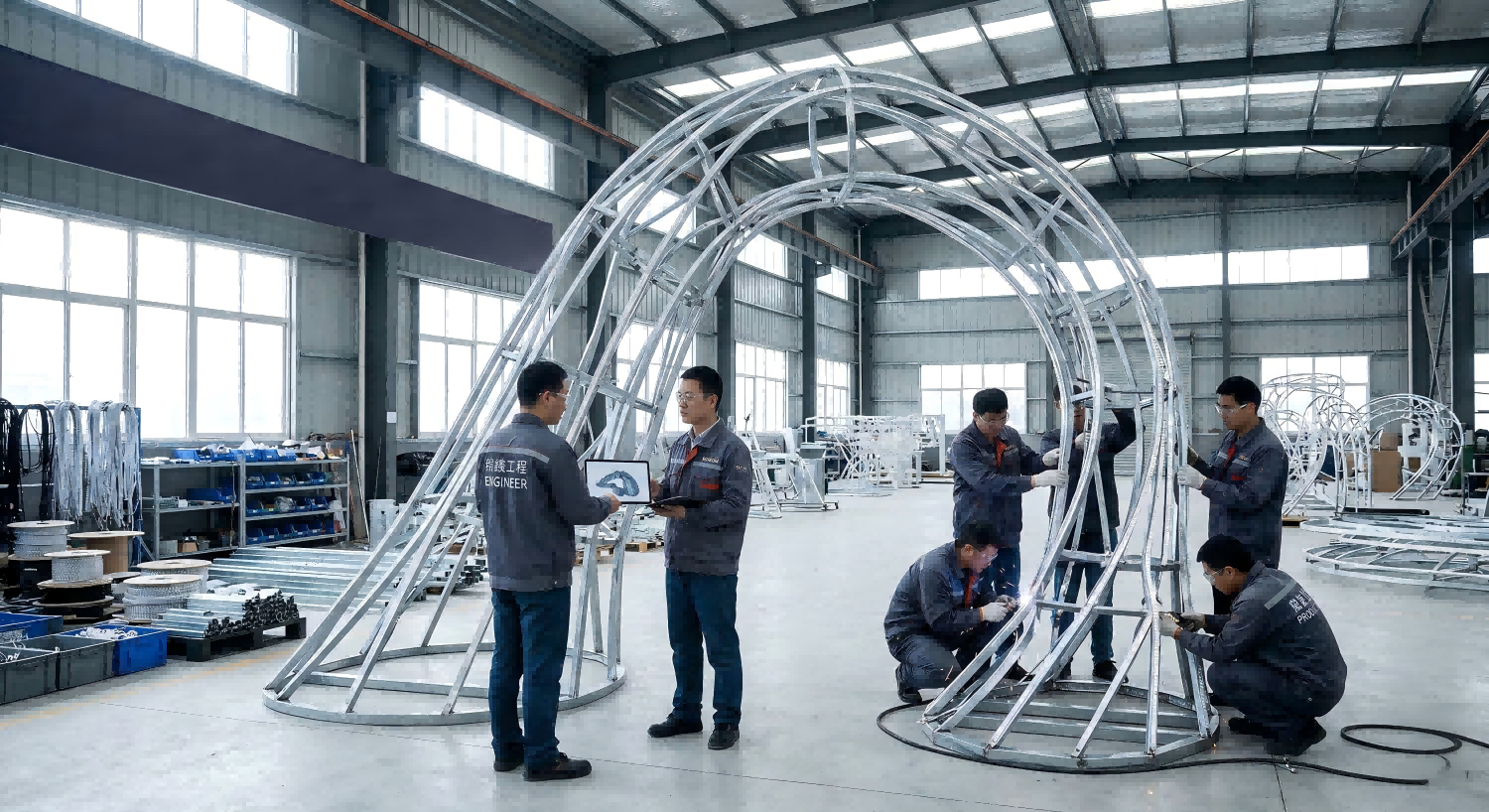
. Check Whether the Supplier Has Real Project Experience
Experience matters in almost every manufacturing sector, but it matters even more in large-scale decorative lighting because these projects often combine structure, electrical systems, visual design, transport planning, and on-site assembly. A supplier may be able to produce small decorative items successfully while lacking the workflow needed for oversized or technically complex installations.
When reviewing a manufacturer, it is useful to look beyond general statements such as “many years of experience” and examine whether the company has handled projects that are similar in scale, environment, and technical complexity to your own. A supplier with genuine project experience should be able to show evidence of installations in outdoor commercial settings, public venues, shopping centers, municipal areas, or large event spaces.
Buyers should also review large-scale commercial installation examples to see whether the supplier has experience with projects of similar scale and operating conditions. A reliable factory usually shows repeated experience across different project types rather than a few isolated photos. It should also be able to explain what parts of the project were handled in-house, such as steel fabrication, lighting integration, control programming, packing design, and assembly guidance.
Another useful checkpoint is whether the manufacturer can support both low-volume customization and larger production runs. Large-scale decorative lighting projects are not always standardized. Some buyers need a one-off landmark installation, while others need coordinated designs for multiple sites. A capable supplier should be able to explain how it manages customized engineering, prototype confirmation, and production planning across different order sizes.
2. Verify Factory Credentials and Export Readiness
For outdoor lighting projects, product appearance is only one part of supplier evaluation. Documentation, compliance awareness, and export readiness are equally important. If the manufacturer cannot provide clear technical records or respond to compliance-related questions with confidence, that may indicate limited experience with international projects.
Buyers often begin by checking whether the supplier can provide basic factory information, such as company registration, workshop photos, production processes, and quality-control procedures. However, that is only the starting point. For commercial projects, it is also useful to ask what export markets the factory serves and whether it is familiar with relevant product standards or documentation requirements.
Certifications such as CE, RoHS, UL-related component familiarity, SAA, or other region-specific compliance references may be relevant depending on the destination market and project scope. The key point is not to collect logos for presentation purposes, but to confirm whether the supplier understands how material choice, electrical configuration, and product design affect compliance in real use conditions.
A factory that frequently supports overseas projects is usually more organized in areas such as carton labeling, spare-parts preparation, wiring identification, voltage confirmation, and shipment documentation. These details may appear routine, but they often determine whether installation proceeds smoothly once the goods arrive on site.
3. Evaluate Control Systems and Programming Ability
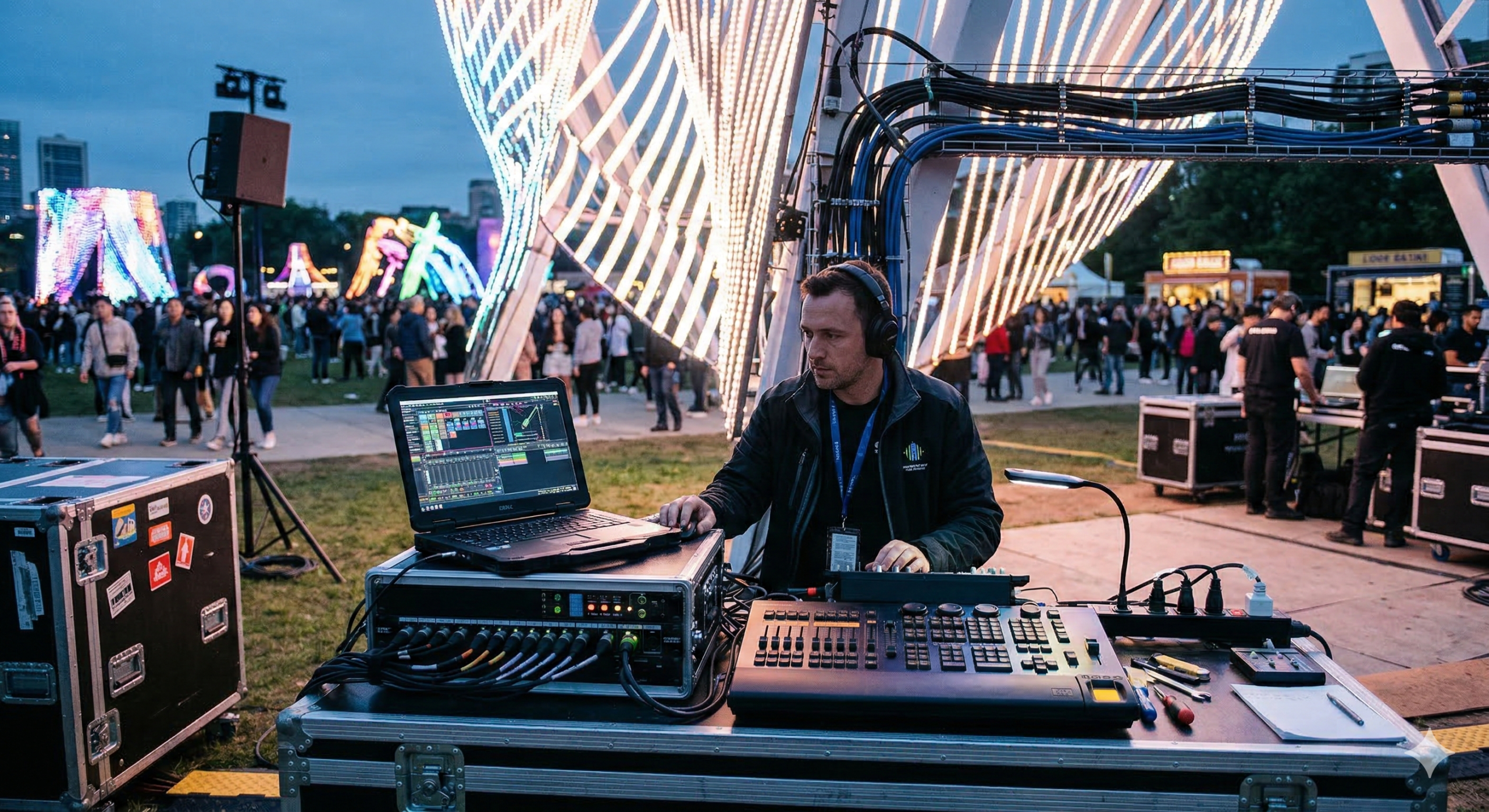
Large decorative lighting structures are no longer limited to static illumination. Many outdoor projects now require dynamic scenes, color changes, chase effects, timed sequences, or coordinated animation across multiple elements. In these situations, the supplier’s control-system capability becomes a major evaluation factor.
One of the first questions to ask is whether the manufacturer works with digital control systems such as DMX512 when the project requires synchronized effects. A supplier should be able to explain when DMX-based control is appropriate, how channels are allocated, how controllers are selected, and how the system is organized for practical maintenance.
For projects that require animation or synchronized effects, it is helpful to understand how DMX-controlled outdoor lighting systems are applied in practical installations. It is also important to distinguish between true programmable lighting and simple sound-reactive or preset effects. In commercial and public environments, reliable show control usually depends on planned programming logic rather than basic audio-trigger response.
If music synchronization is part of the project, buyers should confirm whether the supplier can support actual programmed sequences instead of generic sound sensitivity functions. Another useful sign is whether the manufacturer has its own programming or technical engineering team. Custom outdoor installations often require more than standard controller setup. They may need effect mapping, segment grouping, scene timing, loop adjustments, and troubleshooting support.
Even for projects that do not require highly animated effects, a factory should still be able to provide a clear explanation of its control architecture, power layout, cable planning, and maintenance access strategy. Good lighting performance depends not only on the fixture itself, but also on how the entire electrical system is designed.
4. Inspect Material Selection and Weather Resistance
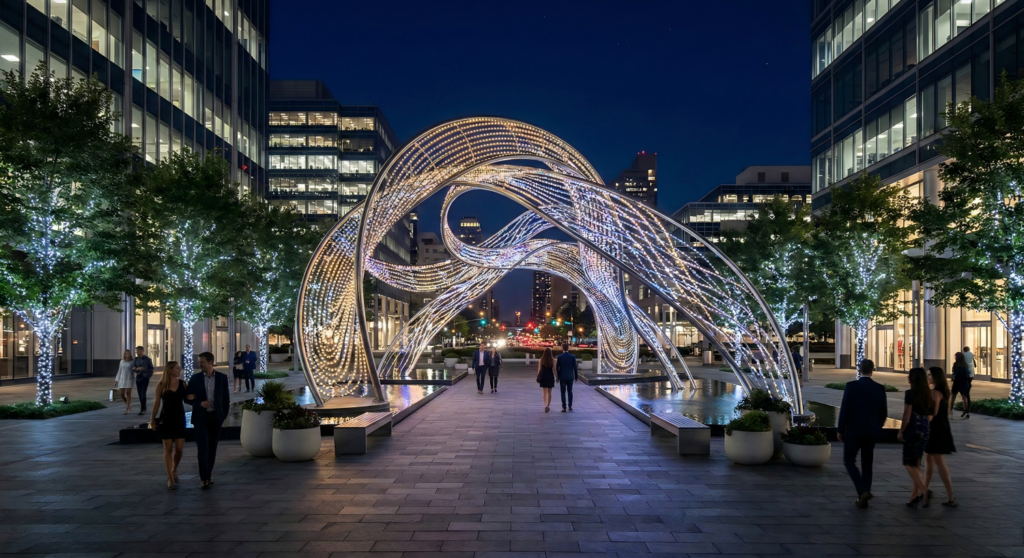
Outdoor decorative lighting installations are exposed to sunlight, wind, moisture, dust, and temperature changes over long periods. Because of this, material selection should always be treated as a technical issue rather than a cosmetic one.
For the lighting components, buyers should ask what type of light sources are being used and why. Different projects may require different solutions, such as sealed LED bulbs, pixel-based full-color lighting, rope-light systems, exposed-node arrangements, or decorative bulb styles. What matters is whether the manufacturer can explain the reason for the chosen configuration in relation to viewing distance, brightness, maintenance, and weather exposure.
Structural materials are equally important. Large outdoor illuminated sculptures usually depend on steel or aluminum frameworks, but not all frame systems perform the same way. Buyers should ask whether the structure uses galvanized steel, aluminum alloy, or other load-bearing materials, and how the frame is designed for transport, assembly, and stability. For larger installations, modular segmentation and joint reinforcement are often just as important as raw material choice.
For example, understanding how hot-dip galvanized steel is selected for large outdoor structures can help buyers evaluate whether a supplier is thinking about corrosion resistance, fabrication efficiency, and long-term structural safety rather than appearance alone.
Waterproofing should also be discussed carefully. For outdoor applications, the relevant question is not simply whether a product is described as waterproof, but how waterproofing is achieved at cable junctions, connectors, control boxes, power supplies, and lighting nodes. A reliable supplier should be able to explain enclosure methods, cable routing, sealing details, and the practical meaning of the stated IP rating in the real installation environment.
Weather resistance also includes finish durability. Painted surfaces, decorative skins, PVC elements, and exposed components should be evaluated for UV stability, color retention, and long-term outdoor appearance. Installations used in public-facing environments often need to look consistent across an entire season, not just during factory inspection.
5. Ask for Technical Drawings and Installation Documents
Well-made products can still create problems if installation support is incomplete. Large-scale decorative lighting projects often involve local contractors, electricians, event teams, or mall maintenance staff. Clear technical documents reduce mistakes during unpacking, assembly, wiring, and commissioning.
Before placing an order, buyers should confirm what documents will be provided. These may include structural assembly drawings, wiring diagrams, controller connection plans, packing lists, module coding references, LED distribution notes, or step-by-step installation guidance. The exact set will vary by project, but the supplier should be able to explain its documentation process clearly.
Projects using programmable systems may require additional information such as controller mapping, address allocation, cable identification, and scene-operation instructions. These documents are valuable not only during first installation, but also later when the project is dismantled, stored, reinstalled, or repaired.
Support during installation is another factor worth clarifying early. Some factories provide remote technical support, visual installation guides, or live troubleshooting assistance. In more complex projects, buyers may also need to discuss whether the manufacturer can support on-site supervision or coordinated guidance through a project partner.
6. Review Maintenance Logic and After-Sales Support
In long-duration outdoor projects, maintenance planning is part of product evaluation. Buyers should not assume that after-sales support means only replacement parts after failure. A more useful question is whether the product and support system are designed to make maintenance manageable over time.
This includes asking how spare parts are prepared, how modules are labeled, whether key lighting sections can be replaced without dismantling the whole structure, and how fault diagnosis is handled remotely. A manufacturer that has worked on real projects usually understands that the easiest product to maintain is not always the same as the simplest product to fabricate.
It is also reasonable to ask about LED service-life expectations, replacement policy, and recommended control schedules. Some projects benefit from timer-based operation or programmed shutdown windows to reduce unnecessary runtime and simplify energy management. These practical details affect operating cost and long-term reliability more than sales brochures often suggest.
7. Study the Project Portfolio Critically
A project portfolio should be treated as a technical reference, not just visual promotion. Good case studies can help buyers understand whether a manufacturer has worked at the right scale, in the right climate conditions, and with the right type of client expectations.
When reviewing project examples, it is helpful to look for variety in both design style and installation environment. A credible large-scale manufacturer should be able to support different forms, such as landmark sculptures, themed walk-through elements, architectural light features, seasonal display centers, or coordinated sets across multiple zones.
Just as importantly, the portfolio should show evidence of practical execution. Photos of fabrication, packing, shipment, wiring layout, structure segmentation, or installation stages can often reveal more than polished catalog images. Buyers can also compare related custom outdoor giant project applications to see how a supplier presents structure, installation logic, and project adaptability across different venues.
Where possible, it is useful to compare whether the supplier’s portfolio covers different project conditions, such as malls, city squares, parks, hotels, and seasonal event sites. A broader range of documented applications may indicate stronger project coordination ability.
Conclusão
Selecting a large-scale decorative lighting manufacturer for an outdoor project is ultimately a risk-management decision. Product appearance matters, but long-term success usually depends on a broader set of factors: project experience, documentation quality, control-system capability, structural material choices, weather resistance, and maintainability.
A reliable supplier should be able to explain its manufacturing process clearly, support technical review with real documentation, and show evidence that it has handled similar projects under real-world conditions. For buyers, the goal is not simply to find a factory that can make an illuminated structure, but to find one that can support the full logic of a large outdoor installation from fabrication through operation.
Editorial note: This article was prepared as an industry-focused reference based on long-term observations of large-scale decorative lighting manufacturing and project delivery practices, including experience associated with manufacturers such as HOYECHI.
Perguntas mais frequentes
1. What is the most important factor when choosing a large-scale decorative lighting manufacturer?
The most important factor is not price alone, but whether the manufacturer can support the full project process. This includes engineering experience, structural safety, control-system capability, material durability, installation documentation, and after-sales support for outdoor use.
2. Why does project experience matter in large outdoor lighting installations?
Large outdoor decorative lighting projects often involve custom structures, transport planning, electrical integration, weather resistance, and on-site assembly. A supplier with proven project experience is generally better prepared to manage these technical and logistical requirements than a supplier focused only on small decorative products.
3. Is DMX512 necessary for every large-scale light sculpture project?
No. DMX512 is most useful when a project requires synchronized lighting effects, color changes, programmed animation, or coordinated control across multiple elements. For static or simple lighting installations, a less complex control system may be sufficient.
4. What materials are commonly used in outdoor decorative lighting structures?
Large outdoor illuminated structures are commonly built with galvanized steel or aluminum alloy frames, combined with weather-resistant lighting components and protective finishes. The exact material choice depends on project size, climate conditions, installation method, and maintenance requirements.
5. Why are technical drawings and wiring diagrams important?
Technical drawings, wiring diagrams, and installation instructions help reduce errors during unpacking, assembly, connection, testing, and future maintenance. They are especially important for custom or programmable lighting projects that may need to be installed by local contractors or reassembled in later seasons.
6. How can buyers tell whether a supplier is a real factory or mainly a trading company?
Buyers can check whether the supplier can provide workshop information, production photos, engineering documents, project process details, and technical answers about materials, structure, wiring, and control systems. A genuine manufacturing-focused supplier is usually able to explain how the product is built and supported in practical terms.