





Guia de tamanhos de grinaldas de Natal comerciais para centros comerciais, hotéis e fachadas de edifícios
The right commercial wreath is not simply the biggest one a buyer can place on a shortlist. It is the candidate whose visible outer size, central opening and depth make sense on the available display surface from the positions where people will normally see it.
Before asking for a recommendation, collect a straight-on site photograph, the measured width and height of the usable display area, the main viewing positions and the dimensions of any exact wreath candidate. This small set of inputs makes a supplier discussion far more useful than saying “large” or “oversized.” It also prevents a product photograph from becoming an accidental scale reference.
This commercial Christmas wreath size guide focuses on visual sizing for buyers who have already chosen a wreath as the display form. It does not decide whether an entrance should use a wreath, arch, garland or another format, and it does not replace mounting, structural, electrical or local review.
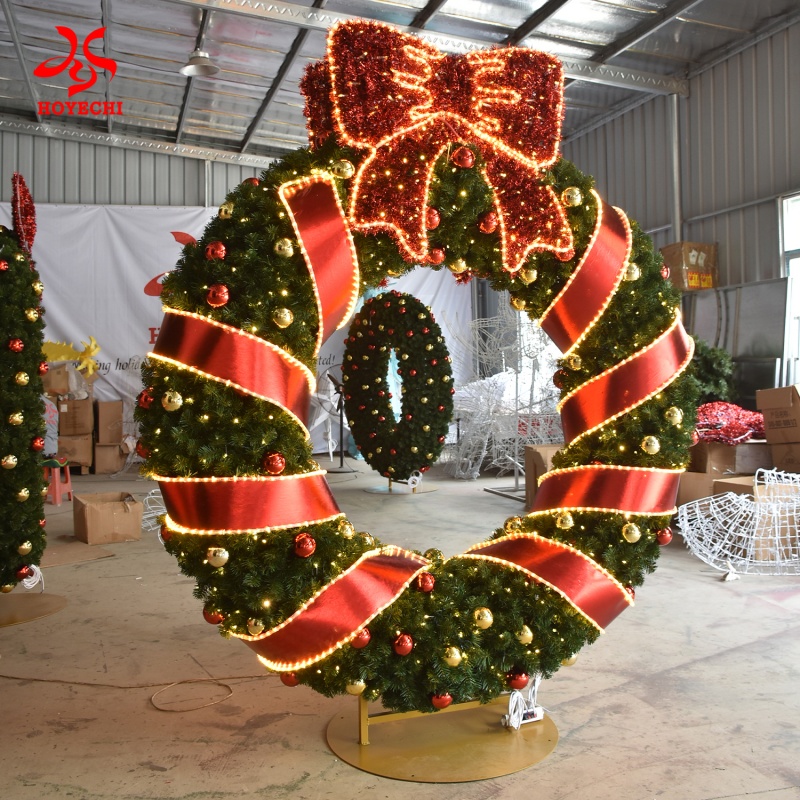
Start with Three Dimensions, Not One
“Wreath size” is often treated as a single diameter. A commercial buyer should record at least three visible dimensions for each candidate.
Outer diameter is the maximum finished width or height from the visible outer edge to the opposite edge. Confirm whether decorative elements such as a bow or projecting ornaments are included in that dimension.
Inner opening is the clear central space. Two wreaths with the same outer diameter can have very different openings, depending on the width and fullness of the decorated ring. The opening affects how much of the wall, window, logo or architectural detail remains visible through the center.
Depth or thickness describes how far the finished wreath projects from front to back. This matters at close viewing positions, beside doors, under canopies and anywhere a side angle is common. A straight-on product image rarely communicates depth accurately.
Ask for a dimensioned front view and side view of the exact candidate. Do not calculate one missing dimension from another unless the supplier’s current drawing explicitly establishes the relationship.

Measure the Usable Display Surface
The full wall or entrance is rarely the same as the usable display area. Signs, doors, glazing joints, decorative trims, cameras, vents, canopies and other retained elements may reduce the surface available for the wreath.
Take the following measurements from the buyer’s current site records:
- usable width and height of the proposed display surface;
- position and dimensions of any feature that must remain visible;
- buyer-identified edges or areas the wreath must not cover;
- distance from the surface to any nearby projecting element;
- height and width of the exact photograph reference area.
Mark these measurements on a straight-on photograph or elevation. Use one clearly identified measured feature as the scale reference. If the photo is angled, distorted or cropped, do not treat it as a measured elevation. Request a better view or keep the visual estimate provisional.
There is no universal wreath-to-wall or wreath-to-door ratio that works for every commercial property. A facade with a broad blank panel creates a different visual context from a narrow hotel entrance with a prominent sign. The buyer should approve the intended visual proportion after reviewing the actual surface and a dimensioned candidate outline.
Record Where People Will Normally See It
A wreath can appear substantial at close range and modest from across a plaza. Rather than using a fixed viewing-distance formula, identify the real positions that matter to the project.
Record where the wreath first becomes visible, where most people approach it, the closest normal viewing point and any important side angle. Note obstructions such as trees, canopies, seasonal kiosks, signage or upper-level railings. For a road-facing facade, the responsible project team should identify the relevant view; this article does not determine road or traffic requirements.
Take site photographs from those positions. A person, door or vehicle should not be used as an assumed measurement unless its actual relevant dimension is known and approved as a reference. Perspective can make foreground objects look larger and background surfaces smaller.
If the wreath must work both by day and when illuminated, collect photographs of the same position under both conditions where practical. The daytime view helps the buyer judge the visible decorated mass; the lit view shows whether the overall ring and opening remain legible against surrounding light. Neither photograph proves product size or suitability without the candidate dimensions.
Apply the Method to Different Commercial Settings
Entradas e átrios de centros comerciais
For a mall, begin with the exact facade, entrance bay or atrium surface—not the total building width. Record nearby tenant signs, digital screens, doors and seasonal elements that will remain. Decide whether the wreath is intended as one focal object or part of a repeated visual line.
A large open atrium may offer long views, while an entrance under a canopy may be seen mainly at close range. Those conditions can point to different visual proportions, but they do not produce a universal size answer. Compare the candidate outline on the current site image and review it from the mall’s normal approach positions.
Hotel entrances and lobby features
At a hotel, a wreath may sit above an entrance, behind a reception view, on a lobby wall or within another confirmed display surface. Measure only the surface being considered and mark brand signs, clocks, artwork, doors or architectural details that must stay visible.
Close viewing makes the inner opening, ring thickness and front-to-back depth especially noticeable. Ask for a side view when the position is near guest circulation or furniture, then send the interface to the responsible site reviewer. This is not an installation-clearance recommendation.
Building façades
A facade wreath may be viewed from farther away and against strong architectural lines. Give the supplier a straight-on elevation or the least-distorted site photograph available, plus a known reference dimension. Identify the primary viewing area instead of asking the product to look equally dominant from every possible position.
Do not assume the visual outline determines mounting or structural feasibility. Once the buyer identifies a promising size direction, the relevant professionals must separately review the exact product, support, facade condition, exposure and local requirements.
Compare Exact Candidates on One Page
Use a compact comparison rather than collecting unrelated product images.
| Candidate check | Candidate A | Candidate B | Buyer decision note |
|---|---|---|---|
| Exact product/page/version | [link or controlled reference] |
[link or controlled reference] |
[which records are current?] |
| Finished outer diameter | [supplier document] |
[supplier document] |
[how each sits within usable width/height] |
| Clear inner opening | [supplier document] |
[supplier document] |
[what remains visible through the center] |
| Finished depth/thickness | [side-view document] |
[side-view document] |
[how it reads from side and close views] |
| Bow/ornament projection included? | [yes/no/unclear] |
[yes/no/unclear] |
[request clarification if unclear] |
| Decorated daytime outline | [current image/sample] |
[current image/sample] |
[fullness against the site surface] |
| Illuminated outline | [current image/video/sample] |
[current image/video/sample] |
[legibility against surrounding light] |
| Site-photo overlay version | [file/date] |
[file/date] |
[approved/provisional/revise] |
The table compares what the buyer can see and verify. It does not score structure, installation, safety or compliance. If a field is missing, ask for the exact product record instead of filling it from a similar image.
Buyers may use the commercial Christmas ornament range to find current product routes, then move to an exact owner such as this current illuminated wreath candidate ou another current wreath route. Category cards and names support discovery; they do not confirm dimensions, availability or site fit.
Make a Simple Photo Overlay
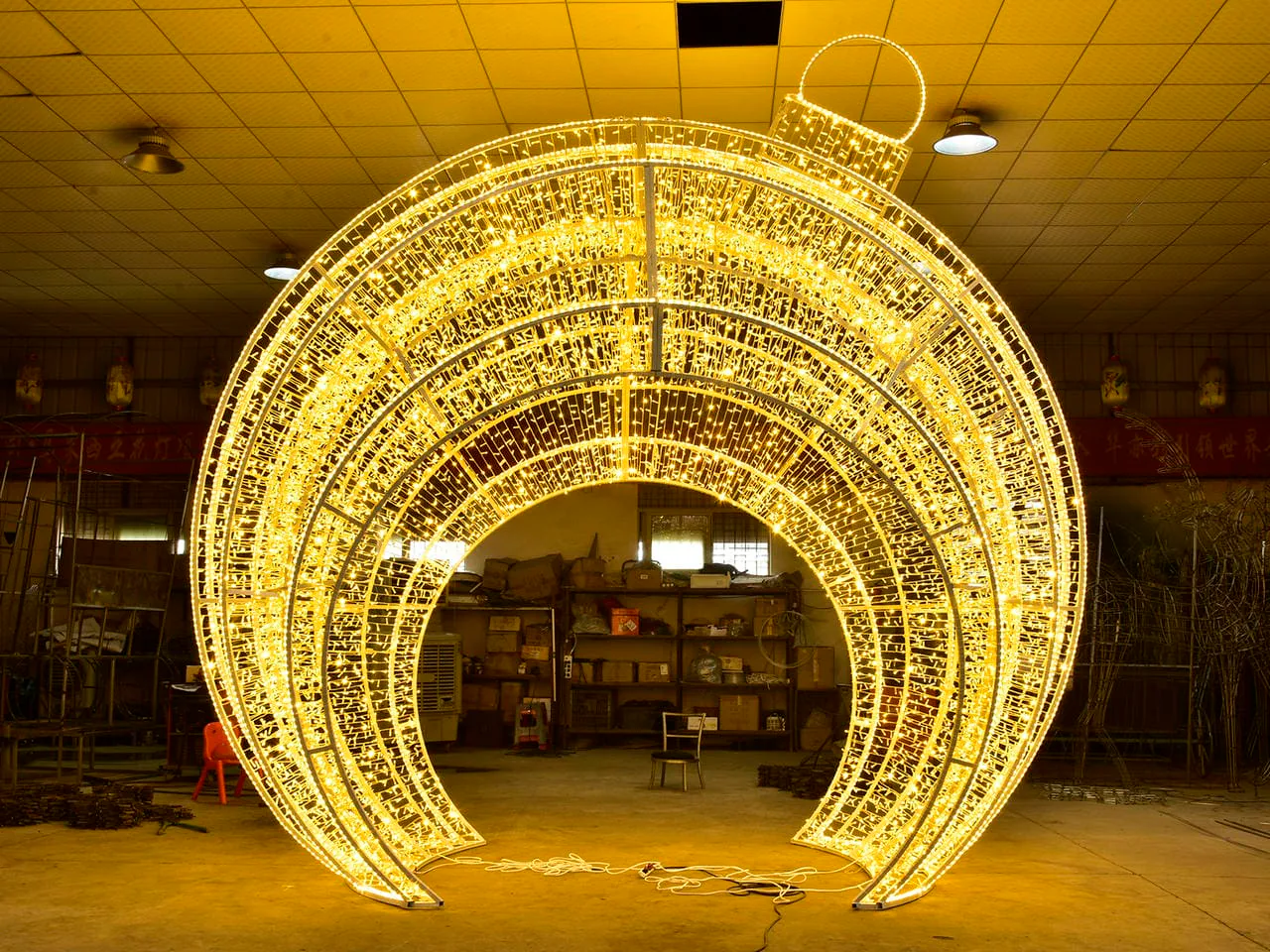
A photo overlay helps non-technical stakeholders discuss visual proportion before detailed review. Start with a straight-on site image and mark the measured usable width and height. Draw a simple circle or insert the front-view outline of the candidate at the same scale. Label the proposed outer diameter and inner opening as candidate data, not final site approval.
Create separate overlays when comparing two sizes. Do not stretch one image freehand until it “looks right,” because that removes the relationship to the measured surface. Keep the file date, candidate identity and source dimensions visible in the record.
Review the overlay from the important viewing positions identified earlier. Ask four practical questions:
- Does the outer edge occupy the intended amount of the usable surface?
- Does the central opening reveal or cover the right background feature?
- Do the bow and other projecting decorations change the apparent balance?
- Does the candidate remain recognizable in both the close and long views that matter?
The overlay is a visual-selection aid. It is not a fabrication drawing, mounting plan or engineering approval.
Decide Between One Focal Wreath and Repeated Wreaths
A single focal wreath and a repeated set create different visual readings even when the individual product is identical. One wreath may be judged against one entrance bay or facade panel. Repeated wreaths must also be judged as a group across the buyer’s chosen sequence.
For repeated use, record the number of intended positions, whether every display surface is actually the same size and which position should control the comparison. Do not assume a candidate approved for the largest bay will suit smaller bays, or that one photograph represents an entire facade.
This remains a wreath-sizing decision, not a full zone or route plan. If spacing, quantities, site interfaces or multiple product families become the main question, move those issues to the appropriate project owner rather than expanding this page.
Avoid Five Common Sizing Mistakes
Choosing from the product photograph alone. A studio or workshop image may have no reliable site-scale reference.
Recording only the outer diameter. The inner opening and depth can materially change the visible result.
Measuring the whole facade instead of the usable surface. Retained signs, openings and architectural features may change the actual comparison area.
Checking only one viewpoint. A close front view can hide how the wreath reads from the normal approach or side angle.
Treating the visual choice as installation approval. A promising outline still requires separate product, site and responsible-party review.
Prepare the Supplier Inquiry
Send a concise input package:
- venue type and exact proposed position;
- one straight-on photo plus relevant approach and side views;
- measured usable display-surface width and height;
- one identified reference dimension shown on the image;
- architectural or brand elements that must remain visible;
- main normal viewing positions;
- single focal or repeated-wreath intent;
- links to any exact candidates already shortlisted;
- requested outer diameter, inner opening and depth records for each candidate;
- current front, side, daytime and illuminated product views where available;
- the buyer’s preferred visual direction and unresolved questions.
Ask the supplier to respond against the exact candidate, not a similar wreath. Any recommendation should remain provisional until the buyer’s site information and the candidate records use the same measurement basis.
Perguntas mais frequentes
What size commercial Christmas wreath do I need?
There is no universal size. Start with the measured usable display surface, normal viewing positions and the exact candidate’s outer diameter, inner opening and depth. Compare a scaled outline on a current site image before approving a visual direction.
Should a wreath be a fixed percentage of the entrance width?
Not as a universal rule. Entrance geometry, signage, glazing, background finishes and viewing positions differ. Use the actual usable surface and a dimensioned candidate overlay rather than transferring a percentage from another property.
Why does the inner opening matter?
The opening controls how much background remains visible and how heavy or open the wreath looks. Two candidates with the same outer diameter may present very differently if their decorated rings and central openings differ.
Can I estimate wreath size from a product photo?
Only when the image includes an accurate, identified reference and is suitable for measurement. Perspective, cropping and camera position can mislead. Request a dimensioned front view and side view of the exact candidate.
Is a visual overlay enough to approve the wreath?
It is enough to discuss visual proportion, not to approve fabrication, mounting, structure, electrical work, safety or local requirements. Those decisions need the exact product information, site evidence and responsible reviewers.
Turn the Size Question into a Better Product Discussion
A useful wreath inquiry does not begin with “send me your biggest model.” It begins with a defined display surface, measured usable width and height, normal viewing positions and a shortlist whose outer diameter, inner opening and depth can be compared on the same basis.
Prepare the site photos, marked dimensions, candidate links and unanswered questions, then send the wreath-sizing brief to HYCLight for a product-specific discussion. This does not promise a size recommendation, product availability, design, quotation, response time, installation support or project result.