





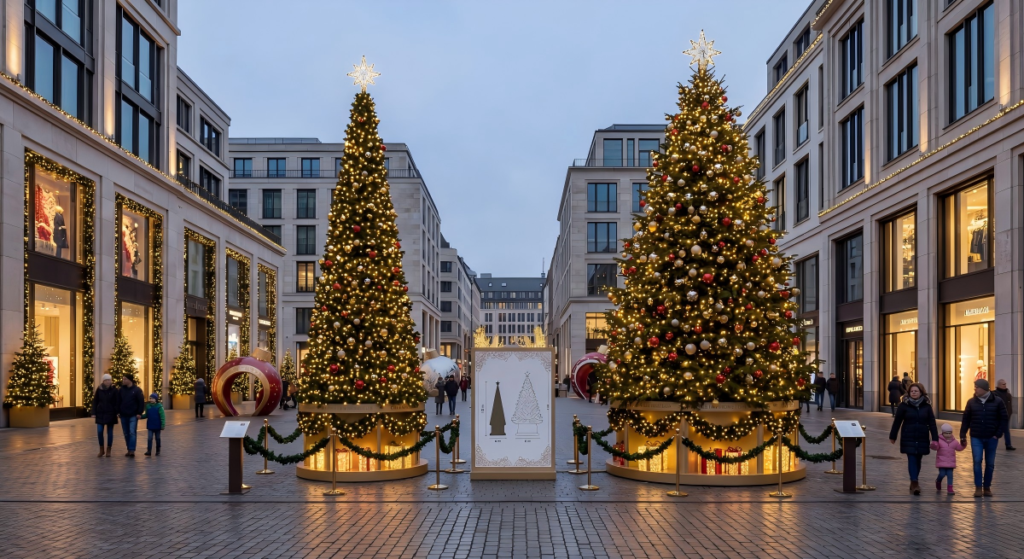
For shopping malls, parks, scenic areas, hotels, city plazas, and commercial streets, a large commercial Christmas tree is often the centerpiece of the entire holiday display. When buyers first make an inquiry, the first question is usually about size: “How much is a 10-meter tree?” “What is the price for a 15-meter tree?” “How much would a full 20-meter setup cost?” These are reasonable questions, but if tree pricing is understood only through height, it becomes very difficult to judge whether a quote is truly reasonable.
The reason is simple. A large commercial Christmas tree is not just an enlarged version of a retail Christmas tree. It is much closer to a project-based holiday installation. Even when two trees have the same height, their prices can still differ significantly, because the cost is influenced by much more than height alone. Base diameter, structural frame, branch material, foliage density, lighting system, decoration complexity, outdoor specification, packing method, installation difficulty, and the level of customization all affect the final price.
In other words, what buyers really need to understand is not just “How much does one tree cost?” but rather “What standard is this tree built to?” Only when that logic is clear does price comparison become meaningful, and only then can budget decisions match the actual needs of the project.
If you are comparing different holiday project options, it also helps to read Como escolher decorações de Natal comerciais para centros comerciais, parques e projectos urbanos first, because tree selection is often only one part of a larger commercial decoration strategy.
Why Can Large Commercial Christmas Tree Prices Vary So Much?
In real purchasing situations, many buyers notice the same thing: two large commercial Christmas trees may both be listed as 10 meters or 12 meters high, yet their prices can be very different. That does not necessarily mean one supplier is overpriced. In most cases, it means the product specifications are not actually the same.
A large commercial Christmas tree is a typical engineering-based holiday installation. It is not only about whether the tree looks impressive from a distance. It must also look full and refined at close range, remain structurally stable, distribute light evenly, ship efficiently, install smoothly, and in many cases, be suitable for repeated use in future seasons. For outdoor projects, the requirements go even further, including wind resistance, corrosion protection, flame-retardant performance, anti-oxidation ability, fade resistance, and long-term storage stability.
Because of that, the real reason behind price differences is usually not “who sells the same tree more cheaply,” but “what level of specifications, materials, and project standards the tree is built to.” The earlier a buyer understands this, the less likely they are to focus only on the number in the quotation and overlook the factors that actually determine long-term value.
Height Matters, but It Is Never the Only Cost Factor
Height is certainly one of the most important basic factors in the price of a large commercial Christmas tree. As the tree becomes taller, the frame usually becomes larger, more branches are required, more lighting coverage is needed, packing volume increases, and installation becomes more complicated. From that perspective, it is perfectly normal for a 10-meter, 15-meter, and 20-meter tree to fall into very different price ranges.
The problem is that height only describes the vertical dimension of the tree. It does not define the full specification. For example, two trees may both be 10 meters high, but one may have a much wider base diameter and a fuller overall shape, while the other may be slimmer. One may be designed for an indoor atrium where refined appearance is the priority, while the other may be intended for an outdoor plaza where stronger structure and weather resistance are essential. Even if the height is the same, the cost logic is not.
That is why large commercial Christmas trees should never be understood through a simple “price per meter” mindset. Height is only a starting point. A realistic quote can only be judged based on the complete specification of the tree.
Beyond Height, Base Diameter and Effective Surface Area Also Strongly Affect Price
When discussing the price of a large commercial Christmas tree, many buyers mention only the height, such as 10 meters, 15 meters, or 20 meters. If the base diameter is not defined at the same time, however, any quotation can only be a rough estimate. For a large commercial Christmas tree, a larger base diameter usually means a larger surface area, which requires more branches, more lights, more ornaments, and often more structural material as well. That directly affects the total cost.
For example, if two Christmas trees are both 10 meters high, but one has a 4-meter base diameter and the other has a 6-meter base diameter, the difference in tree surface area can be around 130 square meters. In a commercial project, this is not a small difference. A larger surface area usually means more foliage material, more lighting coverage, more ornamented area, and a higher installation workload. So when buyers ask why two 10-meter trees can have very different prices, the reason is often not the height itself, but that the actual tree specifications are quite different.
Another detail that is often overlooked is whether the top star is included in the total height. For example, a customer may ask for a 10-meter Christmas tree, but in some cases that total height includes a 1-meter topper, meaning the actual tree body is only 9 meters tall. At first glance, the difference may look small, but once that difference is reflected across the effective surface area of the tree, it can still amount to tens of square meters. That difference also affects the amount of branches, lighting, and decorative materials required, which in turn affects the quote.
For this reason, asking only for a “10-meter tree” is not enough. Buyers should also clarify whether the 10 meters refers to the tree body itself or the overall height including the topper, and what base diameter is expected. These simple parameters can have a direct impact on cost and quotation accuracy.
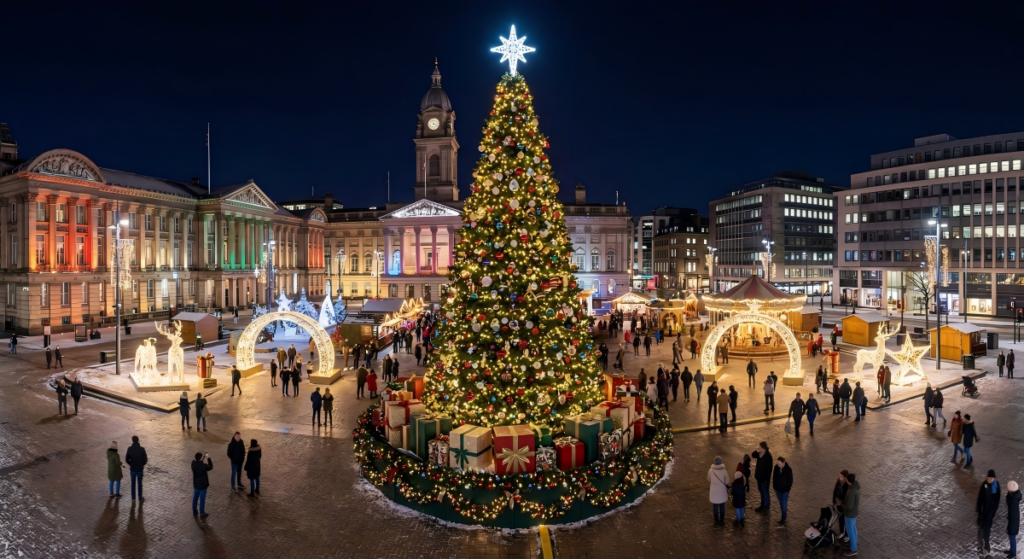
Different Height Ranges Correspond to Different Project Levels and Installation Requirements
5–10 meters: the most common commercial Christmas tree range
The 5–10 meter range is usually the most common size range for commercial projects. This size is widely used because it offers a practical balance between cost control, installation conditions, and in some countries or regions, approval requirements related to height.
For shopping mall atriums, hotel entrances, mid-sized plazas, commercial street nodes, and standard holiday events, a 5–10 meter tree is often large enough to create a strong festive atmosphere while still remaining manageable in transport, installation, and budget. This range is often the easiest to implement and is also the most common choice for buyers planning their first commercial tree project.
10–20 meters: medium-to-large commercial Christmas trees
The 10–20 meter range already belongs to medium-to-large commercial Christmas trees. Compared with the 5–10 meter range, these trees have a much stronger visual presence and are more likely to become the main focal point of the venue. They are highly effective for attracting visitor attention, strengthening seasonal identity, and creating photo-worthy holiday landmarks.
At the same time, installation requirements rise noticeably in this range. Even if the project is not extremely complex, it usually still requires installers with event or large-decoration installation experience. On-site assembly, lifting coordination, and fixing methods all require a more professional level of execution. In other words, once the tree enters the 10-meter range, it is no longer just “a large decoration.” It becomes a project-based holiday installation that depends on real installation experience.
20–40 meters: extra-large commercial Christmas trees
The 20–40 meter range generally belongs to extra-large Christmas trees and is commonly seen in landmark locations, large plazas, core commercial areas, and scenic attraction nodes. These trees are not only seasonal decorations. They usually carry strong landmark value and visitor-attraction value, which means the design, manufacturing, and installation teams must all operate at a higher level.
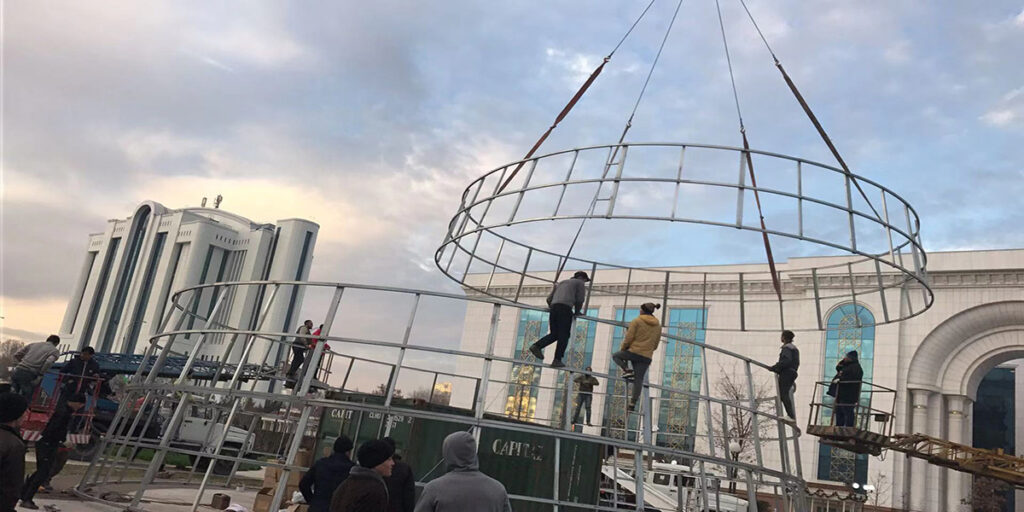
Within this range, the tree often requires more customized design, and the installation team must usually have stronger project experience. In addition to general installation ability, workers may need professional high-altitude training. For this scale of project, a customized steel base structure is often required, together with wind-load calculations and seismic reinforcement planning. Some projects may also involve municipal coordination, such as temporary traffic control, night-work permits, and access for heavy equipment. That means the cost of a 20–40 meter tree is not higher simply because it is taller, but because it belongs to a more advanced project-management category.
Over 40 meters: uncommon landmark-scale Christmas trees
Christmas trees above 40 meters are uncommon and are usually used in parks, landmark public spaces, city-level holiday programs, or other long-term display environments. From design to production to installation, these projects usually involve a more complex process and place far greater emphasis on repeat use and long-term asset value.
For trees above 40 meters, lifecycle management becomes especially important. That includes not only the first design and installation stage, but also steel structure anti-corrosion maintenance, weathering performance upgrades for LED lighting systems, settlement monitoring of the base, and load re-verification over a multi-year period. In other words, a tree of this scale is no longer just a seasonal decoration. It becomes a large public holiday structure with long-term operational characteristics.
What Are the Core Factors That Affect the Price of a Large Commercial Christmas Tree?
1. Tree height, base diameter, and overall specification
Height defines the visual vertical scale of the project, but base diameter defines the spread, the surface area, and the total material coverage required. Many buyers provide only the height when requesting a quote, but without the base diameter, price accuracy will always be limited.
If two trees are both 12 meters high, but one is designed to be slimmer while the other is intended to be wider and fuller, the second one will usually require more branches, more lighting coverage, more ornamented area, and a larger overall structure. Naturally, the price will be higher. For large commercial Christmas trees, a wider base diameter usually means more materials and a greater installation workload.
2. Structural frame and engineering standard
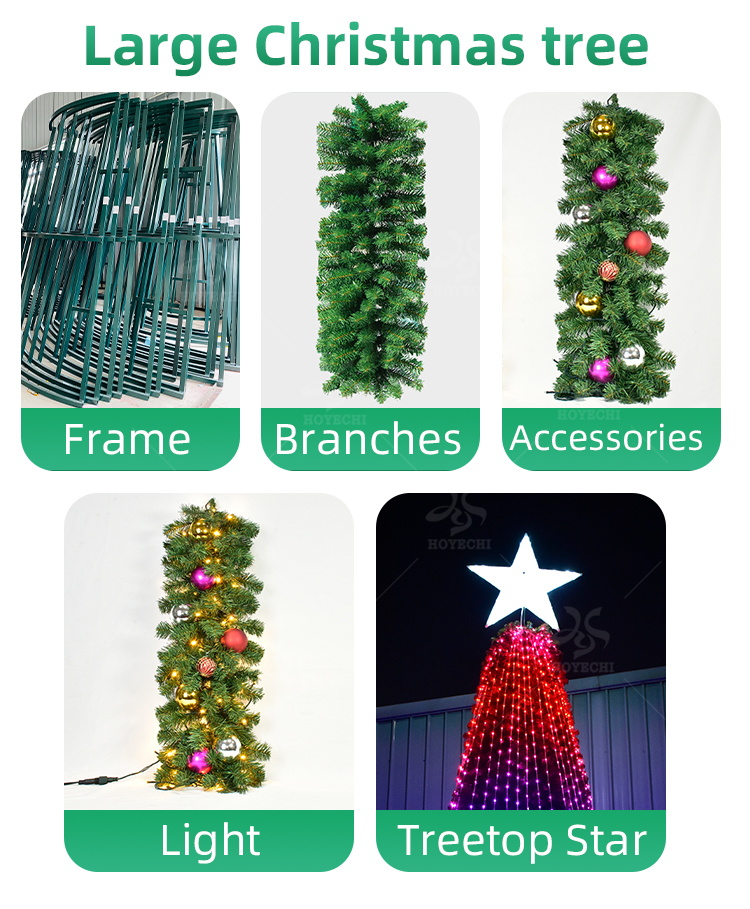
The internal frame of a large commercial Christmas tree is one of the most important cost foundations. Structure determines not only load-bearing capacity, but also stability, packing logic, and installation efficiency.
Indoor trees and outdoor trees are usually built to different structural standards. An indoor atrium tree may focus more on appearance and spatial fit, while an outdoor plaza or park tree must place much more emphasis on wind resistance, corrosion protection, and long-term stability. The choice of material, connection system, modular breakdown, reinforcement standard, and engineering method can all affect cost directly.
If a project also requires more efficient dismantling and repeated transport, then the sectional design and connection system often become even more important, which adds further influence to the quotation.
3. Branch density, foliage quality, and PVC material grade
This is one of the most overlooked factors, yet it is also one of the most direct influences on both appearance and price.
For a large commercial Christmas tree, the first thing people notice is usually not the inner frame, but whether the tree looks full, whether the color appears natural, whether the branches stand upright properly, and whether the tree still looks refined at close distance. All of these impressions depend heavily on branch quality, not just height.
Lower-grade branches often use recycled PVC. They may have shorter branch sections, fewer leaves, thinner film, and color that looks grayish, yellowish, dull, or glossy in an unnatural way. After a period of use, such branches may curl, crease, become brittle, or fade more quickly under sunlight. Even if the tree is large, it can still look flat, sparse, and artificial when viewed closely.
Higher-grade branches, by contrast, usually use virgin PVC. They tend to have longer branch sections, more leaves, larger leaf spread, and more stable film thickness. The result is a fuller, more upright tree with more natural color and a stronger resemblance to real evergreen foliage. These branches usually also have better resilience, faster rebound after bending, and better suitability for repeat seasonal use.
From a purchasing perspective, branch quality affects much more than appearance. It also affects long-term cost. A tree built with lower-grade recycled branches may cost less at the beginning, but may later suffer from fading, brittleness, odor, poor touch experience, and shorter service life. A tree built with better virgin PVC branches may require a higher initial investment, but it usually offers stronger flame-retardant performance, better anti-oxidation ability, more stable appearance, and a safer, more durable user experience. That makes it more suitable for malls, parks, hotels, and public venues where both image and long-term reuse matter.
4. Lighting system configuration
Whether the tree includes lighting, how dense the lighting is, what color scheme is used, and whether the system supports programmable effects all influence the final price.
Some projects need only basic static lighting to create a stable festive atmosphere. Others may require dynamic effects, rhythm changes, or more advanced visual programming. That introduces more complex controls, power distribution, and on-site commissioning. Even when tree height is identical, lighting system differences can easily create large quotation differences.
Lighting is also not just about the number of light strings. Uniform coverage, clean wiring logic, and maintenance convenience all influence cost. For a large commercial tree, lighting is always more than a simple add-on.
5. Degree of pre-installation
This is another key factor that buyers often misunderstand.
Many customers hear the term “pre-installed” and assume the difference between suppliers is minimal. In reality, the degree of pre-installation can greatly affect material cost, labor cost, installation speed, and the final visual result.
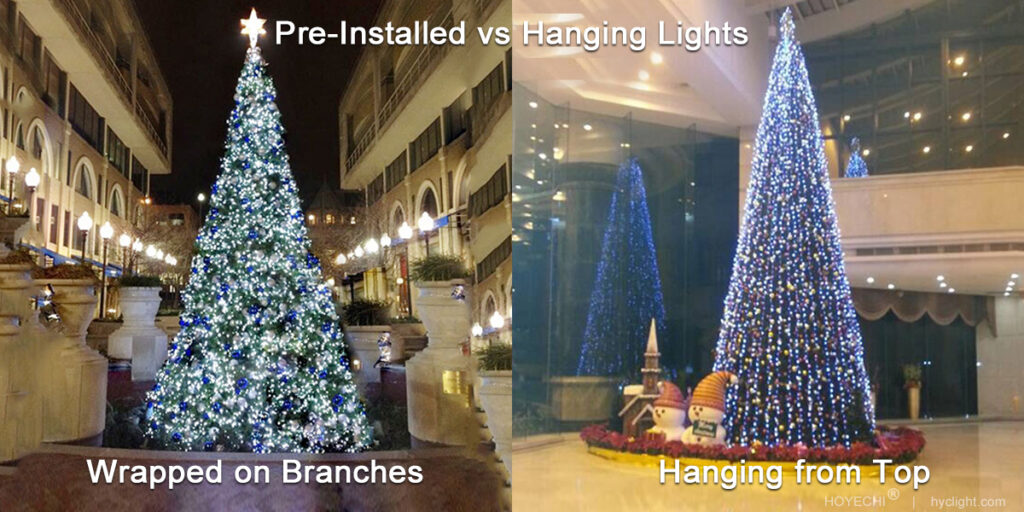
One common lower-cost method is to hang lights vertically from the top of the tree down along the outer edge. This approach is simpler, uses less material, and is usually cheaper because the light runs remain mostly straight and easy to install. However, the weakness is also obvious: the lighting stays mostly on the outer surface of the tree, so the result looks flatter and less layered. From a distance, it can resemble a curtain of lights covering the exterior, with limited internal depth and weaker three-dimensional effect.
A truly higher-grade pre-installed tree uses a very different method. The light strings are pre-wrapped directly onto each branch module, so the illumination works from inside to outside across every branch and branch tip. Once assembled, the whole tree glows in a more natural, even, and three-dimensional way. The internal and external lighting layers work together, producing a richer, more transparent, and more luxurious effect. This is much closer to what high-end commercial projects expect from a signature holiday tree.
Naturally, this level of pre-installation costs more. It requires more light material, more labor, more bending and routing work, and longer production time. But the benefit is also very clear: a fuller visual result, more uniform lighting, better appearance both near and far, and greater installation efficiency on site.
6. Whether a full decoration package is included
Some buyers ask for the “tree price,” while others ask for the “full decorated tree price.” These are not the same thing.
A full decoration package may include the topper, ornaments, bows, gift boxes, themed hanging pieces, and a coordinated color system. Different quantities, sizes, decorative layers, and theme complexity levels can create significant price differences. A plain tree and a fully decorated mall centerpiece tree may have the same height, but their total prices can still be far apart.
That is why it is important to define clearly whether the quote is for the tree body only, a lighted tree, or a fully decorated signature tree with themed visual elements.
7. Indoor standard versus outdoor standard
Many buyers ask whether the price of a 12-meter indoor tree and a 12-meter outdoor tree should be similar. In most cases, the answer is no.
Outdoor large commercial Christmas trees usually need a higher level of weather resistance and safety performance. That may include stronger structural stability, better anti-corrosion treatment, higher flame-retardant grade, better anti-oxidation and fade resistance, and the ability to maintain performance under long-term outdoor exposure. Because of that, an outdoor tree usually costs more than an indoor one.
In spaces such as city plazas, park entrances, and exterior commercial squares, the tree is not just supposed to stand there and look good. It must also operate safely and remain stable in a public environment. For these projects, outdoor specification is not an optional upgrade. It is a core cost factor.
8. Whether customization is required
Standard commercial Christmas trees and customized commercial Christmas trees follow different pricing logic.
Some buyers need only a standard tree shape and classic holiday color scheme, with the priority placed on fast implementation and budget control. Other projects need to match a specific commercial theme, architectural environment, brand color, or holiday storyline. In such cases, customization may involve color matching, decorative customization, shape adjustment, or full thematic design. The more customization required, the higher the design, sampling, material coordination, and project-management cost tends to be.
Not every project needs deep customization, but once a project enters that level, the quotation should no longer be understood as if it were a standard product.
9. Shipping and packing method
Large commercial Christmas trees are big structures, so shipping always affects total cost. If sectional design is inefficient, packing volume is too large, or dismantling is inconvenient, transport cost can increase quickly.
For mature commercial projects, modular design can improve this considerably. If a large commercial Christmas tree uses a modular structure, installation is usually easier and transport cost can be lower. In projects intended for repeated use, modular design also directly affects future packaging, storage, and reinstallation efficiency.
If you want to understand how modular structure and packing logic influence long-term ownership cost, you can also read Como reduzir os custos de envio e armazenamento de decorações festivas de grandes dimensões.
The degree of pre-installation also influences packing logic. When lights and ornaments are pre-installed onto branch modules in the factory, on-site installation becomes more efficient and temporary labor pressure is reduced. That production method itself is part of the cost, because more labor and process integration have already been invested at the factory stage.
10. Installation complexity and site condition
The same large Christmas tree can require very different installation methods depending on whether it is placed in a mall atrium, an outdoor plaza, a hotel lobby, or a city landmark node. Whether lifting equipment is needed, whether high-altitude work is involved, how complex the on-site assembly is, and whether the site limits working hours will all influence the final budget.
In large commercial projects, installation cost usually cannot be estimated through a simple “installation price per tree” logic. It must be judged against real site conditions. For buyers, underestimating installation complexity is one of the most common quotation mistakes.
Why Two Trees of the Same Height Can Still Have Completely Different Prices
The most important principle in understanding large commercial Christmas tree pricing is this: the same height does not mean the same specification, and the same specification does not automatically mean the same long-term value.
For example, two trees may both be 10 meters high, but one may be intended for a mall atrium where fine detail, balanced color, and decorative richness matter most, while the other may be intended for an outdoor plaza where structural stability, weather resistance, and repeat seasonal use matter more. One may use lower-grade recycled branches for a short-term event, while the other may use higher-grade virgin PVC branches with stronger flame-retardant, anti-oxidation, and long-term storage performance. Even with the same height, the cost logic is completely different.
It goes even further than that. Even if both trees are described as “10 meters,” one may have a much larger base diameter, while another may include the topper in the total height. In that case, the effective tree body area and total material usage may already differ substantially. So instead of asking, “Why are two 10-meter trees priced differently?” the more useful question is, “What are the actual specification differences between these two 10-meter trees?” Once a buyer starts comparing at that level, the quotation becomes much more meaningful.
If you are evaluating actual product options, you can also compare with a current commercial Christmas tree project product page to see how height, bottom diameter, structure, lighting, and decoration are usually presented together.
What Buyers Should Clarify Before Requesting a Quote
To get a more accurate quote for a large commercial Christmas tree, buyers should prepare the following information as clearly as possible:
- The actual height of the tree body, and whether the topper is counted separately
- The approximate base diameter required
- Whether the tree will be used indoors or outdoors
- Whether lighting is needed, and whether the lighting is basic or more advanced
- Whether the request is for a plain tree or a fully decorated signature tree
- Se é necessária uma verdadeira pré-instalação da iluminação
- Se a árvore se destina a ser utilizada durante várias estações
- As condições reais do local e as limitações da instalação
- Se são necessárias cores, temas ou elementos de marca personalizados
- O intervalo orçamental aproximado
Os compradores devem comparar o preço ou o valor?
É claro que os compradores têm de comparar preços, mas nos grandes projectos comerciais de árvores de Natal, o que devem realmente comparar é o valor por detrás do preço.
O que realmente importa não é apenas o número de compra inicial, mas se a estrutura é segura, se os ramos parecem cheios, se os materiais são duráveis, se a cor é natural, se a iluminação é estável, se a pré-instalação é genuína, se a embalagem é eficiente, se a instalação é prática e se a árvore pode ser reutilizada em épocas futuras.
Num ambiente comercial, uma árvore de grandes dimensões não é apenas uma decoração festiva. É muitas vezes a peça central visual de todo o espaço. Se a aparência parecer vazia, artificial ou plana, e se a árvore envelhecer rapidamente após uma estação, um preço inicial mais baixo não significa necessariamente um melhor valor.
Nesta perspetiva, o preço é apenas um número. O valor é a verdadeira base da tomada de decisões. Para um comprador maduro, perguntar “Porque é que isto custa mais?” é muitas vezes mais significativo do que perguntar apenas “Isto pode ser mais barato?”
Como escolher a árvore de Natal comercial de grandes dimensões adequada ao seu orçamento
Se o orçamento for limitado mas for necessário criar um ambiente festivo, uma abordagem prática consiste em utilizar uma forma de árvore normalizada, uma iluminação básica e uma decoração mais simples, assegurando ao mesmo tempo a segurança estrutural e o equilíbrio visual global. Para estes projectos, a gama de 5-10 metros é frequentemente a escolha mais segura e mais fácil de gerir.
Se o projeto se destinar a ser um ponto focal de um centro comercial, parque, hotel ou praça comercial, é geralmente melhor escolher um nível de especificação mais equilibrado, em que a densidade dos ramos, a qualidade da cor, a cobertura de iluminação e as camadas decorativas trabalhem em conjunto. Este tipo de árvore pode criar uma forte atração visual, mantendo o orçamento sob um controlo razoável.
Se o projeto pertencer a um espaço emblemático, a uma praça ao nível da cidade ou a um local comercial de primeira qualidade, então o orçamento deve normalmente centrar-se mais na escala global, na qualidade da folhagem, nas especificações exteriores, na decoração personalizada e no valor a longo prazo. Neste tipo de projeto, o verdadeiro objetivo não é baixar o preço o mais possível, mas sim garantir que o efeito final corresponde ao posicionamento do espaço.
Erros comuns que os compradores cometem quando comparam os preços das árvores
- Perguntar apenas pela altura sem mencionar o diâmetro da base ou a especificação completa
- Não confirmar se o chapéu de coco está incluído na altura total
- Comparar apenas o preço do corpo da árvore sem considerar a iluminação, a decoração, o transporte e a instalação
- Ignorar a diferença entre normas interiores e exteriores
- Comparação entre uma árvore de eventos de curto prazo e uma árvore reutilizável de várias estações com a mesma lógica de preços
- Ignorar a qualidade dos ramos e concentrar-se apenas no efeito visual à distância em vez da textura e durabilidade a curta distância
- Tratar as simples luzes exteriores suspensas como se fossem verdadeiras pré-instalações
- Utilizar a lógica das árvores de Natal de retalho para avaliar as árvores de grandes projectos comerciais
Considerações finais
O preço de uma árvore de Natal comercial de grandes dimensões nunca é determinado por um único fator. A altura é certamente importante, mas o diâmetro da base, a área de superfície efectiva, o padrão estrutural, o material dos ramos, a densidade da folhagem, o sistema de iluminação, o grau de pré-instalação, a complexidade da decoração, a especificação para interior ou exterior, o método de embalagem e a abordagem de instalação influenciam a cotação final.
Para os compradores, quanto mais cedo forem esclarecidos os objectivos do projeto, as condições de utilização e os detalhes das especificações, mais fácil será receber um orçamento exato e verdadeiramente útil. Um inquérito maduro nunca é apenas uma questão de “Quanto custa uma árvore desta altura?” Começa por compreender qual o padrão de árvore de Natal comercial de grande porte que é efetivamente necessário.
Se houver alguma incerteza sobre a altura do corpo da árvore, o diâmetro da base, a altura do topo ou o verdadeiro significado de pré-instalação, é sempre melhor confirmar estes pormenores antes de comparar os orçamentos. Caso contrário, árvores que parecem ter a mesma altura podem representar especificações muito diferentes e custos muito diferentes.
Perguntas mais frequentes
Quais são os principais factores que afectam o preço de uma árvore de Natal comercial de grandes dimensões?
Os principais factores incluem normalmente a altura da árvore, o diâmetro da base, a estrutura, a densidade dos ramos, o grau do material PVC, a configuração da iluminação, o grau de pré-instalação, o âmbito da decoração, o padrão interior ou exterior, o método de transporte e a complexidade da instalação.
Porque é que duas grandes árvores de Natal comerciais com a mesma altura têm preços diferentes?
Porque as árvores com a mesma altura podem diferir muito em termos de diâmetro da base, estrutura, material dos ramos, densidade da folhagem, sistema de iluminação, nível de decoração, desempenho no exterior e método de pré-instalação.
Uma árvore de Natal comercial de grandes dimensões ao ar livre é normalmente mais cara do que uma árvore de Natal de interior?
Em muitos casos, sim. As árvores de exterior requerem normalmente uma maior estabilidade estrutural, um melhor tratamento anti-corrosão, um maior desempenho retardador de chama e uma melhor resistência às intempéries a longo prazo.
O orçamento de uma árvore de Natal comercial inclui normalmente luzes e ornamentos?
Nem sempre. Alguns orçamentos incluem apenas o corpo da árvore e os ramos, enquanto outros incluem a iluminação, os elementos da copa, os ornamentos, os laços e um pacote de decoração completo. Os compradores devem confirmar isto claramente antes de compararem os orçamentos.
O que é uma árvore de Natal comercial verdadeiramente pré-instalada?
Uma árvore verdadeiramente pré-instalada significa normalmente que as luzes e, por vezes, os ornamentos já estão previamente montados em cada módulo de ramo, em vez de se limitar a pendurar as luzes verticalmente sobre a superfície exterior da árvore. Estas duas abordagens diferem muito em termos de utilização de materiais, mão de obra, eficiência de instalação e qualidade visual final.
Como é que os compradores podem obter um orçamento mais exato para uma árvore de Natal comercial de grandes dimensões?
Os compradores devem indicar a altura real do corpo da árvore, o diâmetro da base, se o topo é contabilizado na altura total, a utilização no interior ou no exterior, os requisitos de iluminação, o âmbito da decoração, as expectativas de pré-instalação, as condições do local e o orçamento. Quanto mais completas forem as informações, mais útil e exato será o orçamento.