



Lors de l'évaluation d'un sapin de Noël commercial, Dans le cas d'un grand arbre, de nombreux acheteurs se concentrent d'abord sur les effets d'éclairage, la densité des branches, le style décoratif et l'impact visuel global. Cependant, c'est la structure interne du cadre qui détermine véritablement si un grand arbre est stable, durable, sûr et adapté à une utilisation extérieure à long terme.
Pour les centres commerciaux, les places, les parcs, les hôtels, les espaces municipaux et les événements de vacances à thème, un large éventail de produits est disponible. sapin de Noël commercial n'est pas seulement une décoration saisonnière. Il s'agit également d'une structure technique qui doit trouver un équilibre entre la solidité, la résistance au vent, la durabilité aux intempéries, l'efficacité de l'installation et la valeur de réutilisation à long terme. Plus l'arbre est grand, plus la structure principale est importante. En particulier pour les arbres de plus de 10 mètres, un mauvais choix de matériau peut entraîner des secousses, des déformations, de la rouille, une installation difficile, une maintenance fréquente, voire des risques pour la sécurité.
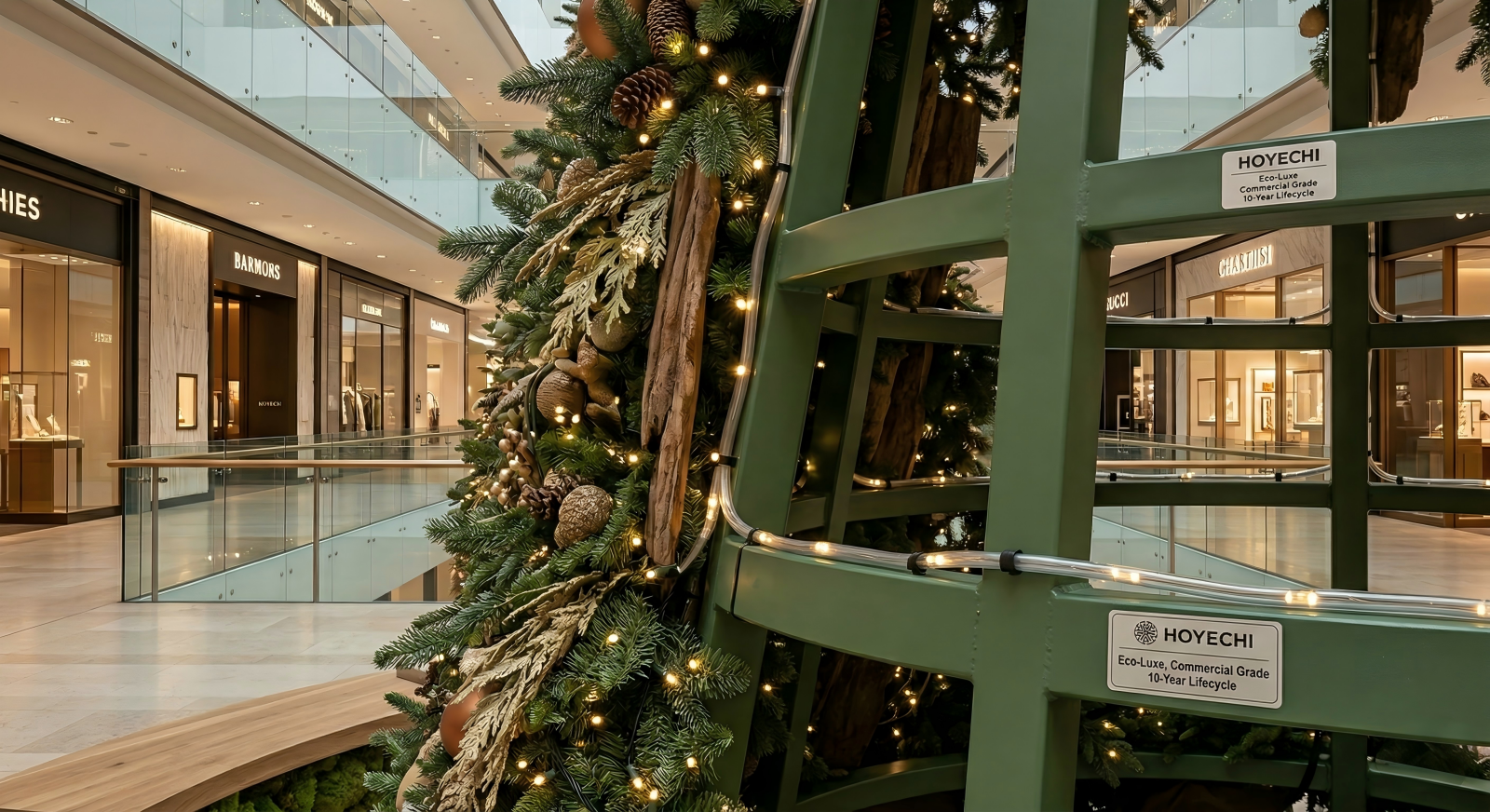
C'est pourquoi, lors du choix d'un sapin de Noël commercial, Il est donc important de ne pas se limiter à l'apparence et aux détails de la décoration. Le matériau du cadre principal, le traitement de surface, la qualité de la soudure, la méthode de connexion et la conception structurelle globale méritent tous une attention particulière.
Pourquoi le matériau du cadre principal est-il important pour un arbre de Noël commercial ?
L'effet extérieur d'un grand arbre de Noël est créé par les branches, les lumières, les ornements et les finitions décoratives. Mais la partie qui supporte le poids, maintient la forme, résiste à l'environnement extérieur et assure la stabilité de la structure est le système d'armature interne.
Un cadre bien conçu doit pouvoir.. :
- Supporte le poids total du corps de l'arbre, des branches, des lumières et des ornements.
- Gérer le vent, le soleil, l'humidité et les changements de température à l'extérieur.
- Faciliter l'installation, le démontage, le transport et la réutilisation
- Réduire le risque de rouille, de déformation et de problèmes de maintenance à long terme
- Maintenir la stabilité dans les environnements commerciaux publics
En d'autres termes, pour un grand sapin de Noël commercial, Le cadre n'est pas un détail caché que l'on peut ignorer. C'est l'un des facteurs clés qui influencent à la fois les performances de l'installation et la sécurité à long terme.
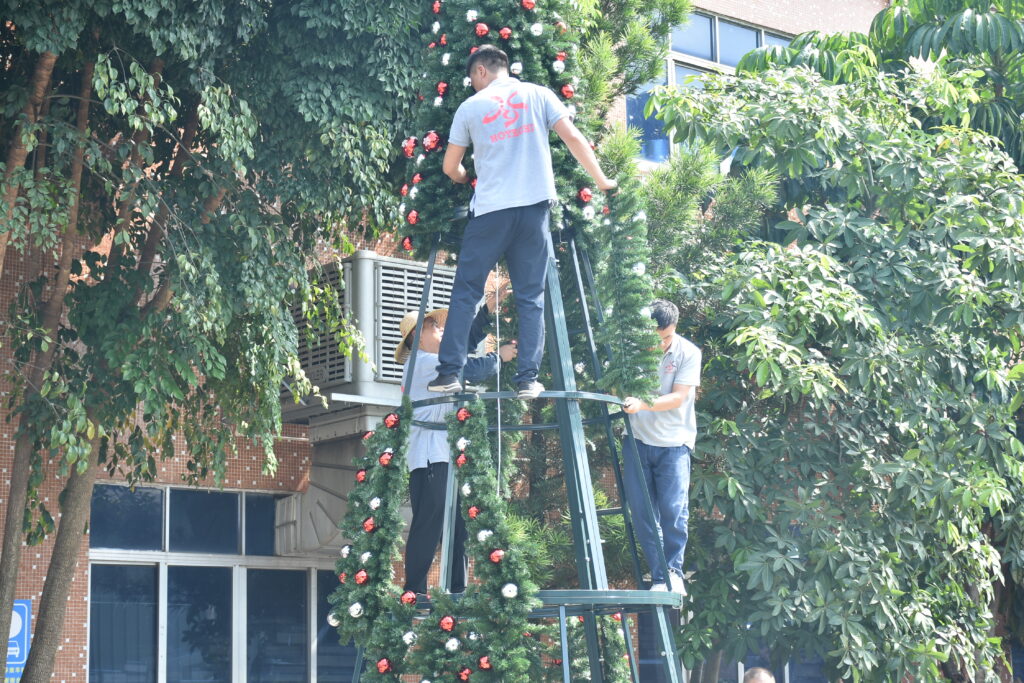
Matériaux courants de l'armature principale utilisés pour les grands arbres de Noël commerciaux
Dans la pratique, la structure principale d'un sapin de Noël commercial est généralement fabriqué à partir de plusieurs matériaux métalliques courants. Chaque option présente des caractéristiques différentes en termes de solidité, de poids, de résistance à la corrosion, de difficulté de traitement et de coût.
1. Tube carré ou tube rond galvanisé : Le choix le plus courant
Pour les grandes sapin de Noël commercial Dans les projets, le matériau le plus couramment utilisé pour les cadres est généralement le bois. tube carré galvanisé ou tube rond galvanisé. Elle est généralement basée sur Acier à faible teneur en carbone Q235 avec galvanisation à chaud, Les dimensions de 30×30 mm, 40×40 mm et 50×50 mm sont souvent utilisées dans les applications structurelles.
Ce matériau est largement choisi parce qu'il offre un bon équilibre entre la solidité, la résistance à la corrosion, la soudabilité, la facilité de fabrication et le coût. Pour la plupart des grands arbres d'extérieur, l'acier galvanisé à chaud peut répondre à la fois aux exigences structurelles et aux exigences de résistance aux intempéries.
Les avantages les plus courants sont les suivants
- Haute résistance structurelle pour les arbres de grande taille et surdimensionnés
- Forte protection contre la rouille après galvanisation à chaud
- Découpe, soudure et assemblage faciles
- Coût global raisonnable pour les projets commerciaux
- Meilleure adaptation à une utilisation extérieure de longue durée
Its main limitation is weight. In extra-tall trees above 20 meters, steel self-weight becomes more significant, so foundation load, lifting methods, modular segmentation, and installation efficiency must also be considered carefully.
2. Hot-Dip Galvanized Angle Steel and Flat Steel: Common for Auxiliary Support
In addition to tubes, hot-dip galvanized angle steel and galvanized flat steel are also commonly used in large sapin de Noël commercial structures. These materials are often applied in auxiliary structural parts such as:
- Layered circular rings
- Diagonal bracing
- Connection plates
- Tension members
- Local reinforcement components
The advantage of these materials is that they offer good rigidity, flexible cutting and drilling, and relatively economical cost. In many projects, they do not carry the entire load alone but work together with square tubes and round tubes to improve the overall frame stability.
3. Aluminum Alloy: Suitable for Some Lightweight or Frequent-Assembly Projects
Another option used in some sapin de Noël commercial projects is 6061 or 6063 aluminum alloy. Compared with steel, aluminum is lighter and more corrosion-resistant, which can make transportation and installation easier.
Main advantages of aluminum include:
- Lighter weight for easier handling and transport
- Better natural corrosion resistance
- Suitable for repeated assembly and disassembly
- Useful in projects where reducing structural weight is important
However, aluminum is not always the best choice for every large sapin de Noël commercial. Compared with hot-dip galvanized steel, aluminum usually costs more, requires more demanding welding processes, and often has slightly lower rigidity. In taller, heavier, long-term outdoor installations, it may not be the most practical option.
In many cases, trees below 10 meters are more suitable for aluminum solutions because these projects often value lighter weight and faster installation. For taller trees, steel remains more common due to its higher strength and structural stability.
4. Black Steel or Non-Galvanized Carbon Steel: Not Ideal for Long-Term Outdoor Use
Certaines structures peu coûteuses utilisent black steel or non-galvanized carbon steel, but these materials are generally not suitable for outdoor sapin de Noël commercial projects. Common problems include:
- Higher risk of rusting
- Weak surface protection
- Shorter service life
- More frequent maintenance
- Long-term impact on both structure and appearance
Although untreated steel may appear cheaper at first, it often creates higher maintenance and replacement costs later. For outdoor public and commercial displays, this is usually not an efficient long-term choice.
How to Judge the Quality of a Commercial Christmas Tree Frame
A practical way to evaluate the structure of a sapin de Noël commercial is to check three key aspects: material, workmanship, and structural design.
1. Check the Material and Surface Treatment
The first step is to confirm whether the material itself is suitable for outdoor long-term use.
Look at the galvanizing method. In general, corrosion protection can be understood in this order:
Hot-dip galvanized > electro-galvanized > painted steel or bare steel
Hot-dip galvanized steel usually has a silver-gray appearance with a thicker, more even zinc layer. Electro-galvanized steel may look brighter, but the coating is usually thinner and less durable outdoors. Painted steel without galvanizing offers even less protection.
Check the wall thickness. If the material is too thin, it may bend, shake, or deform during transport and installation. If it is too thick, it adds unnecessary weight. In many projects, common reference values are:
- Main vertical column: at least 1.5 mm wall thickness
- Diagonal brace: at least 1.2 mm wall thickness
Check for proper material identification. Reliable materials are usually marked with clear specifications such as Q235 grade, tube size, and galvanizing information. Unmarked or mixed materials should be checked more carefully.
2. Check the Workmanship and Fabrication Quality
Even when the same steel is used, different fabrication quality can lead to very different results. Good workmanship has a direct impact on structural life and installation performance.
Check welding quality. A reliable frame usually shows:
- Full and sufficient welding
- Smooth weld seams
- Grinding after welding
- Zinc repair or protective treatment at welded areas
- No obvious incomplete welds, air holes, or slag residue
Check the connection method. Pour les grandes sapin de Noël commercial structures, bolted connections or modular locking systems are usually better for installation, transport, dismantling, and repeated use.
Check detail accuracy. It is also helpful to inspect:
- Whether cut edges are clean and free of burrs
- Whether hole positions are accurate
- Whether components are twisted or deformed
- Whether accessories are standardized and complete
3. Check the Structural Design and Safety
For outdoor large-scale displays, it is not enough for a sapin de Noël commercial to simply stand upright. The structure should also have a reasonable load path, overall stability, and a design suited for public installation environments.
Main vertical column. The central column should be straight, stable, and securely connected to the base plate or flange. A bent or tilted main column can affect the entire load balance of the tree.
Diagonal bracing. Braces help improve stability, distribute loads, and resist lateral movement. A good structure usually has evenly distributed bracing on each level with secure connections.
Wind resistance measures. For trees above 10 meters, wind-resistance design becomes more important. Common measures may include:
- Guy wires
- Ground anchors
- Weighted bases
- Foundation reinforcement
In many real projects, base counterweight equal to at least one-third of the tree’s weight is often used as a basic reference idea, though actual engineering design should always depend on site conditions and tree height.
Ease of assembly and reuse. Since many large displays are reused for multiple seasons, modular structures are often more practical. Good systems usually offer layered modular design, standard connectors, complete accessories, and clear installation guidance.
A Quick On-Site Check Method
If you need a fast way to inspect a frame sample or on-site installation, a simple method is: lift, look, shake, and check.
- Lift: The component should feel solid, not overly light or hollow.
- Look: Check whether galvanizing is complete and whether there is rust, missing coating, or visible deformation.
- Shake: Gently test the assembled structure for looseness, abnormal movement, or noise.
- Check: Verify wall thickness, weld strength, accessory completeness, and hole accuracy.
For a large sapin de Noël commercial, these basic checks can help identify whether the structure is dependable before installation or purchase.
How Material Choice Changes by Tree Height
In practice, different tree heights often require different priorities in frame material selection.
For Trees Above 10 Meters
From the perspective of structural safety, outdoor durability, wind resistance, and long-term reuse, trees above 10 meters are often better suited to hot-dip galvanized steel structures. This type of material is more commonly used in large public installations because it provides stronger overall support and more stable outdoor performance.
If the steel frame also receives high-temperature electrostatic baking paint, the surface finish can become smoother and the overall weather resistance can improve further, helping reduce rust risk in long-term outdoor environments.
For Trees Below 10 Meters
Pour sapin de Noël commercial projects below 10 meters, aluminum can also be a practical option when lightweight transport, fast installation, and repeated dismantling are important. However, because aluminum is usually softer than galvanized steel, the design, connection details, and surface protection still need to meet appropriate standards.
What Buyers Should Confirm Before Choosing a Commercial Christmas Tree
When comparing large tree structures, it is helpful to confirm the following points instead of looking only at appearance or price:
- What frame material is used, and whether it is clearly specified
- Whether the surface treatment is hot-dip galvanized, electro-galvanized, or only painted
- Whether the wall thickness of the main column and braces is adequate
- Whether welding is full, smooth, and properly treated
- Whether bolted or modular assembly is used
- Whether diagonal bracing and wind-resistance solutions are included
- Whether the base, flange, ballast, or anchor system is designed properly
- Whether installation drawings and standardized accessories are provided
- Whether the structure is designed for repeated transport and seasonal reuse
These checks are often more meaningful than comparing lighting style alone, because they directly affect installation efficiency, long-term outdoor safety, and maintenance cost.
Related Reading
If you are evaluating different large tree structures or related holiday display solutions, you may also find these pages useful:
- Commercial Christmas Tree Manufacturer for Malls, Parks, and Holiday Projects
- 33ft Flagpole LED Christmas Tree
- Firework Lighted Christmas Tree
Conclusion
For a large sapin de Noël commercial used in a mall, park, plaza, hotel exterior, or municipal setting, the frame is not just an internal support detail. It is one of the most important parts that determines whether the tree is stable, safe, durable, and suitable for long-term outdoor display.
A well-chosen frame material affects not only installation performance, but also long-term weather resistance, wind resistance, repeat-use value, and maintenance costs. For that reason, when comparing large Christmas tree structures, it is usually more useful to evaluate material suitability, surface treatment, fabrication quality, modular design, and structural safety rather than focusing only on decorative appearance.
FAQ
What is the best frame material for a large commercial Christmas tree?
For many outdoor large-scale applications, hot-dip galvanized steel is one of the most common choices because it offers strong structural support, better corrosion resistance, and stable long-term performance. The best material still depends on tree height, installation conditions, and transport requirements.
Is aluminum better than steel for a commercial Christmas tree frame?
Aluminum is lighter and more corrosion-resistant, which can be useful for smaller trees or projects that require frequent assembly and dismantling. Steel is generally stronger and more rigid, so it is often preferred for taller or heavier outdoor commercial trees.
Why is hot-dip galvanizing important for outdoor Christmas tree frames?
Hot-dip galvanizing creates a thicker and more durable zinc layer that helps protect steel from rust in outdoor environments. This is especially important for trees exposed to rain, humidity, and long seasonal use.
What wall thickness is commonly used in large Christmas tree frames?
In many projects, the main vertical column is often at least 1.5 mm thick and diagonal braces are often at least 1.2 mm thick. Exact requirements depend on tree height, design, and load conditions.
How can I quickly check whether a commercial Christmas tree frame is well made?
A practical way is to inspect the structure by lifting a component to feel its solidity, looking at the galvanizing and finish, shaking the assembled frame for looseness, and checking wall thickness, weld quality, and accessory completeness.