





When people shop for Christmas lights, the words commercial et residential are often used as if they describe a simple price difference. In practice, the gap is usually more about construction quality, weather resistance, connector design, service life, and expected duty cycle.
That matters because a lighting set that performs well on a small home porch may not hold up on a storefront, public walkway, restaurant patio, or large outdoor seasonal display. The more hours a system runs, and the more it is exposed to rain, sun, wind, handling, and repeated installation, the more build quality starts to matter.
This article explains the practical differences between commercial and residential Christmas lights, what those differences mean in real use, and how to choose the right type without relying only on marketing terms.
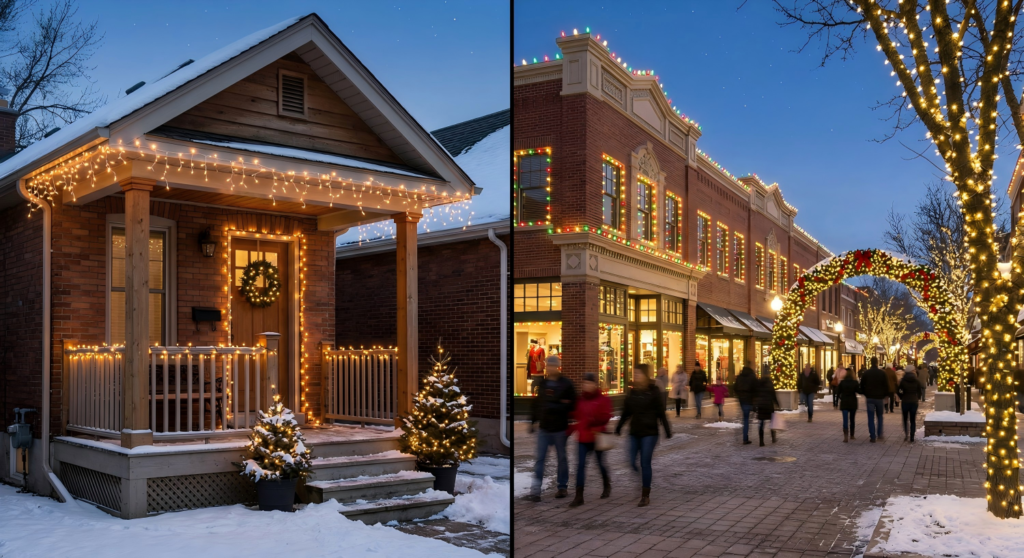
1. The Real Difference Is Not Just Brightness
At first glance, many residential and commercial LED lights look similar. Both may use LED technology, similar color temperatures, and familiar seasonal shapes such as mini lights, C7 bulbs, or C9 bulbs. The more important distinction is usually found in the parts people do not notice first:
- wire thickness and flexibility
- connector sealing
- bulb shell strength
- UV and weather resistance
- mounting durability
- serviceability over multiple seasons
In other words, the difference is less about how the lights look on day one, and more about how they perform after repeated outdoor use.
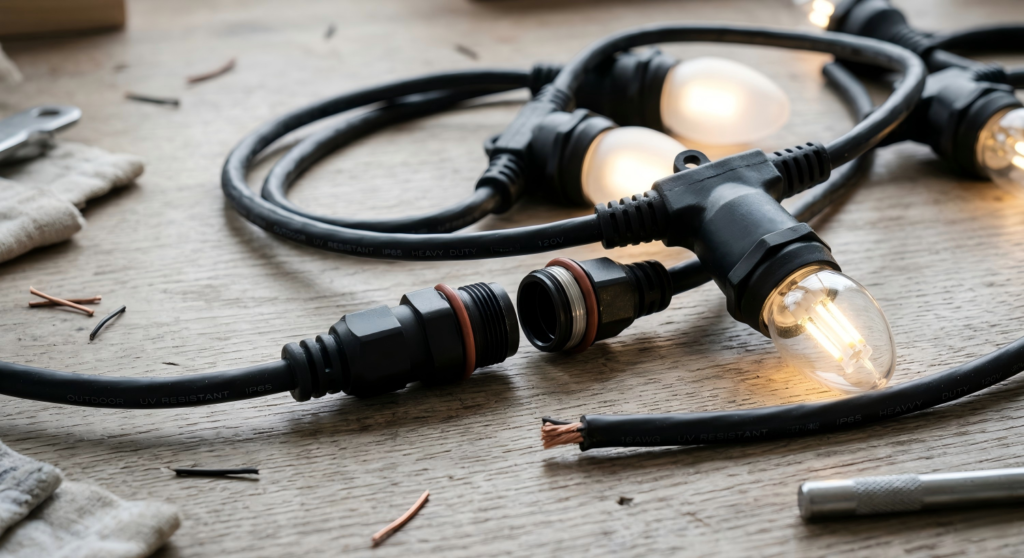
2. Wiring and Connectors Usually Tell You More Than the Label
One of the clearest differences is wiring. In general, heavier-duty holiday lighting systems tend to use thicker wire and more robust insulation than lighter residential string lights. Better outdoor systems usually invest more in the wire and connector assembly because many failures do not begin at the LED chip itself.
In real installations, common failure points include:
- weak connection points
- water intrusion
- cracked insulation
- repeated bending during installation and storage
- long runs with inconsistent performance
For short decorative use at home, lighter construction may be acceptable. For repeated commercial use, stronger wiring and better connector protection usually reduce maintenance problems.
3. Bulb Materials Vary More Than Many People Think
Older discussions often describe residential lights as “glass bulb” products and commercial lights as “polycarbonate” products. That comparison is now too simple.
Today, the market includes many plastic and shatter-resistant LED Christmas bulbs in both consumer and higher-grade product lines. So the real issue is not whether a product is residential or commercial in name, but whether the bulb shell, lens, socket, and connector system are built for repeated outdoor handling.
Commercial-style products often place more emphasis on:
- shatter resistance
- tighter molding consistency
- better sealing around bulb and socket assemblies
- more stable appearance after repeated installation cycles
That is especially important in public-facing displays, where broken shells, loose bulbs, and visual inconsistency create both maintenance issues and a poor presentation.

4. Weather Resistance Is One of the Biggest Practical Divides
A light set can work perfectly during mild holiday weather and still fail early in harder outdoor conditions. Rain, snow, standing moisture, direct sun, temperature swings, and wind all expose weaknesses in construction.
This is why commercial-grade holiday lights are often associated with:
- watertight or better-protected connectors
- thicker insulation
- more durable outer materials
- stronger clips, sockets, or mounting points
- better long-term resistance to UV exposure
By contrast, residential products are often designed for lighter seasonal duty, especially in protected or semi-protected areas such as interior spaces, covered porches, or short-run temporary installations.
For exposed outdoor displays, buyers should pay close attention to the actual listing and rating on the product rather than relying only on words like heavy duty ou professional. Real specifications matter more than labels alone.
5. Safety and Compliance Should Be Read Carefully
For seasonal decorative products in the U.S., safety listing is an important reference point. However, buyers should not assume that every listed seasonal light is automatically ideal for every long-duration or permanently exposed application.
For outdoor projects, it is wise to verify details such as:
- whether the product is marked for wet or outdoor use
- whether the connectors are actually sealed
- whether the mounting method matches the installation environment
- whether local electrical code or project requirements demand additional review
For public spaces, storefronts, hospitality projects, and municipal displays, compliance is not only about safety. It is also about liability, insurance expectations, and predictable performance during the busiest season of the year.
6. Lifespan Is Really a Maintenance Question
Many buyers focus first on purchase price. In practice, the more expensive part of a failed holiday lighting system is often not the light itself, but the labor behind it:
- removing failed sections
- re-installing replacements
- troubleshooting dead runs
- bringing in lifts or crews again
- fixing visual inconsistency in customer-facing areas
This is why commercial-grade products often make more sense in settings where labor, uptime, and presentation matter more than the lowest initial cost.
A homeowner decorating a small area for a few weeks each year may reasonably accept a lighter-duty product. A shopping center, hotel, event venue, or restaurant usually evaluates the problem differently. For them, one mid-season failure can cost more in access, labor, and lost presentation quality than the price difference between the two product grades.
7. When Residential Christmas Lights Are Usually Enough
Residential lights are often a reasonable choice when:
- the display is small
- the installation period is short
- the location is protected or partially covered
- the budget is tight
- the owner accepts that replacement may happen sooner
- visual perfection over many seasons is not the main priority
Examples include:
- indoor trees
- apartment balconies with cover
- short porch railings
- temporary home displays
- occasional decorative use with limited runtime
In these cases, residential products can still deliver good results, especially when the display is not exposed to harsh weather or heavy handling.
8. When Commercial Christmas Lights Usually Make More Sense
Commercial-grade lights are generally the better choice when:
- the display runs for many hours each day
- the installation is exposed to weather
- the site is open to the public
- multiple seasons of reuse are expected
- maintenance access is difficult or expensive
- brand image and presentation consistency matter
Examples include:
- storefront outlines
- restaurant patios
- shopping center common areas
- hotel entrances
- drive-through displays
- public parks and municipal installations
- large-scale holiday features that require repeated setup and teardown
In these situations, the question is not just whether the lights work on day one. The question is whether they stay reliable through weather, operation, storage, transport, and reinstallation. For larger public displays, buyers often also compare the supporting structure, scale, and installation requirements of related seasonal features such as commercial Christmas trees for malls, parks, and holiday projects.
9. How to Evaluate a Product Before You Buy
Instead of asking only whether a product is “commercial” or “residential,” ask for the following:
- wire gauge
- connector type
- outdoor or wet-use suitability
- bulb shell material
- expected use scenario
- replacement and warranty policy
- installation method
- whether the product is intended for repeated seasonal deployment
This approach helps avoid a common mistake: buying based on a category name instead of buying based on actual performance needs. If the project includes streetscape decorations or municipal pole lighting, installation planning is equally important. You can also review this guide on comment installer des lampadaires sur poteau sans endommager le poteau to better understand outdoor mounting considerations.
10. Final Takeaway
Commercial and residential Christmas lights are not separated by one single technical rule. The difference is usually a combination of build quality, sealing, durability, operating expectations, and maintenance burden.
Residential lights can be perfectly suitable for light-duty seasonal decorating at home.
Commercial lights become the better investment when a display faces more hours, more weather, more handling, more visibility, and more liability.
For buyers working on larger outdoor holiday programs, it can also be helpful to compare lighting systems with the structural needs of oversized seasonal décor. A related example is this technical article on how to choose the right main frame steel for a large commercial Christmas tree, which looks at durability from a structural perspective.
So the most useful question is not, “Which one is better?” It is, “Which one matches the way this display will actually be used?”
FAQ
1. Are commercial Christmas lights always brighter than residential lights?
Not necessarily. Brightness depends on bulb type, spacing, lens style, and product design. Commercial-grade products are often chosen for durability and reliability rather than simply higher brightness.
2. Can residential Christmas lights be used for a business display?
They can be used in some short-term or protected situations, but they are usually not the best choice for long daily runtime, exposed outdoor areas, or locations where maintenance and liability matter.
3. Are all residential Christmas bulbs made of glass?
No. Many retail LED Christmas bulbs today are plastic or shatter-resistant, so material should be checked by product specification rather than assumed from category alone.
4. Does “commercial grade” have one universal definition?
No. The term is widely used in the market, but product features vary. Buyers should verify real specifications such as wire gauge, connector sealing, and outdoor suitability instead of relying only on marketing language.
5. What is the most common mistake buyers make?
Choosing only by upfront price. In larger or public-facing displays, maintenance, replacement labor, and downtime often matter more than the original purchase cost.